They were totally B.F.F. — Best Frenemies Forever.
Prior to their unexpected meeting, Tchaikovsky had confided in his diary, “I have played over the music of that scoundrel Brahms. What a giftless bastard!” Brahms reciprocated by falling asleep during Tchaikovsky’s Fifth Symphony, in the presence of the composer.
Here’s a first-hand account of the introduction of the fastidious Tchaikovsky to the acerbic Brahms, with a special appearance by Edvard Grieg and his wife, Nina – making this almost as incident-packed as the new Captain America movie.
Surprise! They actually delighted in one another’s company. In fact, they liked one another so well, they decided to do it again. However, the two never could reconcile themselves to one another’s music. When asked what he thought of the piano trio Brahms had been rehearsing, Tchaikovsky intimated, “Don’t be angry with me, my dear friend, but I did not like it.”
Brahms and Tchaikovsky were totally B.F.F. – Best Frenemies Forever.
The latter famously confided to his diary, “I have played over the music of that scoundrel Brahms. What a giftless bastard!”
And that’s only the short version.
The two shared the same birthday, May 7 (Brahms born in 1833 and Tchaikovsky in 1840). Unfortunately, that was about all they had in common – Brahms, the great classicist among Romantics, and Tchaikovsky, always heart-on-the-sleeve.
Or so they thought, until the two met on New Year’s Day, in 1888. Surprise! They actually delighted in one another’s company. There was much drinking and backslapping and drinking and hanging on one another’s shoulders and drinking and happy tears and drinking. (Of course, all this took place in spite of Brahms falling asleep during a rehearsal of Tchaikovsky’s Fifth Symphony.) In fact, they liked one another so well, they decided to do it again.
However, the two never could reconcile themselves to one another’s music. After a lovely evening with Brahms, during which both men drank and smoked prodigiously, while Adolph Brodsky (the violinist who had introduced Tchaikovsky’s Violin Concerto) rehearsed with some friends a Brahms piano trio, Mrs. Brodsky asked Tchaikovsky what he had thought of the piece.
“Don’t be angry with me, my dear friend,” he said, “but I did not like it.”
Happy birthday, boys!
PHOTOS: Peter Ilych Tchaikovsky (left) and Johannes Brahms, agreeing to disagree
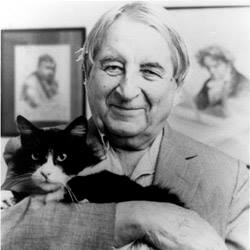
For the birthday of Nicolas Slonimsky (1894-1995), here a few favorites from his sidesplitting compendium of critical vitriol, “Lexicon of Musical Invective”:
“We recoil in horror before this rotting odor which rushes into our nostrils from the disharmonies of this putrefactive counterpoint. His imagination is so incurably sick and warped that anything like regularity in chord progressions and period structure simply do not exist for him. Bruckner composes like a drunkard!”
(Gustav Dompke, The German Times of Vienna, 1886)
“Heartless sterility, obliteration of all melody, all tonal charm, all music… This reveling in the destruction of all tonal essence, raging satanic fury in the orchestra, this demoniacal, lewd caterwauling, scandal-mongering, gun-toting music, with an orchestral accompaniment slapping you in the face… Hence, the secret fascination that makes it the darling of feeble-minded royalty…of the court monkeys covered with reptilian slime, and of the blasé hysterical female court parasites who need this galvanic stimulation by massive instrumental treatment to throw their pleasure-weary frog-legs into violent convulsion…the diabolical din of this pig-headed man, stuffed with brass and sawdust, inflated, in an insanely destructive self-aggrandizement, by Mephistopheles’ mephitic and most venomous hellish miasma, into Beelzebub’s Court Composer and General Director of Hell’s Music — Wagner!”
(J.L. Klein, “History of the Drama,” 1871)
And of course, who could forget:
“The violin is no longer played; it is pulled, torn, drubbed…. We see plainly the savage vulgar faces, we hear curses, we smell vodka.… Tchaikovsky’s Violin Concerto gives us for the first time the hideous notion that there can be music that stinks to the ear.”
(Eduard Hanslick, New Free Press, Vienna, 1881)
Tchaikovsky could recite every word of Hanslick’s sustained screed, from which this is but an excerpt, from memory.
The “Lexicon” is merely the tip of the Slonimsky iceberg. He conducted first performances of works by Ives and Varèse. His “Thesaurus of Scales and Melodic Patterns” influenced musicians from John Coltrane to Frank Zappa. His sly wit made him a favorite guest on radio and television programs, including “The Tonight Show.” It’s not surprising that he lived to be 101.
Happy birthday, Nicholas Slonimsky.
Slonimsky documentary on YouTube — narrated by Michael York!
If you ever detected a sinister undertow in Tchaikovsky’s ballet “The Nutcracker,” the source material, by E.T.A. Hoffmann is much worse.
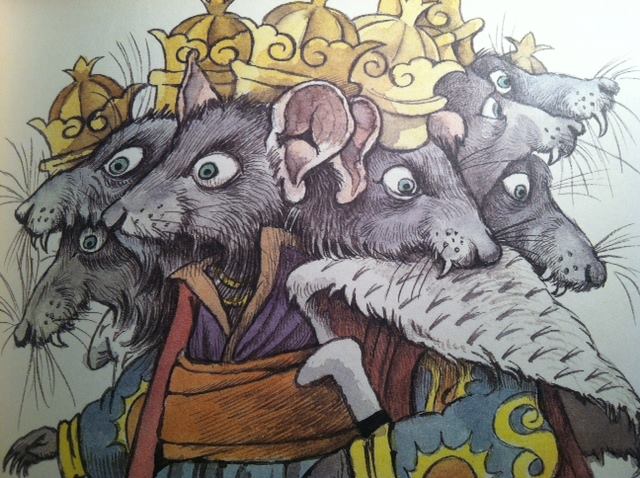
Hoffmann’s 1816 story focuses on the Nutcracker’s battle with the evil Mouse King, filtered through the vivid imagination of a doomed dreamer with a perpetual mistrust of adults. It’s Herr Drosselmayer all the way, baby.
It often puzzles me how so many adaptations of Hoffmann’s stories gloss over the sinister and the uncanny elements. “The Nutcracker” has its share of up-tempo numbers. They’re mostly the ones we hear in stores while we’re out Christmas shopping. However, there’s little doubt the composer grasped the inexorable undertow of Hoffmann, since his score conveys plenty of anxiety to counterbalance the twee sweets.
Listen to the bass clarinet slither beneath that glittery celesta in the “Dance of the Sugar Plum Fairy.” And what’s all that creeping around, with the disturbing sforzandi? There’s something desperate and perhaps a little manic underpinning the magic.