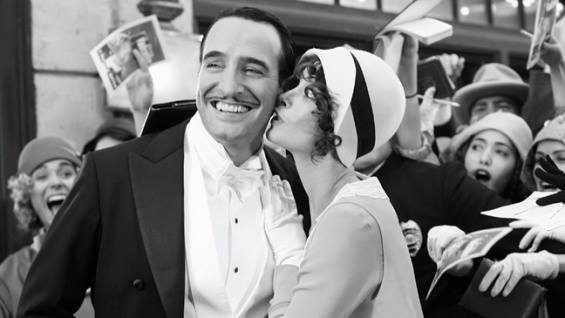
If you’ve never seen “The Artist” (which is best experienced in a theatre, with an audience), tonight’s your chance, as TCM continues with its annual celebration, “31 Days of Oscar.” “The Artist” was nominated for ten Academy Awards and won five, including those for Best Picture, Best Director (Michel Hazanavicius), Best Actor (Jean Dujardin) and Best Original Score (Ludovic Bource).
If you think you don’t like silent movies, give it a shot. At the very least, tune in for the first five minutes for the delirious “original” film that opens the piece. The only thing that would have made “The Artist” better is if they had made a separate feature of the opening! Fans of classic film music will delight in Bource’s spot-on impressions of Franz Waxman and Alfred Newman.
Of course, if none of that appeals to you, there’s always Uggie, the precocious terrier.
The fun begins at 8 ET, on Turner Classic Movies: TCM.
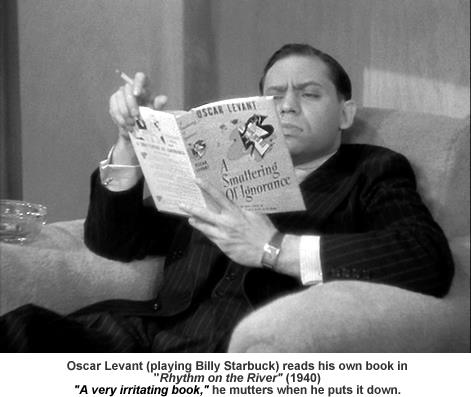
Since there seemed to be a lot of interest when I posted about Oscar Levant the other week, on the occasion of his birthday anniversary, I thought I’d point out the fact that Turner Classic Movies: TCM is showing “Rhapsody in Blue” tonight at 10 ET. In this 1945 film, an alleged biography of George Gershwin, Levant plays a supporting role – as himself. The composer is played by Robert Alda, Alan Alda’s dad.
My mention of Charles Dickens in yesterday’s post about malevolent puppets reminds me that ‘tis the season for Dickens adaptations.
So it’s no surprise that Turner Classic Movies: TCM will be presenting a Dickens double-feature tonight as part of its evening line-up. Neither film is an adaptation of “A Christmas Carol,” though there are several in TCM’s holiday rotation. There must be something up with the rights to the 1951 version, with Alastair Sim as the definitive Scrooge, since the network is always passing over it in favor of the inferior 1938 version, starring Reginald Owen, even to the point of arranging big screen showings nationwide.
The 1938 version of “A Christmas Carol” is actually a rare example of mediocre Dickens on the silver screen. From the 1930s up through 1951 and the Sim version (released in England as “Scrooge”) – which LOOKS as if it were made in the ‘30s – Dickens enjoyed some very fine advocacy.
One of the best adaptations, of course, is David Lean’s “Great Expectations” (1946), with its atmospheric touches and top-notch cast (Alec Guinness made his film debut as Herbert Pocket). It takes some liberties with the novel, especially toward the end, but who cares? This is as idiomatic a film version of Dickens as one is likely to get. The same could be said for Lean’s “Oliver Twist” (1948), again with Guinness (brilliant, though controversial, as Fagin).
I often wonder if there is something in the black and white cinematography – and, in the case of some of the British productions, the often limited budgets – that just makes them seem more authentic, both because of their sense of history – these obviously being films of the distant past – but also because of the effectiveness of the at times murky technology in conjuring an atmosphere akin to that of dreams and fairy tales – which is how I often view films made in the ‘30s.
The 1951 version of “A Christmas Carol” is made even better by the at times indistinct images. This is exactly how I imagine things to have looked in Dickens’ day – although, of course, it is complete nonsense. Everything then was as vivid and mundane as it is now. Yet put modern actors in immaculate stove pipe hats and capture the images with sharp, state-of-the-art technology, and it all seems like play acting. There’s something cheap-looking about it, like a “Masterpiece ” (formerly “Masterpiece Theater”) import, where most of the budget is spent on costume rentals and hiring Judy Dench.
I mean, Judy Dench is a fine actress, but she is nowhere near as Dickensian as Edna May Oliver, who plays Aunt Betsy in “David Copperfield” (1935). It was one of producer David O. Selznick’s lifelong ambitions to get “Copperfield” on the big screen in a respectable, mostly faithful form, and despite some stunt casting (W.C. Fields as Micawber), it really works. There is no way any movie featuring Basil Rathbone, Elsa Lanchester, Lionel Barrymore and Una O’Connor can be bad.
TCM will show “Great Expectations” tonight at 8 ET, and “David Copperfield” at 10:15.
I also highly recommend “A Tale of Two Cities” (1935), “Nicholas Nickleby” (1947) and “The Pickwick Papers” (1952) as further examples of early, murky, delectable Dickens. Later adaptations are more comprehensively faithful, perhaps, yet somehow manage to lose much of the flavor of the original novels. Dickens’ appeal may be timeless, but the costumes and character ticks just seem to suit those times (circa 1935 to 1952) much better than our own.
To keep it musical, here is a suite from Richard Addinsell’s score for “A Christmas Carol,” from 1951:
Addinsell, of course, is the composer of the “Warsaw Concerto.” His suite will be among the selections I’ll be playing this Friday evening at 6, on “Picture Perfect,” as I offer up a “literary Christmas,” at http://www.wwfm.org.
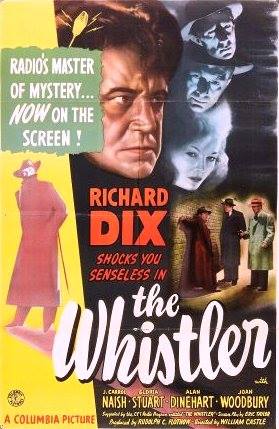
What the hell is the theme to “The Whistler?” The completely counterintuitive signature music, by Wilbur Hatch, is warbled not only at the opening of the classic radio show, but also the start of the oddly enjoyable movie series featuring Richard Dix (a.k.a. Wooden Dix).
Dix couldn’t act his way out of a paper bag (one of cinema’s great mysteries is how he was nominated as Best Actor for “Cimarron” in 1931), but I have to admire his tenacity. He appears in seven of the eight “Whistler” films, playing a different character in each one. For some reason, he retired before the last. At that point, why bother?
“The Whistler” is obviously the poor man’s version of “The Shadow.” Each story follows the formula of a criminal undone by an overlooked detail, fate or his own stupidity. Irony is an essential element. The Whistler looks on as a dispassionate narrator, offering his commentary like a Greek chorus.
Turner Classic Movies: TCM is showing four installments of the series, tonight, beginning at 8 ET, including “The Whistler,” “The Power of the Whistler,” “The Voice of the Whistler” and “Mysterious Intruder.”
Several of the Whistler films were directed by William Castle, who would later earn notoriety for his outrageous showmanship, promoting B-horror classics like “The House on Haunted Hill,” “The Tingler” and “13 Ghosts” by offering life insurance policies or having a registered nurse on hand in the lobby in the unlikely event a viewer would suffer cardiac arrest from fright.
“I am the Whistler, and I know many things, for I walk by night.” What? Does one necessarily follow the other? Am I missing something?
Turner Classic Movies: TCM will begin its month-long festival, “The Projected Image: The Jewish Experience in Film,” tonight at 8 ET. Robert Osborne’s co-host for the event, which will air on Tuesday evenings through September, will be Eric Goldman.
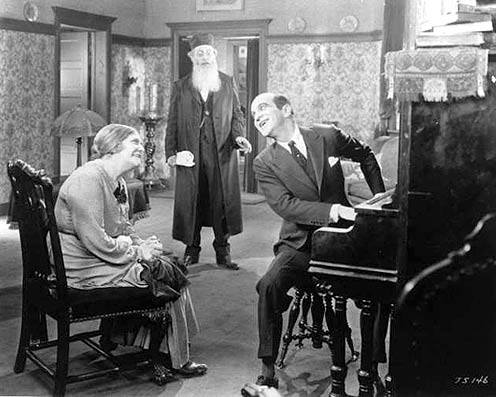
The prime time schedule features two versions of “The Jazz Singer,” including the one commonly credited as the first feature-length quasi-talkie, starring Al Jolson, and a musical version with Danny Thomas. (Sorry, no Neil Diamond.)
Tonight’s line-up:
8:00 The Jazz Singer (1927)
9:45 The Jazz Singer (1953)
11:45 Hester Street (1975)
1:30 Avalon (1990)
“The Jazz Singer” tells the story of a cantor’s son, who forsakes the ways of his fathers to pursue his dream of finding work in show business. This, of course, sets up a conflict of duty and devotion to family vs. the protagonist’s hopeless love for worldly jazz.
Jolson, who was born Asa Yoelson, sells it all with a confidence born of the stage, including, naturally, “Mammy,” delivered in his signature black-face. The cantor is played by Warner Oland, who would later achieve enduring fame as Charlie Chan.
Lest you be tempted to dismiss the film on these grounds as a landmark of racial insensitivity, “The Jazz Singer” is a fascinating document on many levels, dealing with the issues of personal and ethnic identity, an inspiring example of the immigrant experience in a country determinedly on the way up. The film proved a major hit and changed the industry forever.