Since I was taken ill a few weeks ago, when I was hoping to get in to the Metropolitan Opera for a Saturday matinee of “Eugene Onegin,” my ticket was exchanged for a new opera by Gabriela Lena Frank, longtime composer-in-residence with the Philadelphia Orchestra, whose stock has since skyrocketed, as she was recently awarded this year’s Pulitzer Prize for Music. I had intended to catch “El último sueño de Frida y Diego” anyway, at the movies, as part of the Met Live in HD series (on May 30 or June 3). That said, how lucky I was to actually experience it in the house!
The opera, a postscript to the tempestuous real-life love story of Mexican artists Frida Kahlo and Diego Rivera, is ingeniously set during El Día del Los Muertos – the Day of the Dead. Kahlo’s spirit returns in a kind of reverse Orpheus and Eurydice story to guide Rivera to the afterlife. A great many operas can be summed up in a line or two, but any such synopsis cannot do justice to the Met’s production design (by Jon Bausor) and choreography (by director Deborah Colker). Predictably, some of Kahlo’s most iconic paintings are recreated, and Diego perches on a scaffold before one of his murals in its early stages, but the eyepopping supernatural element brings a whole other element of interest.
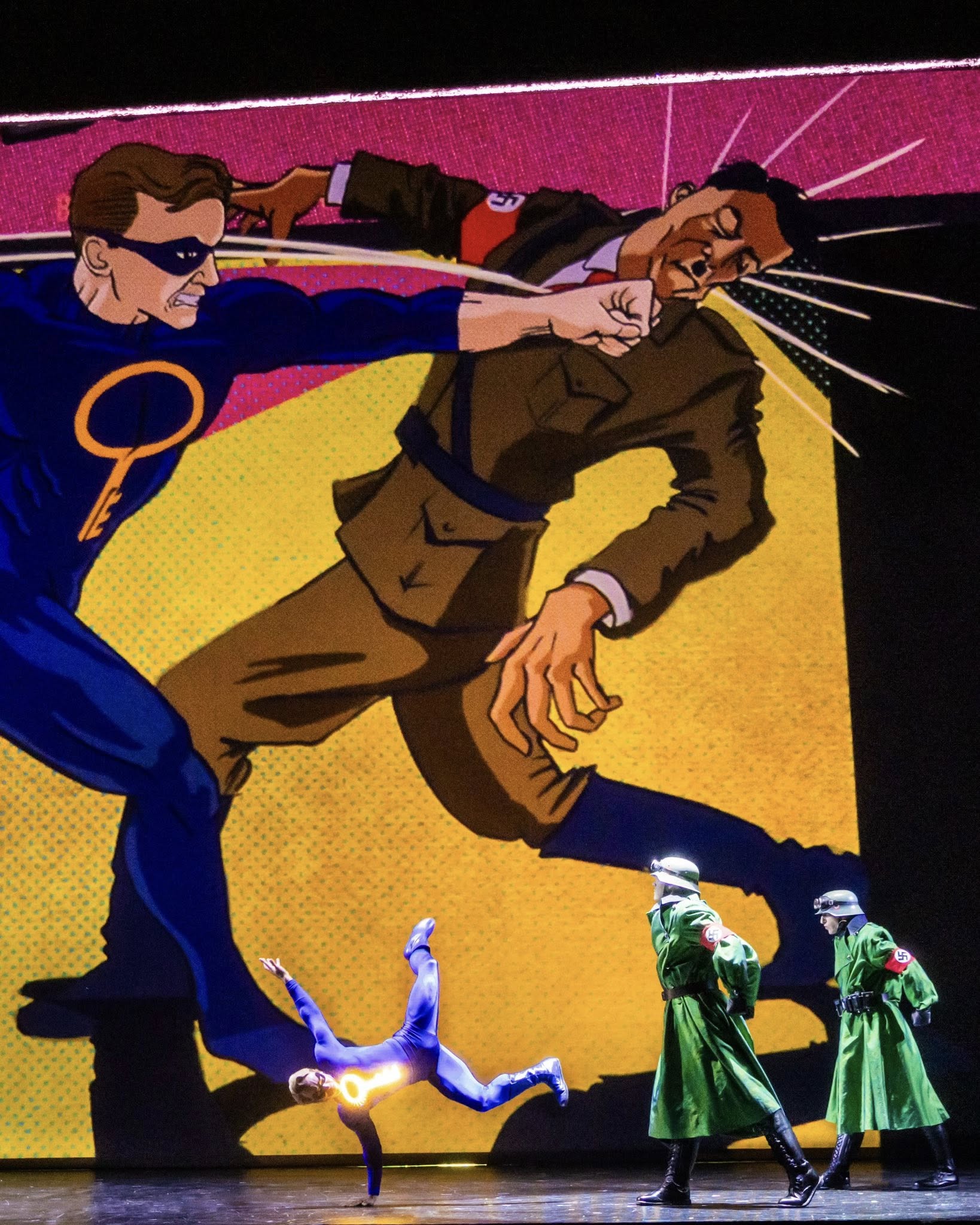
As with this season’s immigrant experience/proto-superhero comic book “The Amazing Adventures of Kavalier & Clay,” another Met debut, I was set to wondering how well the work succeeds as an opera, as opposed to a functional score elevated by all the superlative stagecraft. As I remarked about “Kavalier & Clay,” I’m not sure if the music in itself fits the bill, but I am unshakeable in my conviction that it’s one hell of a show. Frankly, comparing the two is kind of like comparing a corned beef sandwich and a tamale. Anyway, even a fabulous score can misalign on the opera stage, where words and music, conflict and emotion need to strike a perfect balance. There are plenty of great composers who have been unable to stick the landing.
My impression of “Frida y Diego,” on first hearing, is that the music is on an entirely different level than Mason Bates’ for “Kavalier & Clay,” perhaps less overtly melodic (“K&C” was almost like a movie in sound and execution), yet ultimately having greater resonance. The piece is marvelously orchestrated (although I can’t say I could really make out some of the more novel touches, such as when one of the percussionists ran bows along the keys of a marimba). But not all operas are driven by melody. It’s not that “Frida y Diego” is not “melodic” (it’s definitely tonal), it just doesn’t really have any big tunes. So don’t go into it expecting to luxuriate in bel canto.
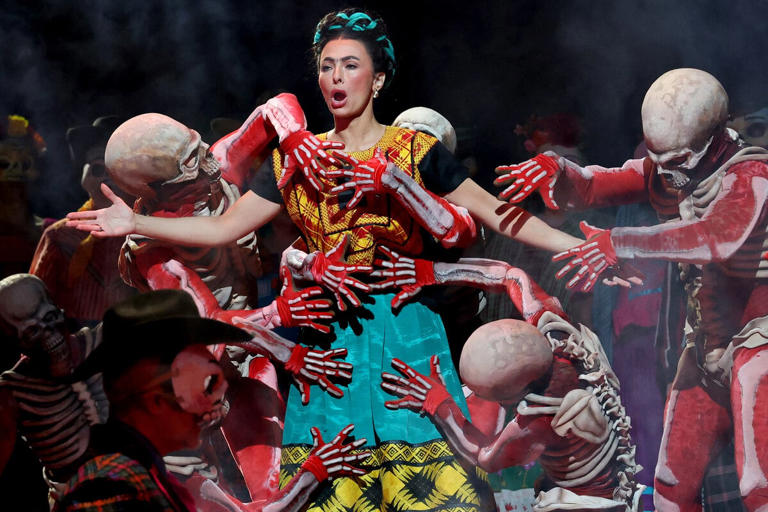
That’s not to say it doesn’t have arias and even some showstopping moments. Mezzo-soprano Isabel Leonard, as always, is excellent as Frida – and my, did the make-up people transform her into the spitting image of Kahlo – even when she was called upon to lie down or execute certain pieces of choreography.
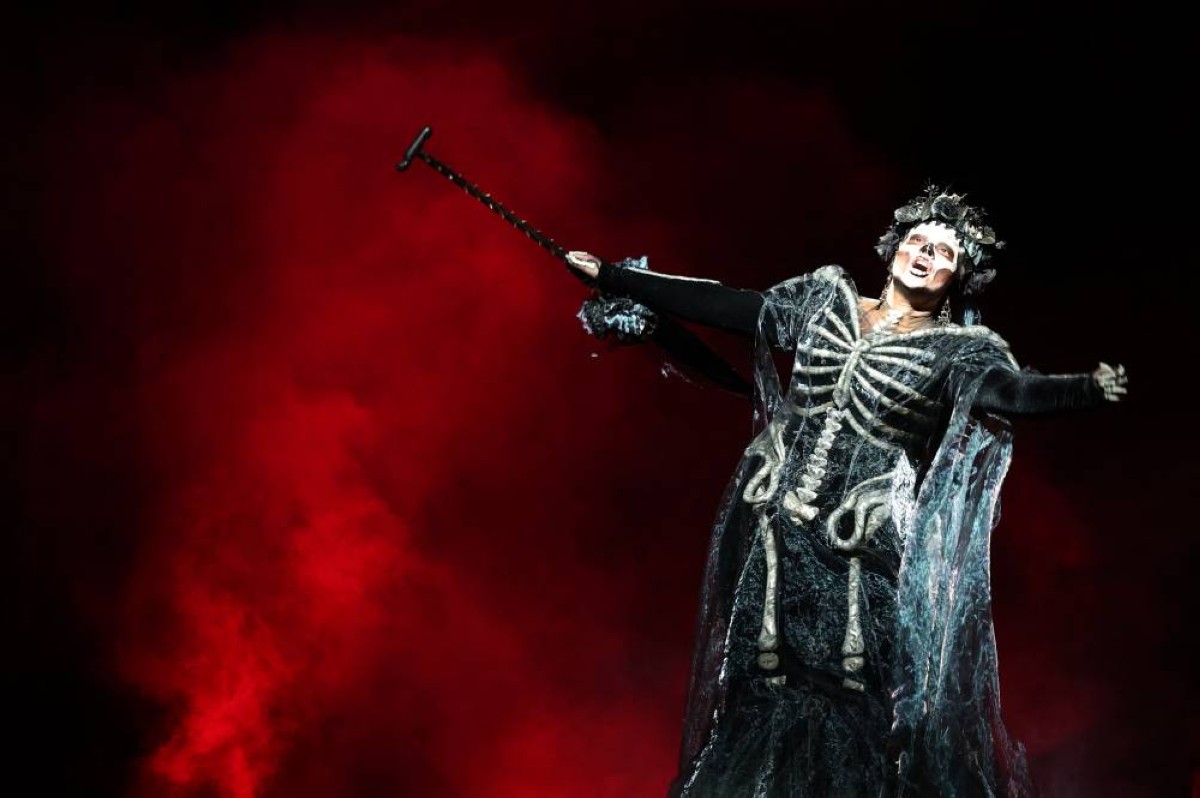
However, soprano Gabriella Reyes brought it big time as Catrina, Keeper of the Dead, transcending, rather than being swallowed up by, her incredible skull-and-bones costume. She positively owned the role.
It says something for countertenor Nils Wanderer that up against such a powerhouse that he would make such a strong impression as Leonardo, a Greta Garbo impersonator(!) dressed as Queen Christina. It’s hard to explain this element, but just go with it. It’s oddly moving, and it works. Also, watch “Queen Christina.” It’s a great movie.
It was good to see baritone Carlos Álvarez back on the Met stage, but especially in the scene where he’s standing on the scaffold, the acoustic did his voice no favors. It’s not that he sounded bad – he did not – it’s just that he didn’t carry as well as did his higher-voiced colleagues. With six levels and close to 4,000 seats, the Met is an enormous house. Speaking of enormous, I do hope that the costumers gave him a padded suit to play Rivera. I would hate to think that he let himself go to the point that he now has the physique of Fred Mertz. Since Rivera generally looked like Darius Milhaud on a bad day, I would think that it was an artistic transformation.
The skeletal dancers busted some very impressive moves. Some of them would not have been out of place in Michael Jackson’s “Thriller.” Even more astonishing was the ability of the dancers to stay in sync with one another in situations where they were either in cumbersome-looking, sight-obstructing masks or otherwise blocked from one another’s view.
Music director Yannick Nézet-Séguin was in the pit. In his other role, as music director of the Philadelphia Orchestra, he’s had a wealth of experience conducting Frank’s music. He didn’t conduct with quite the brio he can sometimes bring, whether you want it or not, but here that wasn’t necessarily a bad thing. Really, it’s a more atmospheric piece. There was plenty of energy onstage, and Frank’s sound-world kept the ear engaged, with the character of Leonardo getting the most sensuous music. I confess, there were times, given the subject matter, that I wondered if I might be watching a dry run for Missy Mazzoli’s “Lincoln in the Bardo,” set to make its Met debut next season.
Whether or not Frank’s opera will endure, no one can predict with any certainty, but experiencing it now at the Met is definitely worthwhile. You won’t leave the house (or the movie theater) whistling any of the tunes, but it is an absorbing magical realism experiment, and I think it works. I wouldn’t mind catching it again. Perhaps I will, at the movie theater.
Incredibly, it turned out to be a two-opera weekend for me, as Friday evening I drove down to Wilmington for OperaDelaware’s concluding performance of Umberto Giordano’s “Andrea Chénier.” This was a more traditional, blood-and-thunder operatic experience, composed during the height of the verismo craze (the libretto is by frequent Puccini collaborator Luigi Illica), though set during the French Revolution.
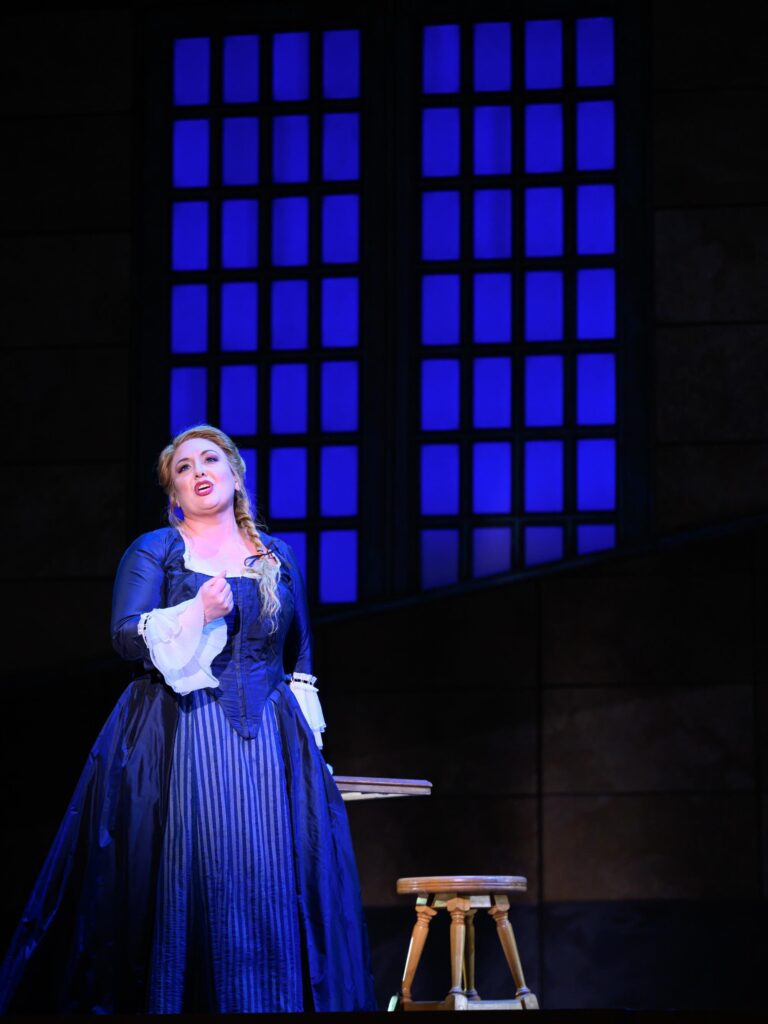
The work was sung with great passion by soprano Toni Marie Palmertree, tenor Dane Suarez, and baritone Gerald Moon. (Palmertree went for broke as Tosca at last year’s Princeton Festival; she’ll return to Princeton next month as Madama Butterfly – a role she sang this year at the Met!) Contralto Daryl Freedman deserves special mention for her poignant, showstopping aria as Madelon, a blind woman nearing the end of her days, who commits her grandson, the last of her line, to the cause of the Revolution.
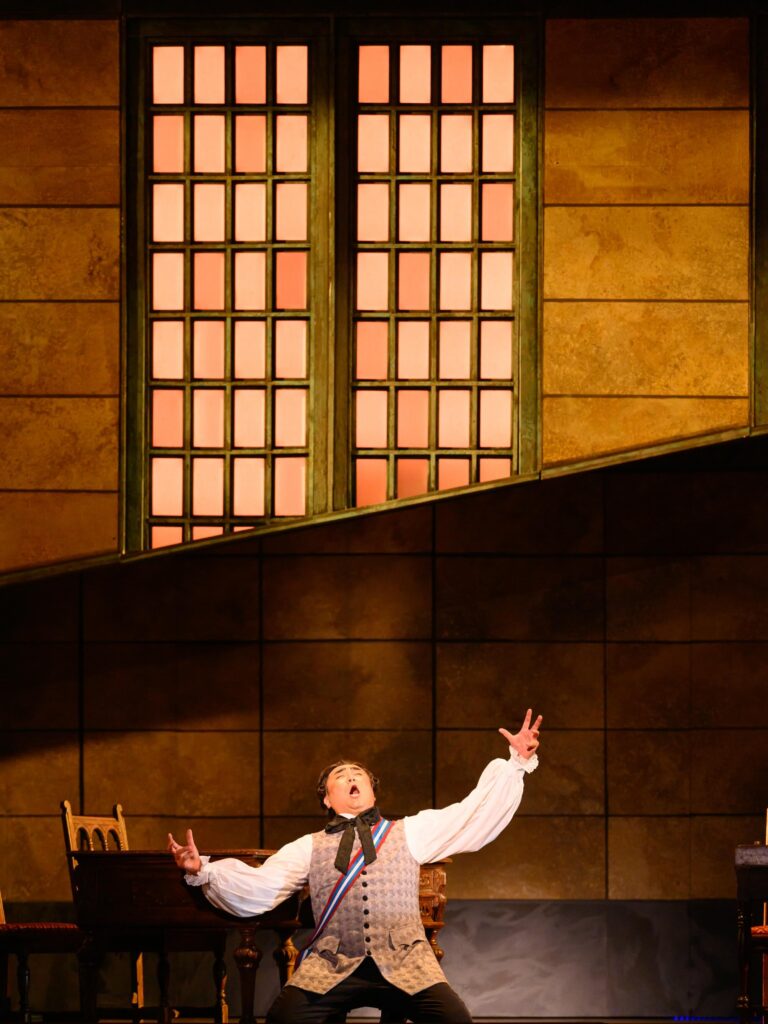
The opera was presented with minimal props, a few tables and chairs, and some bleachers in the courtroom scene. Singers were in period costume. Stylized, bisected windows formed the backdrop throughout, but the mood was varied, in no small part through skillful lighting, whether supporting a garish party of willfully oblivious aristocrats or doomed lovers languishing in a prison cell. Most effective was a silhouetted guillotine, an imaginative touch toward the end, its blade dropping with shattering finality at the curtain. The chorus sang lustily, lending the performance a sense of grandeur and scope.
The experience was enhanced by the charmingly intimate and historic 1,140-seat Wilmington Grand Opera House. With its frescos and muraled ceilings, tiered wooden seats, and wraparound stalls and balcony, the theater embodies a kind of 19th century craftsmanship one rarely encounters these days. It’s practically a toy theater compared to the Met, more in line with what I imagine would have been the norm with many European houses, back in the day. Ingmar Bergman would have loved this place. Perhaps Wes Anderson too. What a great venue!
The orchestra played well, if not impeccably. The fact that it did play so well made the (very) occasional cracked note in the pit serve as a reminder that this was, after all, live music-making, not karaoke, and I wouldn’t have had it any other way. The dramatic sweep of the performance was authentic and all the more compelling for it. How many freelance musicians and singers are out there, playing regional houses, and making music of this quality?
Conductor Anthony Barrese directed a flowing, emotionally immediate performance. He generously offered the baton to an assistant for the opera’s eventful second act, citing the fact that he himself was only able to learn on the job and opportunities to do so in opera are scant. In the event – to my ears, anyway – the assistant acquitted himself beautifully. Barrese also provided one of the program booklet’s informative historical notes. He and outgoing general director Brendan Cooke, who share a rich history spanning decades and several opera companies, exchanged some poignant words before the evening’s performance. So not all the tears were on the stage!
I should mention that the stage director, Octavio Cardenas, also contributed to the booklet. His thought-provoking introduction brings into focus the dangerous – and innately human – factors that contributed to the tragedy and violence of a political movement that turned into one of history’s most horrific bloodbaths. (Keep in mind, the opera was written scarcely a hundred years after the period in which it is set.)
“This production of ‘Andrea Chénier’ is driven by a central question: what happens when idealism stops being a guiding principle and becomes a form of blindness? Set against the backdrop of the French Revolution, the opera is not presented as a celebration of political awakening, but as an examination of how moral certainty can harden into cruelty. The Revolution in this reading is not simply an historical force, but a mirror of human nature itself, capable of both aspiration and destruction, often at the same time.”
And later…
“Ultimately the production emphasizes that human nature resists purity. Even the most noble ideas are filtered through fear, desire, and self-preservation. The opera’s final moments do not offer resolution in a political sense, but instead reveal a more intimate truth: that love and cruelty, clarity and blindness, idealism and violence can coexist in the same human heart.”
Bravo. And God help us all.
——–
Gabriella Reyes raises the dead as Catrina in “El último sueño de Frida y Diego”
Isabel Leonard as Frida
Skeletons in rehearsal
Five more performances of “Frida y Diego,” through June 5
https://www.metopera.org/season/2025-26-season/el-ultimo-sueno-de-frida-y-diego/
Can’t make it to New York? The Met Live in HD will bring it to select movie theaters, May 30 & June 3 (search by clicking the red bar beneath the banner, at the right of the screen)
https://www.metopera.org/season/in-cinemas/2025-26-season/el-ultimo-sueno-de-frida-y-diego/
OperaDelaware website (next season yet to be announced)
https://www.operade.org/