Tag: The Twelve Days of Christmas

  • “Twelve Days of Christmas” Alternatives

    “Twelve Days of Christmas” Alternatives

    My most despised Christmas carol? Why, “The Twelve Days of Christmas,” of course. Fun to sing, maybe, but maddening to listen to. Like “99 Bottles of Beer on the Wall,” with the beer replaced by wassail and eggnog.

    But at least it serves to remind us that the Christmas season does not end on Christmas Day.

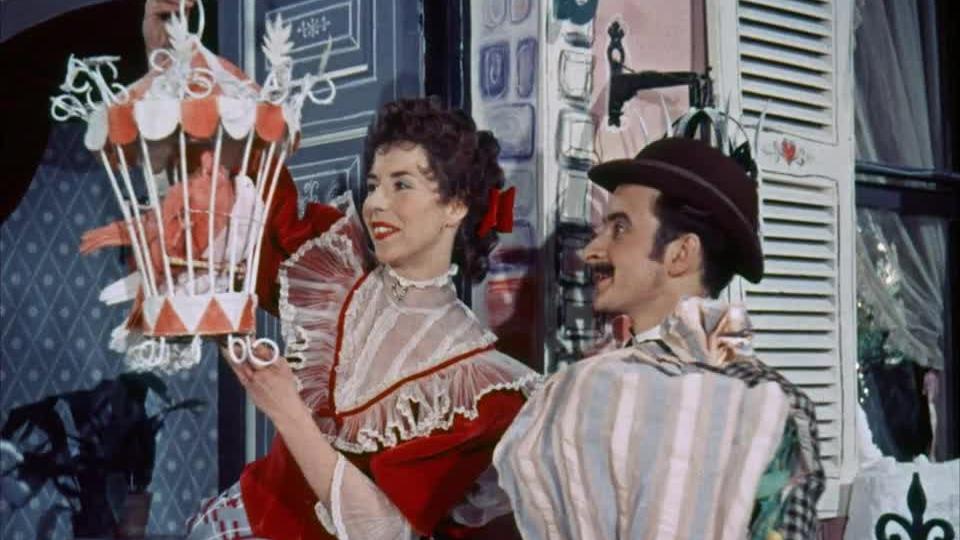
    Here’s a real curio: a short film I discovered from the U.K. called “On the Twelfth Day” (1955). I came to it by way of the “back door,” as it were, since I’m familiar with the film’s score, by Doreen Carwithen. Some credit Carwithen with having been the first female full-time film composer. In 20 minutes, the short subject demonstrates what a living hell life would be if someone were actually to receive all those gifts. Even worse than having to listening to the actual carol!

    Wendy Toye was the film’s director and devised its scenario. She’s also the unfortunate object of her truelove’s munificence.

    Also perhaps of interest, the designs are by Ronald Searle. Searle was the creator of the St. Trinian’s School cartoons, which became the basis for the popular film series. With Albert Finney’s “Scrooge” still fresh in everyone’s minds, Searle also designed and did the paintings for that film’s opening credits.

    Previously, Toye and Searle collaborated on the stage play “Wild Thyme” (1955) and subsequently a film, “The King’s Breakfast” (1963). For these projects, Searle designed the décor and costumes and painted the sets. For the films, obviously, he also did the credits. Toye, who was also a dancer and choreographer, included in her projects elements of slapstick, dance, and mime.

    Watch “On the Twelfth Day” here:

    The carol itself is traditional, its origins reaching way back, but it was English composer Frederic Austin who gave us its modern form in 1909. He codified the melody and lyrics, replacing “colly birds” with “calling birds,” and – the masterstroke – extending the cadence of “five go-old rinnnnnnnnngs.” That’s the part everyone really likes to sing, isn’t it?

    Now, Austin is not the best-known of English composers (nor is Carwithen, for that matter), but I’ve always been a bit of a musical Anglophile, so I do have some of his concert works in my collection.

    Here’s Austin’s “The Sea Venturers,” from 1935:

    And Carwithen’s film score:

    I know of two other treatments of this insufferable carol that manage to make it somewhat interesting, and I try to play them every year. The first is “Partridge Pie,” by English composer Richard Rodney Bennett. It’s a piano suite, consisting of wholly original music for each of the twelve days. Thankfully, unlike in the carol as it is sung, the material is not repeated from verse to verse.

    Book I

    Book II

    The other is “A Musicological Journey Through ‘The Twelve Days of Christmas,’” by American composer Craig Courtney. Courtney arranges each of the verses in the style of a different composer or historical era, reaching back to Gregorian chant and culminating in a pseudo-Sousa march. It tickles the ear as no recording of the traditional “Twelve Days” ever does. Here’s my preferred recording, with the Bach Choir of Pittsburgh and the Pittsburgh Brass. Each of the movements is posted separately, so you have to let the playlist run through to enjoy each of the twelve days.

    Let the gratuitous gift-giving continue!

  • Hating the Twelve Days of Christmas

    Hating the Twelve Days of Christmas

    “The Twelve Days of Christmas” is easily my least favorite Christmas carol. Fun to sing, maybe, but maddening to listen to. Like “99 Bottles of Beer on the Wall,” with the beer replaced by wassail and eggnog. Maybe that would take some of the sting out. But to have to listen to anyone sing it? Sinatra, Crosby, The Chipmunks, I don’t care – it’s torture.

    Be that as it may, it was part of the season’s rituals to sing it as a kid. It was only much later that it became clear that this Twelve Days of Christmas business doesn’t really start until December 25. In fact, many seem to be oblivious to the fact that the twelve days run through January 6, or Epiphany – the Feast of Three Kings.

    By then, for most, the gifts are already put away, and for plenty, the trees, the stockings, and other Christmas trappings are already snug in the attic. But really, everything is supposed to stay up until Twelfth Night.

    On the other hand, if you’re superstitious, you don’t want them up any longer than that, or it will bring bad luck. The only way to avert it, then, would be to leave all the decorations in place for another year. Which wouldn’t exactly be horrible – I’m sure that’s what Santa does – but your neighbors would beg to differ.

    Today, then, is the Fourth Day of Christmas, which I single out for the gift of “four calling birds.” Apparently, it was originally “colly birds,” “colly” being archaic for “black as coal” (think “collier”). So, blackbirds is what you would get, if you were a recipient of this peculiar Christmas largesse.

    The carol has been around forever, appearing in print for the first time in 1780, but as a fun “memory song” from an era before recording artists, it’s the kind of thing that probably reaches back further into the primordial ooze of oral tradition.

    What’s really interesting to me, as a classical music nut, is that so many of the familiar carols are so closely connected with the great composers. “Hark! The Herald Angels Sing” was set to music of Mendelssohn. “Joy to the World” leans on Handel. “O Holy Night” was written by Adolphe Adam (composer of “Giselle”), and so on.

    In the case of “Twelve Days,” its origins are traditional, but it was English composer Frederic Austin who gave us its modern form in 1909. He codified the melody and lyrics, replacing “colly” with “calling,” and – the masterstroke – extending the cadence of “five go-old rinnnnnnnnngs.” That’s the part of the song any singer really likes, isn’t it?

    Now, Austin is not the best-known of English composers, but I’ve always been a bit of a musical Anglophile, so I do have some of his concert works in my collection.

    Here’s Austin’s “The Sea Venturers,” from 1935:

    I know of two treatments of this insufferable carol that manage to make it somewhat interesting, and I try to play them every year. The first is “Partridge Pie,” by English composer Richard Rodney Bennett. It’s a piano suite, consisting of wholly original music for each of the twelve days. Thankfully, unlike in the carol as it is sung, the material is not repeated from verse to verse.

    Book I

    Book II

    The other is “A Musicological Journey Through ‘The Twelve Days of Christmas,’” by American composer @Craig Courtney Craig Courtney. Courtney arranges each of the verses in the style of a different composer or historical era, reaching back to Gregorian chant and culminating in a pseudo-Sousa march. It tickles the ear as no recording of the traditional “Twelve Days” ever does. Here’s my preferred recording, with the Bach Choir of Pittsburgh and the Pittsburgh Brass. Each of the movements is posted separately, so you have to let the playlist run through to enjoy each of the twelve days.

    Let the gratuitous gift-giving continue! Still eight days of Christmas to come!
  • Christmas Overload The 12 Days Stress

    Christmas Overload The 12 Days Stress

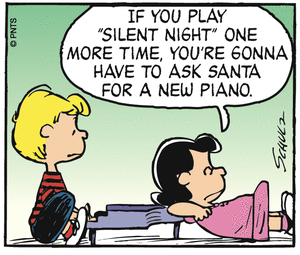
    Generally it’s “The Twelve Days of Christmas” that puts me over the edge.

Tag Cloud

Aaron Copland (92) Beethoven (95) Composer (114) Film Music (119) Film Score (143) Film Scores (255) Halloween (94) John Williams (185) KWAX (229) Leonard Bernstein (99) Marlboro Music Festival (125) Movie Music (134) Opera (198) Philadelphia Orchestra (87) Picture Perfect (174) Princeton Symphony Orchestra (106) Radio (87) Ralph Vaughan Williams (85) Ross Amico (244) Roy's Tie-Dye Sci-Fi Corner (290) The Classical Network (101) The Lost Chord (268) Vaughan Williams (102) WPRB (396) WWFM (881)

DON’T MISS A BEAT

Receive a weekly digest every Sunday at noon by signing up here


RECENT POSTS