Tag: The Wasps

  • Vaughan Williams’ Wasps Premiere: Unassuming Start

    Vaughan Williams’ Wasps Premiere: Unassuming Start

    How unassuming was the premiere of Ralph Vaughan Williams’ incidental music for “The Wasps?”

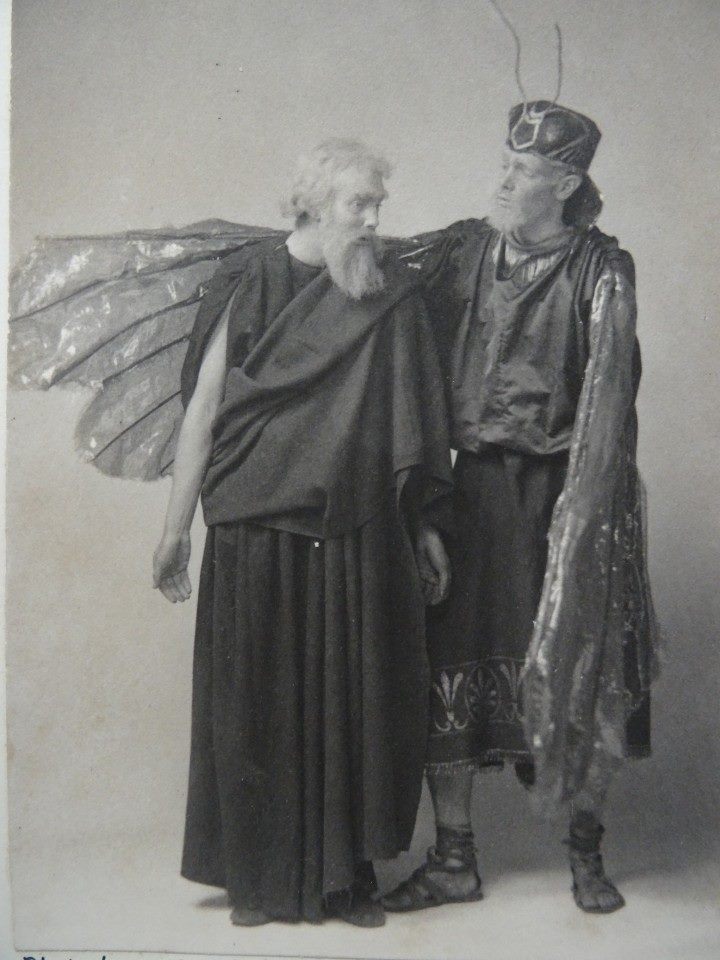
    Aristophanes’ comedy, a stinging commentary on the Athenian judicial system, was produced as the Cambridge Greek Play at Trinity College in 1909. The play itself was performed in Greek, with translations sold to the audience. As you can see, when you click through the gallery of photos at the link at the bottom of this post, the composer’s credit is buried midway down the third page of the printed program (as “R. Vaughan Williams”). The music is offered for sale, “price three shillings.”

    The year before, Vaughan Williams spent three months in Paris studying with Maurice Ravel, who was at first reluctant to take him on as a pupil. But RVW wouldn’t take no for an answer. Despite his earthy disposition (his response to Ravel’s assignment to write a minuet in the manner of Mozart was met with an unprintable response), Vaughan Williams quickly earned his teacher’s admiration and soon his friendship. Ravel later remarked that Vaughan Williams was “the only one of my pupils who does not write my music.” RVW, already in his mid-30s and three years older than his teacher, learned his lessons well (at least the ones he considered valid), assimilated what he found useful, and applied it to the achievement of his own objectives.

    Ravel’s influence is most evident in the transitional moments of “The Wasps Overture” and in its dreamy central section. The opening, of course, is a musical joke, self-evident from the onomatopoeic buzzing around the orchestra, but the middle introduces one of those immediately endearing, big-hearted English melodies. The jolly, rollicking theme in the outer portions of the overture sounds equally homegrown.

    Vaughan Williams’ complete incidental music runs to approximately 1 hour and 45 minutes. It was recorded for the first time, with English narration, in 2006. The overture has been a concert favorite since its introduction. Vaughan Williams himself recorded the jauntiest version on record, back in 1925, at a manic 7 minutes and 25 seconds. An average performance of the work is more in the ballpark of 9-10 minutes.

    You’d think that more American orchestras would have taken it up as a guaranteed crowd-pleaser to open concerts during this RVW sesquicentennial year. But U.S. music directors and administrators – “The Lark Ascending” and the “Fantasia on a Theme by Thomas Tallis” aside – remain largely immune to the charms and allure, and certainly the versatility, of Ralph Vaughan Williams. For the composer’s enthusiasts, it’s a good year to live in the U.K.


    “Gentlemen who are willing to be tried for the chorus are requested to state whether their voices are tenor or bass.” Stills from the 1909 Cambridge production.

    https://www.cambridgegreekplay.com/plays/1909/wasps

    The overture opens this 26-minute concert suite, which also includes the equally charming “March Past of the Kitchen Utensils” (at the 13-minute mark).

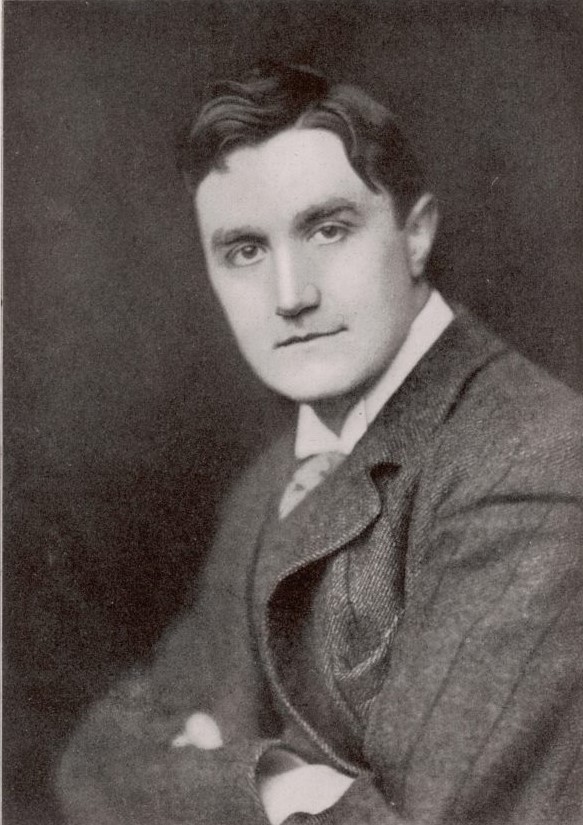
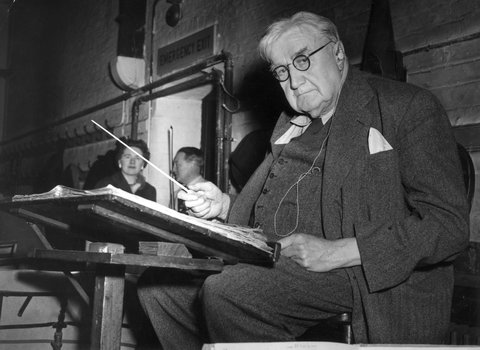
    Vaughan Williams and Ravel
    https://www.theguardian.com/music/tomserviceblog/2014/feb/28/ravel-vaughan-williams-friendship-radio3-ravel-day

  • Vaughan Williams Rare Recordings

    Vaughan Williams Rare Recordings

    Unlike Sir Edward Elgar, who was given the opportunity to record most of his major output, Ralph Vaughan Williams was generally overlooked as a conductor by the major labels – which is a shame, because the few recordings he did make are superb.

    This Sunday night on “The Lost Chord,” we’ll anticipate the 150th anniversary of the birth of one of England’s finest composers (October 12, 1872) by way of three rare recordings he made of his own music.

    Among the acoustical documents, none match the hilarity of RVW’s 1925 performance of “The Wasps” overture. Vaughan Williams’ recording is by far the fastest – and jauntiest – “Wasps” on record, although I’m unsure whether it is due to the composer’s own preference, or because of the limitations of the technology. It’s hard not to smile at such manic high spirits.

    By contrast, his 1937 recording of the Symphony No. 4 is a masterpiece of temperament and ferocity – all the more jarring in that the turbulence evoked in the work is not at all what most people associate with this composer. The urgency of the music is captured, eerily, at a time when the ink was still fresh on the page and the world was on the brink of chaos. It certainly belies the snide dismissal of much of the composer’s output as languid “cow-pat” music.

    In all, Vaughan Willliams’ meager commercial discography as a conductor wouldn’t even fill two hours. It is most fortunate, then, that a few concert recordings have emerged over the years. We’ll conclude with of one of RVW’s loveliest pieces, the “Serenade to Music,” a work which, at its first performance, actually brought tears to the eyes of Sergei Rachmaninoff. (On the first half of the concert, Rachmaninoff was soloist in his own Piano Concerto No. 2.) The text is taken from Act V, Scene I, of Shakespeare’s “The Merchant of Venice.”

    “How sweet the moonlight sleeps upon this bank!
    Here will we sit and let the sounds of music
    Creep in our ears: soft stillness and the night,
    Become the touches of sweet harmony.”

    The recorded performance was captured at Royal Festival Hall on November 22, 1951. Vaughan Williams was 79 years old. What’s especially remarkable is that the recording features 11 of the 16 soloists who sang in the work’s 1938 premiere. We’ll hear it from a compact disc issued on Albion Records, the official label of the Ralph Vaughan Williams Society.

    Vaughan Williams’ ashes are interred in Westminster Abbey alongside some of the nation’s greatest artists – yet, in some measure, the composer is still underestimated, especially by those outside the British Isles. I hope you’ll join me as we celebrate RVW for his sesquicentenary. That’s “Vaughan, But Not Forgotten,” this Sunday night at 10:00 EDT, on WWFM – The Classical Network and wwfm.org.

  • WPRB Sunday: Theater Music & Vaughan Williams

    WPRB Sunday: Theater Music & Vaughan Williams

    The subject may be “incidental,” but the music is center stage, this Sunday morning on WPRB. Join me for music written for the theater by the likes of Ludwig van Beethoven, Karl-Birger Blomdahl, Aaron Copland, Gabriel Fauré, Jean Sibelius, and Ralph Vaughan Williams.

    The featured highlight of the morning will be a complete performance of Vaughan Williams’ “The Wasps,” written for a 1909 Cambridge University production of Aristophanes’ satire. The composer re-arranged parts of the music to create a five-movement concert suite – the overture is especially well-known – but the complete, original, 80-minute score went unheard for nearly a century after its premiere. In fact, this is its first recording, set down in 2005. Bawdiness and spleen characterize the highly vernacular translation by David Pountney.

    Everyone knows where a wasp wears its stinger, this Sunday morning from 7 to 10 EST, on WPRB 103.3 FM and wprb.com. We’ll do our best to stay ahead of the behind, on Classic Ross Amico.

  • Rediscovering Lost Incidental Music

    Rediscovering Lost Incidental Music

    The play’s the thing – not only to uncover the conscience of the king, but to inspire music from untold composers down the ages. We refer to this kind of music, somewhat belittlingly, as “incidental.”

    No doubt, there are instances of incidental music having entered the standard concert repertoire – Edvard Grieg’s “Peer Gynt,” Georges Bizet’s “L’Arlésienne,” Felix Mendelssohn’s “A Midsummer Night’s Dream” – but so much more numerous are those that have suffered from neglect. Generally speaking, even under the best circumstances, the music is distilled into concert suites, offering but a few numbers, while some excellent work by some very fine composers goes unheard.

    This Sunday morning on WPRB, we’ll listen to incidental music by composers both well-known and perhaps not-quite-so, and marvel at the ingenuity on display, as acts are bridged and scenes are set in flourishes that last no more than a few moments.

    The highlight of the morning will be a complete performance of Ralph Vaughan Williams’ “The Wasps,” written for a 1909 Cambridge University production of Aristophanes’ satire. Vaughan Williams re-arranged parts of the music to create a five-movement concert suite – the overture is especially well-known – but the complete, original, 80-minute score had faded from memory until this 2005 world premiere recording. The whole is held together by judicious narration and a pinch of salty dialogue.

    Join me for these unstung pleasures. We offer them incidentally, this Sunday morning from 7 to 10 EST, on WPRB 103.3 FM and wprb.com. Needless to say, it will all be very “playful,” on Classic Ross Amico.

Tag Cloud

Aaron Copland (92) Beethoven (95) Composer (114) Film Music (119) Film Score (143) Film Scores (255) Halloween (94) John Williams (185) KWAX (229) Leonard Bernstein (99) Marlboro Music Festival (125) Movie Music (134) Opera (198) Philadelphia Orchestra (87) Picture Perfect (174) Princeton Symphony Orchestra (106) Radio (87) Ralph Vaughan Williams (85) Ross Amico (244) Roy's Tie-Dye Sci-Fi Corner (290) The Classical Network (101) The Lost Chord (268) Vaughan Williams (102) WPRB (396) WWFM (881)

DON’T MISS A BEAT

Receive a weekly digest every Sunday at noon by signing up here


RECENT POSTS