Tag: Ulysses Kay

  • Black Composers Reissue: Still, Kay & More

    Black Composers Reissue: Still, Kay & More

    As someone with an insatiable appetite for American symphonies composed during the first half of the 20th century, I try not to miss a performance, or even a radio broadcast, of music by Roy Harris, William Schuman, or Aaron Copland. But for as much as I adore those composers, the American symphonies that delight me the most, off the top of my head, are Charles Ives’ 2nd, Howard Hanson’s 2nd (the “Romantic”), and William Grant Still’s 1st (the “Afro-American”).

    Still’s symphony, the first by a Black American to be performed by a major orchestra, serves as a kind of capstone to my four-part survey of Columbia Records’ landmark Black Composer Series. This was put together for “The Lost Chord” and originally broadcast on WWFM The Classical Network to mark the belated reissue of the series – after 40 years! – as a 10-CD boxed set by Sony Classical.

    The “Afro-American Symphony” is one of the few pieces in this set, which originally appeared on vinyl between 1974 and 1978, that is heard with any frequency. It serves as a portrait of the artist as a young man, drawing on spirituals, blues, and banjo riffs redolent of the composer’s boyhood in Little Rock, Arkansas. (He was born in Woodville, Mississippi.) More enterprising music directors should give it a shot. It’s the kind of work that goes straight to the heart and gets lodged in the head. Audiences will love it.

    Hear it on the final program in my survey, which also includes “Markings,” by Ulysses Kay. Kay composed his piece in 1966 to the memory of Dag Hammerskjöld, secretary general of the United Nations. Called “the greatest statesman of our century” by John F. Kennedy, Hammarskjöld was awarded a posthumous Nobel Peace Prize, after he was killed in a plane crash en route to ceasefire negotiations during the Congo Crisis of 1961.

    The series concludes on an “up” note, with a lively “Danse Nègre,” from the “African Suite” of 1898, by Afro-English composer Samuel Coleridge-Taylor.

    Enjoy the fourth and final installment of “Black to the Future” – celebrating the reissue of Columbia Records’ forward-looking Black Composers Series – by following the link and clicking on “listen”:

    https://www.wwfm.org/post/lost-chord-february-24-black-future-part-iv

    In case you missed it, here’s Part One, with music by Chevalier de Saint-Georges, Olly Wilson, and Fela Sowande:

    https://www.wwfm.org/post/lost-chord-february-3-black-future

    Part Two, with works by George Walker and José Maurício Nunes Garcia:

    https://www.wwfm.org/post/lost-chord-black-future-part-ii

    And Part Three, with works by José Silvestre de los Dolores White y Lafitte (José White), David Baker, and Roque Cordero:

    https://www.wwfm.org/post/lost-chord-february-17-black-future-part-iii

    On a related note, Michael Kownacky will introduce Still’s “Troubled Island,” the first opera by an African-American composer to be staged by a major company – the New York City Opera, in 1949 – on a double-bill with Paul Moravec’s “Sanctuary Road,” this week on the Sunday Opera at 3:00 EST, on WWFM – The Classical Network and wwfm.org.


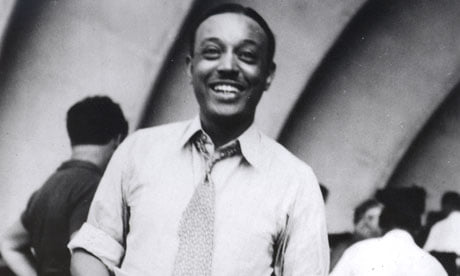
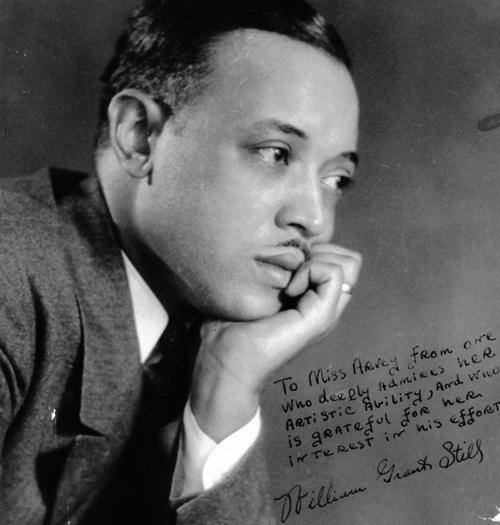
    PHOTO: William Grant Still at the Hollywood Bowl
  • Black Composers Series on WWFM

    Black Composers Series on WWFM

    It’s music by the so-called “Dean of Afro-American composers” tonight on “The Lost Chord.”

    William Grant Still’s “Afro-American Symphony” (1930) will be heard alongside Ulysses Kay’s “Markings” (1966), an elegy for secretary general of the United Nations Dag Hammerskjöld, and Samuel Coleridge-Taylor’s lively “Danse Nègre” from the “African Suite” (1898).

    I hope you’ll join me for the grand conclusion of my month-long survey of highlights from the landmark Black Composers Series of 1974-1978, newly reissued in a handsome 10-CD boxed set, thanks to Sony Classical, on “Black to the Future, Part IV,” this Sunday night at 10:00 EST, on WWFM – The Classical Network.

    But if you find the siren song of Oscar is simply too strong to resist, you can always catch the show later in the week as a webcast, along with previous installments from the series, at wwfm.org.


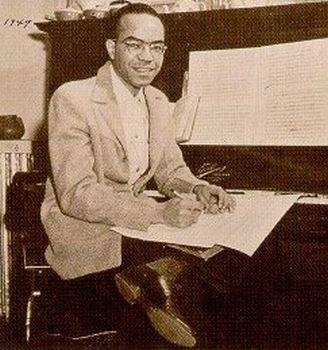
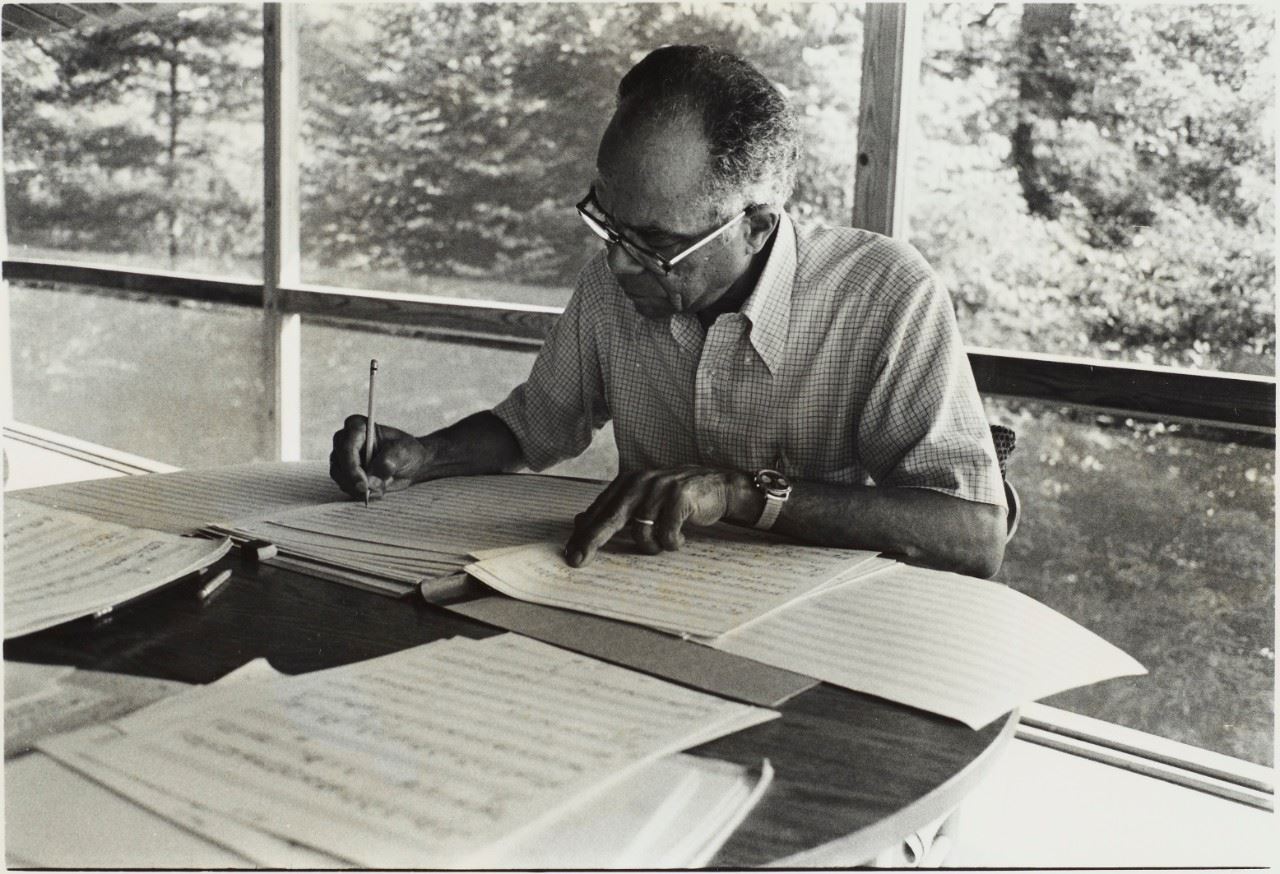
    PHOTOS (clockwise from left): William Grant Still, Ulysses Kay, and Samuel Coleridge-Taylor

  • Rediscovering Ulysses Kay: A Neglected American Voice

    Rediscovering Ulysses Kay: A Neglected American Voice

    Regrettably, the music of Ulysses Kay is under-represented in the current catalogue. His delightful “Six Dances for String Orchestra,” probably the lightest music he ever wrote, has been available sporadically on the Vox label, though always badly in need of a new recording. This Sunday night on “The Lost Chord,” we’ll hear one of those dances as part of an hour devoted to Kay’s music.

    Born in Tuscon, AZ, in 1917, Kay was the nephew of jazz musician King Oliver. His uncle encouraged him to study music formally. Likewise, he received moral support from William Grant Still, then recognized as the “Dean of Afro-American Composers.” Kay attended the University of Arizona, before heading on to the Eastman-School, where he studied with Howard Hanson and Bernard Rogers. Also influential were studies with Paul Hindemith at the Berkshire Music Center, and then Yale.

    Kay served in the United States Navy during World War II. He then continued his studies at Columbia with Otto Luening. A recipient of multiple scholarships, grants and awards, he was able to live and study abroad, in Rome, where he attended the American Academy, for several years.

    From 1953 to 1968, he worked for BMI. He was then appointed professor at Lehman College of the City University of New York, where he remained until his retirement, two decades later. A longtime resident of Teaneck, NJ, he composed orchestral, chamber, choral and instrumental works, and five operas. He died in 1995 at the age of 88.

    In addition to that dance for strings, we’ll also hear Kay’s work for trumpet and piano, “Tromba,” from 1985; a long out-of-print LP of his “Concerto for Orchestra,” recorded in 1953; and a suite from his film score to “The Quiet One,” from 1947. A quasi-documentary about an abused African American child and his subsequent coming of age, “The Quiet One” received an Oscar nomination for Best Story and Screenplay, and was listed by the New York Times and the National Board of Review as one of the ten best movies of 1948.

    I hope you’ll join me for “Giving Kay His Say,” this Sunday night at 10:00 EST, on WWFM – The Classical Network and wwfm.org.


    An interview with Kay conducted by Bruce Duffie:
    http://www.bruceduffie.com/kay.html


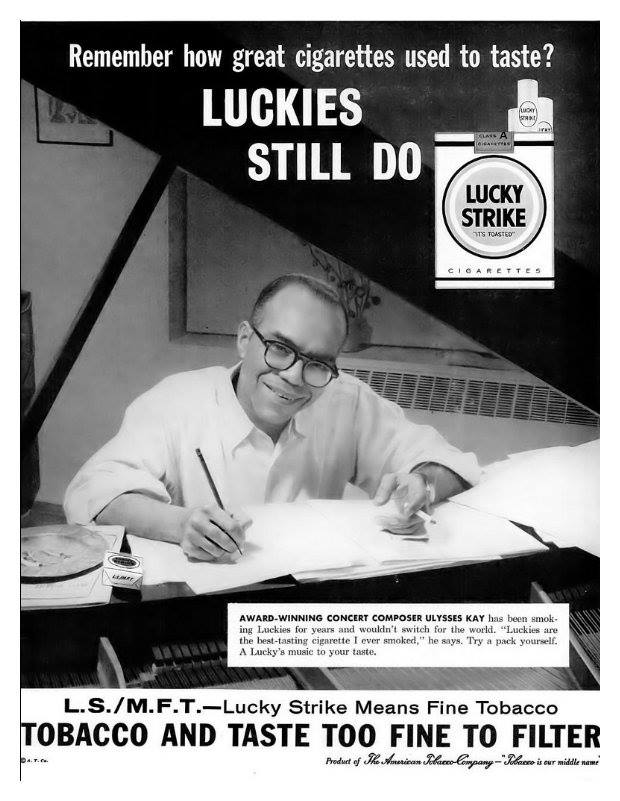
    PHOTO: Kay gets Lucky!

  • Ulysses Kay Rediscovered on The Lost Chord

    Ulysses Kay Rediscovered on The Lost Chord

    Regrettably, the music of Ulysses Kay is under-represented in the current catalogue. His delightful “Six Dances for String Orchestra,” probably the lightest music he ever wrote, has been available sporadically on the Vox label, though always badly in need of a new recording. This Sunday night on “The Lost Chord,” we’ll hear two of those dances as part of an hour devoted to Kay’s music, as we celebrate the composer’s centenary. (He was born on January 7, 1917.)

    We’ll hear his work for trumpet and piano, “Tromba,” from 1985; a long out-of-print LP of his “Concerto for Orchestra,” recorded in 1953; and a suite from his film score to “The Quiet One,” from 1947. A quasi-documentary about an abused African American child and his subsequent coming of age, “The Quiet One” received an Oscar nomination for Best Story and Screenplay, and was listed by the New York Times and the National Board of Review as one of the ten best movies of 1948.

    I hope you’ll join me for “Giving Kay His Say,” Sunday night at 10:00 EST, on WWFM – The Classical Network and at wwfm.org.

  • Ulysses Kay American Composer Centennial Celebration

    Ulysses Kay American Composer Centennial Celebration

    Ulysses Kay was born in Tuscon, AZ, on this date in 1917. A nephew of jazz musician King Oliver, his uncle encouraged him to study music formally. Likewise, he received encouragement from William Grant Still, then recognized as the “Dean of African-American Composers.” Kay attended the University of Arizona, before heading on to the Eastman-School, where he studied with Howard Hanson and Bernard Rogers. Also influential were studies with Paul Hindemith at the Berkshire Music Center, and then Yale.

    Kay served in the United States Navy during World War II. He then continued his studies at Columbia with Otto Luening. A recipient of multiple scholarships, grants and awards, he was able to live and study abroad, in Rome, where he attended the American Academy, for several years.

    From 1953 to 1968, he worked for BMI. He was then appointed professor at Lehman College of the City University of New York, where he remained until his retirement, two decades later. A longtime resident of Teaneck, NJ, he composed orchestral, chamber, choral and instrumental works, and five operas. He died in 1995 at the age of 88.

    We’ll celebrate the 100th anniversary of Kay’s birth with an hour of his music, “Giving Kay His Say,” this Sunday night at 10:00 EST on “The Lost Chord,” on WWFM – The Classical Network and at wwfm.org.


    An interview with Kay conducted by Bruce Duffie:

    http://www.bruceduffie.com/kay.html

Tag Cloud

Aaron Copland (92) Beethoven (95) Composer (114) Film Music (123) Film Score (143) Film Scores (255) Halloween (94) John Williams (187) KWAX (229) Leonard Bernstein (101) Marlboro Music Festival (125) Movie Music (138) Opera (202) Philadelphia Orchestra (89) Picture Perfect (174) Princeton Symphony Orchestra (106) Radio (87) Ralph Vaughan Williams (85) Ross Amico (244) Roy's Tie-Dye Sci-Fi Corner (290) The Classical Network (101) The Lost Chord (268) Vaughan Williams (103) WPRB (396) WWFM (881)

DON’T MISS A BEAT

Receive a weekly digest every Sunday at noon by signing up here


RECENT POSTS