Tag: Vaughan Williams

  • British Composers at Marlboro: Vaughan Williams & Bax

    British Composers at Marlboro: Vaughan Williams & Bax

    On this week’s “Music from Marlboro,” we’ll be doing some real Channel surfing – the English Channel, that is – with two works by British composers who were steeped in cross-cultural currents.

    Ralph Vaughan Williams studied in Paris with Maurice Ravel for three months in 1907-08. Ravel took few pupils, but he said of Vaughan Williams, “he is my only pupil who does not write my music.” For his part, Vaughan Williams credited Ravel with helping him to overcome a heavy Germanic influence. Ravel had the effect of lightening the textures in Vaughan Williams’ music and sharpening his focus.

    Vaughan Williams’ “Phantasy Quintet” of 1912 was one of numerous works commissioned from England’s great composers by one Walter Wilson Cobbett, a businessman and amateur musician whose dual passions were chamber music and music of the Elizabethan era. (“Phantasy” was Cobbett’s preferred spelling.) The quintet is full of Tudor inflections and stamped by Vaughan Williams’ tell-tale love of folk music. The composer doubles his violas, and the instrument is heard to great effect throughout the piece. We’ll hear a performance from the 1975 Marlboro Music Festival, with James Buswell and Sachiko Nakajima, violins; Philipp Naegele and Caroline Levine, viola; and Anne Martindale, cello.

    Sir Arnold Bax composed his evocative “Elegiac Trio” in 1916. The work, scored for flute, viola, and harp, appeared the year after Claude Debussy’s trio for the same instrumental combination. Its alluring melancholy emerged from a world at war. Bax was especially affected by escalating tensions between England and his beloved Ireland, which had just boiled over into violence with the Easter Rising. We’ll hear a performance of the trio from 1978, with Carol Wincenc, flute; Caroline Levine, viola; and Moya Wright, harp.

    Ravel too had his influences. His String Quartet in F major, composed in 1903, when he was 28 years-old, bears a superficial resemblance to Debussy’s famous quartet. But whereas Debussy’s aim was to obscure the rules of classical harmony in a sensual pursuit of greater artistic freedom – he confided to his diary, “Any sounds in any combination and in any succession are henceforth free to be used in a musical continuity” – Ravel returned to classical standards, revealing his mastery through quiet innovation within traditional forms. We’ll hear a performance from 2007, with Soovin Kim and Jessica Lee, violins; Jonathan Vinocour, viola; and Scott Bae, cello; from a concert that took place at the Isabella Stewart Gardner Museum in Boston, MA.

    Musicians from Marlboro tour several times throughout the year. The final tour of this season will take place from April 29 to May 6, with stops in Greenwich, CT (at Greenwich Library); New York City (Weill Recital Hall at Carnegie Hall); Philadelphia (Perleman Theater at the Kimmel Center for the Performing Arts); Washington, DC (Freer Gallery’s Meyer Auditorium); and Boston (the Isabella Stewart Gardner Museum). On the program will be Haydn’s String Quartet in D major, Op. 20, No. 4; Krzysztof Penderecki’s String Trio; and Johannes Brahms’ String Quintet No. 1 in F major, Op. 88. You’ll find more information at marlboromusic.org.

    It’s a Franco-British alliance this week, on “Music from Marlboro.” Join me Wednesday at 6 p.m. EDT, on WWFM – The Classical Network and wwfm.org.
    Marlboro School of Music and Festival: Official Page


    A bewhiskered Maurice Ravel in 1907, the year he met Ralph Vaughan Williams

  • WPRB Sunday: Theater Music & Vaughan Williams

    WPRB Sunday: Theater Music & Vaughan Williams

    The subject may be “incidental,” but the music is center stage, this Sunday morning on WPRB. Join me for music written for the theater by the likes of Ludwig van Beethoven, Karl-Birger Blomdahl, Aaron Copland, Gabriel Fauré, Jean Sibelius, and Ralph Vaughan Williams.

    The featured highlight of the morning will be a complete performance of Vaughan Williams’ “The Wasps,” written for a 1909 Cambridge University production of Aristophanes’ satire. The composer re-arranged parts of the music to create a five-movement concert suite – the overture is especially well-known – but the complete, original, 80-minute score went unheard for nearly a century after its premiere. In fact, this is its first recording, set down in 2005. Bawdiness and spleen characterize the highly vernacular translation by David Pountney.

    Everyone knows where a wasp wears its stinger, this Sunday morning from 7 to 10 EST, on WPRB 103.3 FM and wprb.com. We’ll do our best to stay ahead of the behind, on Classic Ross Amico.

  • Christmas Eve Music Parry Vaughan Williams

    Christmas Eve Music Parry Vaughan Williams

    On Christmas Eve, with much gift wrapping and cooking yet to be done, we pause to remember the story of the first Christmas with music by a couple of English composers inspired by the Nativity.

    Alongside Sir Charles Villiers Stanford and Sir Edward Elgar, Sir Hubert Parry was one of the key figures of the so-called “English Musical Renaissance.” He influenced a whole generation of much better known composers, including Ralph Vaughan Williams and Gustav Holst. We’ll hear his “Ode on the Nativity,” given its first performance on the same concert, at the Hereford Three Choirs Festival in 1912, as Vaughan Williams’ “Fantasia on Christmas Carols.”

    Vaughan Williams, the great-nephew of Charles Darwin and an atheist in his youth, later softened into a kind of cheerful agnosticism. He dearly loved the King James Bible, and he especially enjoyed Christmas. Of course, he wrote much music on the subject. In fact, his very last composition was “The First Nowell.” He worked diligently at the piece, inspired by medieval pageants, during his final month, but died suddenly before its completion.

    However, even at 85 years-old, RVW retained a remarkable concentration. He managed to pound out the whole thing in short score in only a few weeks. Furthermore, he had actually orchestrated the first two-thirds. The finishing touches were applied by his assistant, Roy Douglas – he of “Les Sylphides” fame.

    If you like the “Fantasia on Christmas Carols,” I think you’ll really enjoy this. It’s pastoral music for a pastoral scene. Join me for “A Play in a Manger,” this Sunday night at 10:00 EST, on WWFM – The Classical Network and wwfm.org.
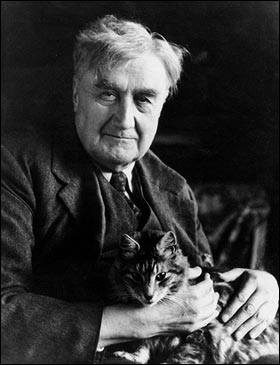
  • Vaughan Williams’ Job on WWFM Today

    Vaughan Williams’ Job on WWFM Today

    Be patient for “Job: A Masque for Dancing.” Experience Ralph Vaughan Williams’ unsung masterpiece, inspired by the Book of Job, from the Hebrew Bible, in an illustrated edition by William Blake. It’s coming up this afternoon in the 2:00 hour EST, on WWFM – The Classical Network and wwfm.org.

  • Vaughan Williams & Sibelius Symphonies on WWFM

    Vaughan Williams & Sibelius Symphonies on WWFM

    Self-indulgence alert!

    This Monday afternoon, we’ll hear two symphonies: Ralph Vaughan Williams’ Symphony No. 8, with its striking use of percussion (no pun intended), and Jean Sibelius’ Symphony No. 6.

    The Vaughan Williams has been playing in my car pretty much incessantly since the composer’s birthday last Thursday. Beyond the “Sinfonia Antarctica” – the Symphony No. 7, with its programmatic associations with the film “Scott of the Antarctic” – we don’t really hear much of Vaughan Williams’ later symphonies. This one is a gem, with its tuned gongs and movement-long showcases for the wind and string sections. It also happens to be the shortest of Vaughan Williams’ symphonies, and, though marked by ambiguity, it seems not to slip into intimations of the unknown (i.e. death) in quite the same way as the Symphonies Nos. 6, 7 & 9 appear to do. That said, the third movement contains a theme that brings to mind the chorale “O Sacred Head, Now Wounded,” used in Bach’s “St. Matthew Passion.” Vaughan Williams wrote the work when he was in his early 80s, between 1953 and 1955.

    Sibelius’ 6th, completed in 1923, always puts me in an autumnal frame of mind, probably in part because of the composer’s suggested motto: “When shadows lengthen.” Sibelius described the work as “cold spring water;” no doubt an antidote to the contemporary “cocktails,” as he called them, being served up by Igor Stravinsky. It certainly opens with some of the composer’s most hypnotic and gorgeous music. Sibelius said of the work, “The sixth symphony always reminds me of the scent of first snow.” We all know winter comes early to Finland.

    We’ll also hear from Hungarian flutist and composer Franz Doppler, an associate of Franz Liszt; Bohemian Baroque master Jan Dismas Zelenka; contemporary Estonian composer Erkki-Sven Tüür; and Russian baritone Dmitri Hvorostovsky, on their birthdays. I hope you’ll join me for autumnal symphonies and more, from 4 to 7 p.m. EDT, on WWFM – The Classical Network and wwfm.org.


    Sardanapalus wants all his pleasures at once

Tag Cloud

Aaron Copland (92) Beethoven (95) Composer (114) Film Music (124) Film Score (143) Film Scores (255) Halloween (94) John Williams (188) KWAX (229) Leonard Bernstein (101) Marlboro Music Festival (125) Movie Music (139) Opera (202) Philadelphia Orchestra (89) Picture Perfect (174) Princeton Symphony Orchestra (106) Radio (87) Ralph Vaughan Williams (85) Ross Amico (244) Roy's Tie-Dye Sci-Fi Corner (290) The Classical Network (101) The Lost Chord (268) Vaughan Williams (103) WPRB (396) WWFM (881)

DON’T MISS A BEAT

Receive a weekly digest every Sunday at noon by signing up here


RECENT POSTS