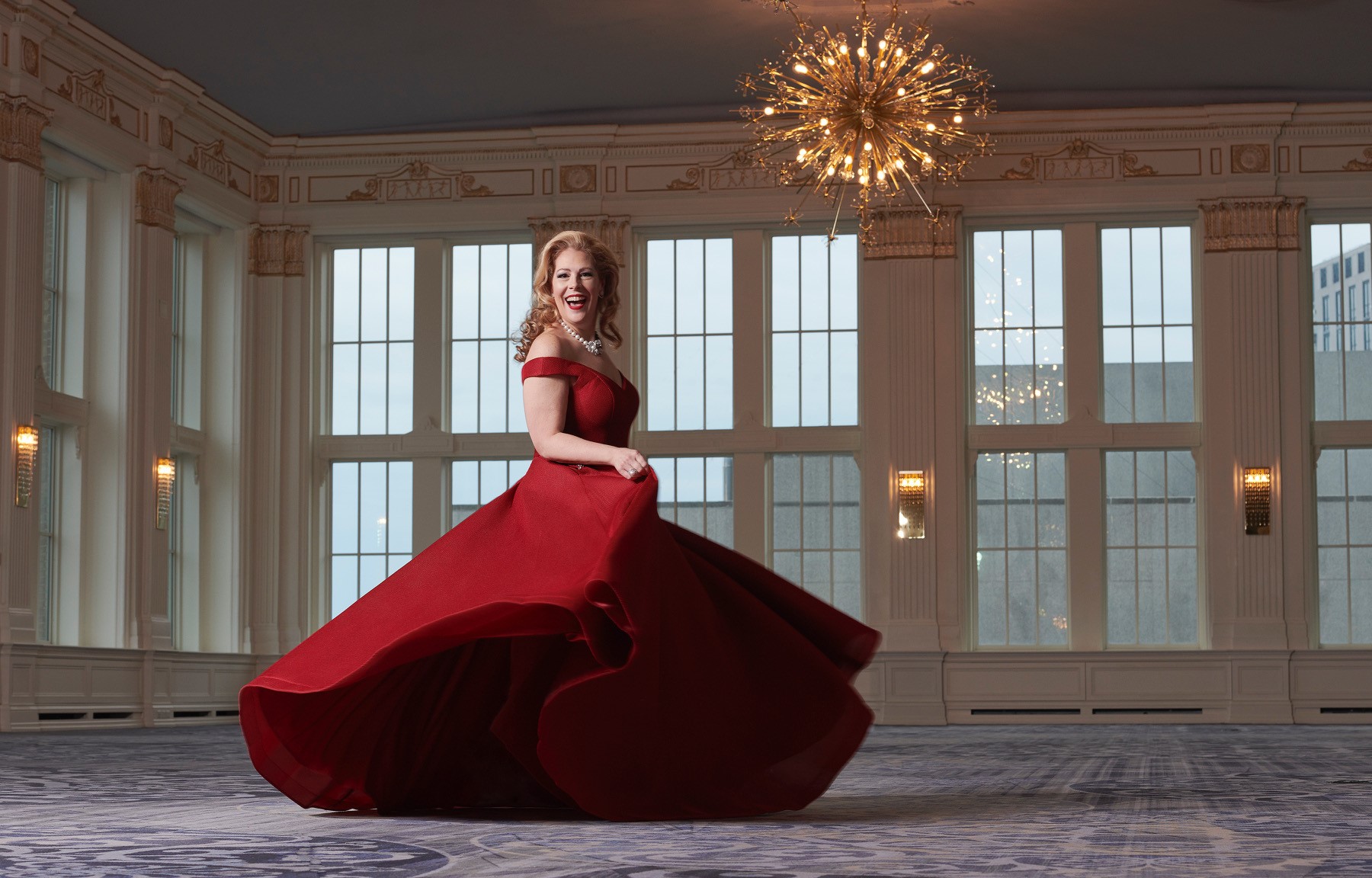
Because of safety concerns regarding the ill-timed thunderstorms that battered the region last night not long before curtain, it was nearly 9:00 before soprano Sondra Radvanovsky took the stage of the performance pavilion at Morven Museum & Garden for the second night of The Princeton Festival. But boy, when she did, did she deliver.
The program was perfectly tailored to suit her voice, with selections by Verdi (“La forza del destino”), Giordano (“André Chénier”), and Puccini (“Tosca” – which she’ll be singing at the Met next season – and an imperious Turandot). Her control was riveting, her dramatic presence hypnotic, and when she was under full sail, she flooded the tent with a magisterial voice that stirred overwhelming emotion.
She was joined by rising tenor Victor Starsky, a Princeton Festival veteran, who sang Cavaradossi in last year’s production of “Tosca” and will return next week as Pinkerton in “Madama Butterfly.” Starsky had his time in the spotlight with “Celeste Aida” and that old standby, “Nessun Dorma.” Nothing sets a crowd wild like a tenor in full voice.
But even more compelling, for me, personally, were his duets with Radvanovsky (from “Un Ballo in maschera” and “Manon Lescaut”), which allowed his passion to bubble over. I was left shaken by their concluding “Vicino a te s’acqueta,” from “André Chénier,” in which the couple anticipates fulfillment of their love in their impending death at the guillotine (“Viva la morte insiem!”) – so much so that, as I was chatting with some people behind me afterward, I nearly broke down.
No doubt there would have been encores, but it was already pushing 11:00. I’m sure a lot of contracted employees are going to be getting overtime.
Rossen Milanov conducted The Princeton Symphony Orchestra, in support of the singers, but also supplied the overtures and interludes by Verdi, Mascagni, and Leoncavallo. It was a late night, so I was thankful for having imbibed a strong cold brew beforehand. Even so, I think it would have been impossible to nod. It was definitely worth sweating it out in the car for an hour, waiting for the thunder and lightning to subside.
Today is the festival’s Community Day, with Yoga in the Garden (to live musical accompaniment) already underway. That will be followed this afternoon by family friendly activities, including an instrument “petting zoo,” a musical story time, a quilting exhibition, “Harriet Powers: American Icon,” with the Princeton Sankofa Stitchers Modern Quilt Guild, and American Repertory Ballet‘s 30-minute “Swan Lake Experience,” an accelerated story of the ballet with audience participation, from 12-3 p.m.
This evening, Milanov and the PSO will return to join the dancers for a program that will feature pas de deux from Tchaikovsky’s “Swan Lake” and “The Sleeping Beauty,” Samuel Barber’s “Adagio for Strings,” and a world premiere choreographed to music by Pulitzer Prize winner Caroline Shaw. But especially interesting to me will be a ballet set to Jean Françaix’s Piano Concerto, with Steven Beck the soloist. The event will commence in the performance pavilion on the Morven grounds at 7 p.m.
Morven Museum & Garden is located at 55 Stockton Street (Route 206) in Princeton, NJ.
The Princeton Festival runs through July 21. For tickets and information, visit princetonsymphony.org/festival.
——–
I didn’t take any pictures last night. I’ll add a more pertinent photo once the Princeton Festival makes one available!
Tag: Verdi
-
Stunning Radvanovsky Worth the Wait, After Rain Delay at the Princeton Festival
-

Regal Radio Verdi Delibes & More on KWAX
I don’t know what got into me. I knew it was Presidents Day weekend, and still somehow I went with the autocrats. Must have been a Freudian slip. Whatever the motivation, this week on “Sweetness and Light,” we don’t need ermine or orbs and sceptres to vicariously live like kings.
Not when we can enjoy regal music by Giuseppe Verdi, Léo Delibes, Sir Arthur Bliss, Percy Grainger, Emmanuel Chabrier, Adolphe Adam, and Henry VIII.
This country may have been founded on principles that rejected such things, but heavy is the head that bears the burden of coming up with a good theme.
I spare you the royal pain! Absolute power delights absolutely on “Sweetness and Light,” this Saturday morning at 11:00 EST/8:00 PST, exclusively on KWAX, the radio station of the University of Oregon!
Stream it, wherever you are, at the link:
-

Marian Anderson at the Met 70 Years Ago
It was on this date 70 years ago that Marian Anderson made her Metropolitan Opera debut, as the sorceress Ulrica, in Verdi’s “Un ballo in maschera” (“A Masked Ball”), making her the first African American singer to appear in a solo role on the Met stage.
Anderson, whose talent was described by Arturo Toscanini as “a voice one hears once in a hundred years,” was already in her late 50s, at the far end of a singing career that had already made her a household name and a reluctant symbol for social justice. Her legendary recital from the steps of the Lincoln Memorial took place on Easter, 1939 – nearly 16 years earlier – after she was shut out of performing at Constitution Hall by the Daughters of the American Revolution because of her skin color. Ironically, this only served to increase her exposure. The audience gathered on the National Mall was estimated at 75,000, with millions listening to the live radio broadcast in their kitchens and living rooms across the nation.
Anderson’s belated appearance at the Met may have signaled a new era, but progress was slow, and the administration was careful about which singers it sent to tour in certain areas of the country.
It would be churlish of me to observe that, in order for a Black woman to make it on stage at the Met, she had to be dressed like Screamin’ Jay Hawkins. Because it is opera, after all, and everyone dresses like that.
The first male African American soloist appeared on the Met stage only a few weeks later. Baritone Robert McFarrin sang Amonasro in Verdi’s “Aida.” McFerrin was the father of “Don’t Worry, Be Happy” singer Bobby McFerrin, to give you an idea of how recent this history is.
Now it’s not unusual to see Black singers in whatever role. Opera is fantasy, after all. Everything is heightened. It shouldn’t matter if different cultures and social strata are inexplicable melting pots. In the past, no one thought twice if a white Canadian sang Otello or an Italian woman sang Cio-Cio-San or if the principals were a mix of French, German, Irish, and American.
The core of opera is great singing. And no matter how outlandish the plots or settings or costumes or make-up, the most enduring examples of the form deal in emotional truth. It’s one of the few arenas in which all men and women are received with an enthusiasm commensurate with their talent.
-

Opera Ballet Scandals Wagner Verdi
In the 19th century, when your opera was accepted in Paris, it meant you definitely needed a ballet. It was tradition. It provided a danced divertissement for French audiences, who were accustomed to a little light entertainment in the middle of an evening heavy on singing.
Richard Wagner bemoaned the fact, when “Tannhäuser” was accepted there, and he ruffled quite a few feathers when he frontloaded his ballet, essentially “getting it out of the way,” by including it in the first act as a bacchanale – which makes perfect dramatic sense in the Venusberg, the sensual realm of Venus.
Nevertheless, Parisian aristocrats were none too happy, as this conflicted with their dining schedules. (There’s a reason they call it “fashionably late.”) French soldiers too were accustomed to arriving with full bellies and light spirits to ogle dancers during their traditional appearance in a later act.
For this, among other reasons, “Tannhäuser” was met with whistles and catcalls. By the third performance, the backlash had become so intense, with interruptions of up to 15 minutes at a time, that Wagner finally withdrew the opera.
Giuseppe Verdi wasn’t crazy about the whole ballet idea either. Nevertheless, when he was invited to submit “Macbeth,” originally composed in 1847, for performance in Paris (first in 1852, and when he didn’t follow through, for a second time in 1864), he acquiesced. Of course, Verdi being Verdi, it became a much more involved undertaking than he had anticipated, and he wound up revising the entire opera.
Privately, he expressed reservations about the inclusion of ballet in opera, but unlike Wagner, he figured out ways for it to suit the drama AND at the accepted place in an evening’s entertainment. In short, when life gave him lemons, he made limoncello.
Verdi was a canny enough showman to know to give the public what it wanted: cavorting witches!
You go, Joe! Happy birthday!
Totally Goth witches’ chorus from “Macbeth”:
https://www.youtube.com/watch?v=7b4tKhV5mcg
Act III Witches’ Dance from Taiwan:
“The Three Witches from Macbeth” (1827) by Alexandre-Marie Colin
-

Pretty Yende Sings in Princeton With PSO
More than just a pretty voice, soprano superstar Pretty Yende will display her versatility in Princeton this weekend, on a pair of concerts presented by the Princeton Symphony Orchestra.
The second half of the program, as might be expected, will feature sparkling arias from Rossini’s “The Barber of Seville” and Verdi’s “La traviata;” but the first half of the concert, devoted to American music, will include Yende’s soulful rendition of Samuel Barber’s nostalgic and poignant “Knoxville: Summer of 1915.” Also on the program will be overtures from Rossini and Verdi operas and Aaron Copland’s Pulitzer Prize winning masterwork, “Appalachian Spring.”
Put a spring in your step with the Princeton Symphony Orchestra, at Richardson Auditorium this Saturday evening at 8:00 and Sunday afternoon at 4:00. Sunday’s performance will be a preceded by an onstage conversation with music director Rossen Milanov at 3:00. For tickets and information, visit princetonsymphony.org.
Curious to learn more about “Knoxville?” The PSO will host musicologist Austin Stewart, as he reflects on the backgrounds of both Barber’s composition and the James Agee text upon which it is based, at Princeton Public Library this Thursday evening at 7:00. The library event is free and open to the public.
Tag Cloud
Aaron Copland (94) Beethoven (95) Composer (114) Film Music (150) Film Score (143) Film Scores (255) Halloween (102) John Williams (198) KWAX (233) Leonard Bernstein (105) Marlboro Music Festival (125) Movie Music (165) Mozart (91) Opera (215) Philadelphia Orchestra (90) Picture Perfect (174) Princeton Symphony Orchestra (110) Radio (90) Ross Amico (244) Roy's Tie-Dye Sci-Fi Corner (290) The Classical Network (101) The Lost Chord (269) Vaughan Williams (107) WPRB (397) WWFM (881)