Tag: Vincent Persichetti

  • Ormandy’s Lost Chord American Music

    Ormandy’s Lost Chord American Music

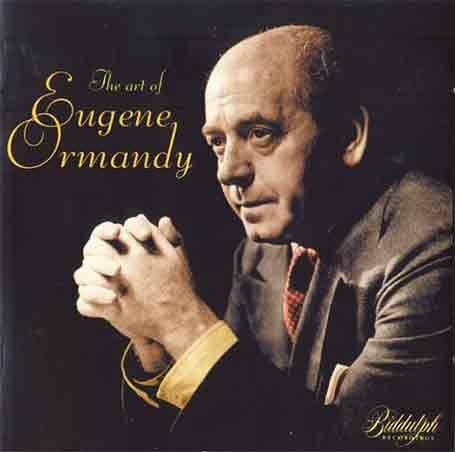
    This week on “The Lost Chord,” for Eugene Ormandy’s birthday, it’s the second installment in a three-part series of Ormandy conducting the Philadelphia Orchestra in rarely-heard recordings of American music.

    Samuel Barber was born in West Chester, Pa., not far from Philly, in 1910. He attended Philadelphia’s Curtis Institute of Music and had his first orchestral work, the “School for Scandal Overture,” performed by the Philadelphia Orchestra in 1931, when he was 21 years-old.

    His “First Essay for Orchestra” was sent to Arturo Toscanini in the same mail as his “Adagio for Strings.” Toscanini performed both works with the NBC Symphony in 1938, but it was Eugene Ormandy who made the first recording of “Essay,” with the Philadelphians, in 1940.

    Vincent Persichetti was born in Philadelphia in 1915, and he died there in 1987. In between, he attended Combs College of Music, the Curtis Institute (where he studied conducting with Fritz Reiner) and the Philadelphia Conservatory. He taught at Combs and the Philly Conservatory. Then he received an invitation from William Schuman (some of whose music we heard last week) to take up a professorship at Juilliard.

    Persichetti was one of our great composers, but to this day he remains underappreciated, more respected than loved. His Symphony No 4 of 1951 must be one of his most immediately attractive works.

    Finally, John Vincent may be the most undeservedly neglected composer in Ormandy’s entire discography. Ormandy described his recording of Vincent’s Symphony in D (“A Festival Piece in One Movement”) as “one of the best we have ever done,” and the piece itself as “one of the finest compositions created by an American composer in the past decade.” The 1954 work sounds at times like Sibelius gone to the rodeo, but my, is it good stuff!

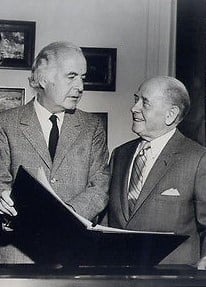
    I hope you’ll join me for “All-American Ormandy II.” Ormandy recommends a visit to the Barber (pictured), then convinces with the Vincents, on “The Lost Chord,” now in syndication on KWAX, the radio station of the University of Oregon!

    Happy birthday, Eugene Ormandy!


    Remember, KWAX is on the West Coast, so there’s a three-hour difference for the Trenton-Princeton area. Here are the respective air-times of my recorded shows (with East Coast conversions in parentheses):

    PICTURE PERFECT, the movie music show – Friday on KWAX at 5:00 PACIFIC TIME (8:00 PM EST)

    THE LOST CHORD, unusual and neglected rep – Saturday on KWAX at 4:00 PACIFIC TIME (7:00 PM EST)

    Stream them here!

    https://kwax.uoregon.edu/


    PLEASE NOTE: Ormandy’s recording of John Vincent’s Symphony in D was reissued yesterday, November 17, as part of Sony Classical’s new 88-CD box, “Eugene Ormandy/The Philadelphia Orchestra: The Columbia Stereo Collection.” I opened my set this morning with trembling hands!

    Persichetti’s Symphony No. 4 was reissued in 2021, as part of Sony’s laudable 120-CD box of Ormandy’s Philadelphia mono recordings, “Eugene Ormandy: The Columbia Legacy.”

    Both Sony releases are newly-remastered.
  • Remembering Vincent Persichetti

    Remembering Vincent Persichetti

    Vincent Persichetti was born in Philadelphia on this date in 1915. He died there in 1987. Although he seems to have had more of a lasting influence as a teacher – having molded legions of budding composers through his work at Combs College of Music, the Philadelphia Conservatory, and the Juilliard School – his own compositions are invariably well-crafted and certainly well worth listening to.

    Somewhere, I’ve got one of his manuscripts in a box of musical collectibles I acquired at Freeman’s Auction House, back in the day when, if no one bid on a lot, it would go down to a dollar. It may have been in with a box of conductor James De Preist’s homework. I ought to make a point to dig that out. Nothing major, maybe a fanfare or something, a short work for brass.

    The Philadelphia Orchestra used to play his work from time to time, but I haven’t seen any of Persichetti’s music on their programs for years. There is a document from the Muti era, on New World Records, a CD of live performances of the Symphony No. 5 for strings and the Piano Concerto, with Robert Taub as soloist. Frankly, I prefer this symphony, recorded by Ormandy and posted here in four movements:

    I. https://www.youtube.com/watch?v=Ajw4Ayhd1AA

    II. https://www.youtube.com/watch?v=2hkAvb3Gx7A

    III. https://www.youtube.com/watch?v=7BASajjHG08

    IV. https://www.youtube.com/watch?v=_rONwSSdlDE

    A 1983 documentary on Persichetti

    An interview with Bruce Duffie

    http://www.bruceduffie.com/persichetti.html

    An afternoon with Tim Page

    https://www.wnyc.org/story/an-afternoon-with-vincent-persichetti/

    Happy birthday, Vincent Persichetti!


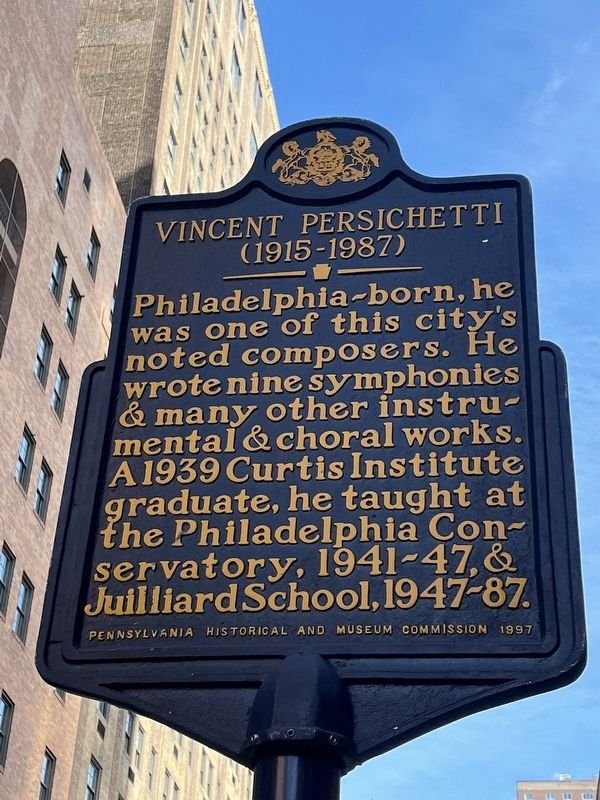
    PHOTO: The Vincent Persichetti historical marker outside the Curtis Institute of Music, from which he graduated in 1939

  • Thanksgiving Classical Music: Dvořák & More

    Thanksgiving Classical Music: Dvořák & More

    Over the river and through the wood, to grandmother’s house we go…

    Who are we kidding? We’re not going anywhere.

    While you’re whiling away the hours in Thanksgiving traffic, I hope you’ll join me on The Classical Network, on this busiest travel day of the year, as I crown a late afternoon of American music with an hour calculated to put you in a thankful frame of mind.

    Sure, in the amount of time it takes you to get where you’re going, Antonin Dvořák very likely was able to cross the Atlantic, to assume the directorship of the newly-minted National Conservatory of Music in New York. Some of the composer’s most beloved works had their genesis in his stay in the United States – the “New World” Symphony and the Cello Concerto in B minor, among them.

    Of his chamber music, I imagine none of it is more frequently encountered than his “American” String Quartet in F major, Op. 96. Written during the summer of 1893, while the composer was on holiday in the Czech community of Spillville, Iowa, the work is beautiful and ingratiating to an extraordinary degree. What’s puzzling is why the composer’s equally beautiful and ingratiating String Quintet in E-flat major, Op. 97, composed in Spillville immediately after – and also sometimes identified as the “American” – has not achieved the same degree of popularity.

    We’ll get to enjoy it this evening, in a performance featuring a young Joshua Bell, who joins violinist Felix Galimir, violists Ulrich Eichenauer and Judith Busbridge, and cellist Wendy Sutter, at the 1989 Marlboro Music Festival.

    Dvořák’s underrated quintet will be flanked by two works by American composers.

    We’ll begin with Vincent Persichetti, who was born in Philadelphia in 1915. (He died there in 1987.) Although Persichetti seems to have had more of a lasting influence as a teacher – having molded legions of budding composers through his work at Combs College of Music, the Philadelphia Conservatory, and the Juilliard School – his own compositions are invariably well-crafted and certainly well worth listening to.

    Persichetti composed 15 serenades for a variety of instrumental combinations. We’ll hear the Serenade No. 10, from 1961. It was performed at Marlboro, by flutist Julia Bogorad and harpist Rita Tursi, in 1976.

    The hour will conclude with an 8-minute Woodwind Quintet by the dread Elliot Carter. Carter is the kind of composer who, for the six decades or so that comprised his artistic maturity, had a tendency to get lost in his own head. (He lived to 103 and wrote right up to the very end.) Not to worry: in 1948, he still had one foot in Audience Land.

    We’ll hear Carter’s quintet performed in 2006 by flutist Valérie Tessa Chermiset, oboist Winnie Cheng-Wen Lai, clarinetist Charles Neidich, bassoonist Martin Garcia, and hornist Wei-Ping Chou.

    Classic Ross Amico will be your co-pilot, on the next “Music from Marlboro.” Misery loves company, this Wednesday evening at 6:00 EST, on WWFM – The Classical Network and wwfm.org.

    Happy Thanksgiving, and safe travels!

    Marlboro School of Music and Festival: Official Page

  • Ormandy’s Lost American Music Recordings

    Ormandy’s Lost American Music Recordings

    It’s not so much that I am out of ideas, but it is mighty convenient that I have so much material left over from last week’s show. Even now, I run my eye down the stack of CDs with the warm satisfaction of an acquisitive magpie.

    This Sunday night on “The Lost Chord,” it’s the second installment in what is shaping up to be a three-part series of Eugene Ormandy conducting the Philadelphia Orchestra in rarely-heard recordings of American music.

    Samuel Barber was born in West Chester, Pa., not far from Philly, in 1910. He attended Philadelphia’s Curtis Institute of Music and had his first orchestral work, the “School for Scandal Overture,” performed by the Philadelphia Orchestra in 1931, when he was 21 years-old.

    His “First Essay for Orchestra” was sent to Arturo Toscanini in the same mail as his “Adagio for Strings.” Toscanini performed both works with the NBC Symphony in 1938, but it was Eugene Ormandy who made the first recording of “Essay,” with the Philadelphians, in 1940.

    Vincent Persichetti was born in Philadelphia in 1915, and he died there in 1987. In between, he attended Combs College of Music, the Curtis Institute (where he studied conducting with Fritz Reiner) and the Philadelphia Conservatory. He taught at Combs and the Philly Conservatory. Then he received an invitation from William Schuman (some of whose music we heard last week) to take up a professorship at Juilliard.

    Persichetti was one of our great composers, but to this day he remains underappreciated, more respected than loved. His Symphony No 4 of 1951 must be one of his most immediately attractive works.

    Finally, John Vincent may be the most undeservedly neglected composer in Ormandy’s entire discography. Ormandy described his recording of Vincent’s Symphony in D (“A Festival Piece in One Movement”) as “one of the best we have ever done,” and the piece itself as “one of the finest compositions created by an American composer in the past decade.” The 1954 work sounds at times like Sibelius gone to the rodeo, but my, is it good stuff!

    I hope you’ll join me for “All-American Ormandy II.” Ormandy recommends a visit to the Barber (pictured), then convinces with the Vincents, this Sunday night at 10:00 EST, on WWFM – The Classical Network and wwfm.org.

  • Ormandy’s Lost American Gems Barber Persichetti Vincent

    Ormandy’s Lost American Gems Barber Persichetti Vincent

    It’s not so much that I am out of ideas, but it is mighty convenient that I had so much material left over from last week’s show, consisting of rarely-heard recordings of American music performed by Eugene Ormandy and the Philadelphia Orchestra.

    This Sunday night on “The Lost Chord,” I reach for the already conveniently stacked CDs to cue up three more gems.

    Samuel Barber was born in West Chester, Pa., not far from Philly, in 1910. He attended Philadelphia’s Curtis Institute of Music and had his first orchestral work, the “School for Scandal Overture,” performed by the Philadelphia Orchestra in 1931, when he was 21 years-old.

    His “First Essay for Orchestra” was sent to Arturo Toscanini in the same mail as his “Adagio for Strings.” Toscanini performed both works with the NBC Symphony in 1938, but it was Eugene Ormandy who made the first recording of the “Essay,” with the Philadelphians, in 1940.

    Vincent Persichetti was born in Philadelphia in 1915, and he died there in 1987. In between, he attended Combs College of Music, the Curtis Institute (where he studied conducting with Fritz Reiner) and the Philadelphia Conservatory. He taught at Combs and the Philly Conservatory. Then he received an invitation from William Schuman (some of whose music we heard last week) to take up a professorship at Juilliard.

    Persichetti was one of our great composers, but to this day he remains underappreciated, more respected than loved. His Symphony No 4 of 1951 must be one of his most immediately attractive works.

    Finally, John Vincent may be the most undeservedly neglected composer in Ormandy’s entire discography. Ormandy described his recording of Vincent’s Symphony in D (“A Festival Piece in One Movement”) as “one of the best we have ever done,” and the piece itself as “one of the finest compositions created by an American composer in the past decade.” The 1954 work sounds at times like Sibelius gone to the rodeo, but my, is it good stuff!

    I hope you’ll join me for “All-American Ormandy II,” rarely-heard recordings of Barber, Persichetti and Vincent, on “The Lost Chord,” this Sunday night at 10 ET, with a repeat Wednesday evening at 6; or that you’ll listen to it later as a webcast at wwfm.org.

    To help get you in the mood, here’s an in-depth interview with Persichetti by Bruce Duffie:

    http://www.bruceduffie.com/persichetti.html

Tag Cloud

Aaron Copland (92) Beethoven (95) Composer (114) Film Music (123) Film Score (143) Film Scores (255) Halloween (94) John Williams (187) KWAX (229) Leonard Bernstein (101) Marlboro Music Festival (125) Movie Music (138) Opera (202) Philadelphia Orchestra (89) Picture Perfect (174) Princeton Symphony Orchestra (106) Radio (87) Ralph Vaughan Williams (85) Ross Amico (244) Roy's Tie-Dye Sci-Fi Corner (290) The Classical Network (101) The Lost Chord (268) Vaughan Williams (103) WPRB (396) WWFM (881)

DON’T MISS A BEAT

Receive a weekly digest every Sunday at noon by signing up here


RECENT POSTS