Tag: William Byrd

  • Elizabeth I, Tallis & Byrd: Music, Faith & Intrigue

    Elizabeth I, Tallis & Byrd: Music, Faith & Intrigue

    It was on this date, 450 years ago, that Queen Elizabeth I granted license to Thomas Tallis and William Byrd for the exclusive printing of music and ruled music paper in England for 21 years. Naturally, the composers were quick to dedicate their “Cantiones que ab argumento sacrae vocantur,” a collection of 34 Latin motets and one of the first sets of sacred music printed in England, to the queen. Among the motets is Tallis’ “O Nata Lux.” Unfortunately, the volume proved to be a financial flop, and the composers were forced to petition the queen for aid. She responded by granting the leases to certain lands for the period of their musical monopoly.

    Interestingly, in an era when different sects within one’s own religion were often regarded with suspicion and subject to discrimination, criminalization, violence, and even death (composer Peter Phillips, a Roman Catholic priest, fled to mainland Europe to escape persecution in England, and was imprisoned by the Dutch authorities, for allegedly plotting the assassination of Elizabeth), the queen, who was Protestant, looked past the fact that both Byrd and Tallis were Catholic.

    Tallis, who was clearly either an extremely likeable fellow or a savvy political animal (perhaps both), managed to survive and even thrive, since 1542, as Gentleman of the Chapel Royal, an office for which he composed and performed for Henry VIII, Edward VI, Mary I, and Elizabeth I. Somehow, he always managed to steer clear of religious controversy.

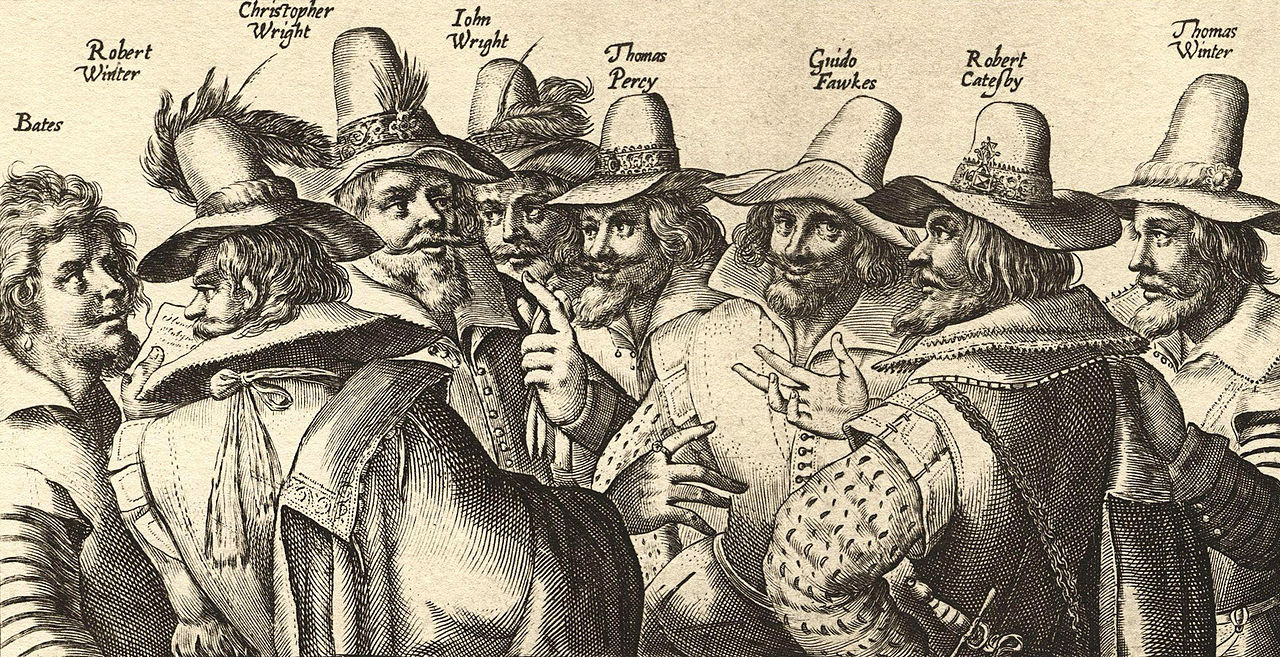
    On the other hand, Byrd, Tallis’ pupil, who also served as Gentleman of the Chapel Royal, beginning in 1572, actually converted to Catholicism in the 1570s, and even rubbed shoulders with Robert Catesby, who formulated the Gunpowder Plot to blow up Parliament in 1605, during the reign of James I, for which Guy Fawkes gained his undying notoriety.

    Though Byrd was never subject to imprisonment for his religious beliefs, he was involved in numerous lawsuits and subjected to heavy fines. Elizabeth interceded on his behalf at least once. He participated in illegal services, and the texts he chose to set to music could, at times, have a subversive edge. In particular, as a Catholic in a Protestant country, he became fond of texts related to persecution. Comparatively speaking, he went unmolested, because of his record of allegiance to the crown.

    A good movie could be made about these two composers and their relationship with the queen. Perhaps Cate Blanchett could be convinced to return for a third time as Elizabeth…


    Byrd, “Ne irascaris Domine” (“Do not be angry, Lord”), from his “Cantiones sacrae”

    Writing for the Anglican Church: “O Lord make They servant Elizabeth our queen”

    It’s not easy being Catholic (in a Protestant country): “Tristitia et Anxietas”

    Tallis, “O Nata Lux”

    “Why fum’th in sight?” (basis for Vaughan Williams’ “Fantasia on a Theme by Thomas Tallis”)

    Tallis’ greatest hit, “Spem in alium”

  • Guy Fawkes Night William Byrd’s Secret Plot

    Guy Fawkes Night William Byrd’s Secret Plot

    Remember, remember, the Fifth of November. I imagine you’re putting the finishing touches on your effigies, as Guy Fawkes Night approaches. Have a great time. Just don’t burn my outhouse!

    https://en.wikipedia.org/wiki/Guy_Fawkes_Night

    William Byrd, a “Gentleman of the Chapel Royal,” was one of the best loved and certainly one of the most powerful musicians in England. In 1575, Queen Elizabeth granted him and Thomas Tallis – who had been a “Gentleman” from the time of Henry VIII – a 21-year monopoly on polyphonic music and a patent to print and publish music.

    Despite Byrd’s favored status within the Anglican Church, he converted to Catholicism, and even rubbed shoulders with Robert Catesby, who formulated the Gunpowder Plot to blow up Parliament in 1605, during the reign of James I, for which Guy Fawkes gained his undying notoriety.

    Though Byrd was never subject to imprisonment for his religion, he was involved in numerous lawsuits and subjected to heavy fines. Elizabeth interceded on his behalf at least once. He participated in illegal services, and the texts he chose to set to music could, at times, have a subversive edge. In particular, as a Catholic in a Protestant country, he became fond of texts related to persecution. Comparatively speaking, he went unmolested, because of his record of allegiance to the crown.

    Learn more about Byrd here:

    https://en.wikipedia.org/wiki/William_Byrd

    The secret life of William Byrd:

    https://www.telegraph.co.uk/news/religion/10323301/The-secret-life-of-William-Byrd.html?fbclid=IwAR3HQMCv8G7wQyUnhFgittM7ts3W9vHQg-L5frQkKDudFvqY46xETuXJiYQ

    Byrd’s motet, “Ne irascaris Domine” (“Do not be angry, Lord”), from his “Cantiones sacrae”


    PICTURED: Gunpowder Plot conspirators

  • Byrd Remembered A Belated Tribute

    Byrd Remembered A Belated Tribute

    Consider it a belated tribute to William Byrd.

    Byrd died 400 years ago, on July 4, 1623. I think it’s understandable that as an American – especially one born on the Fourth – I would have let the observance slip by, at a time when my head would have been a tug-of-war between fireworks and regret.

    Byrd is one albatross I will finally be able to address, this weekend on “The Lost Chord.”

    A “Gentleman of the Chapel Royal,” Byrd was one of the best loved and certainly one of the most powerful musicians in England. In 1575, Queen Elizabeth granted him and Thomas Tallis – who had been a “Gentleman” from the time of Henry VIII – a 21-year monopoly on polyphonic music and a patent to print and publish music.

    Not incidentally, Byrd has his own fireworks connection. Despite his favored status within the Anglican Church, he converted to Catholicism, and even rubbed shoulders with Robert Catesby. Catesby formulated the Gunpowder Plot to blow up Parliament in 1605, during the reign of James I, for which Guy Fawkes gained his undying notoriety.

    Though Byrd was never imprisoned for his religion, he was involved in numerous lawsuits and subjected to heavy fines. Elizabeth interceded on his behalf at least once. He participated in illegal services, and the texts he chose to set to music could, at times, have a subversive edge. In particular, as a Catholic in a Protestant country, he became fond of texts related to persecution. Comparatively speaking, he went unmolested, because of his record of allegiance to the crown.

    Glancing through my recorded shows, I note that Byrd makes a substantial appearance on one of them, by way of Gordon Jacob.

    Jacob, born in 1895, is perhaps best remembered these days as an orchestrator. He did a popular arrangement for full orchestra of Vaughan Williams’ “English Folk Song Suite,” originally composed for symphonic band; he orchestrated Sir Edward Elgar’s Organ Sonata; and his arrangement of the ballet “Les Sylphides” has been eclipsed only by that of Roy Douglas.

    But he was also a prolific composer himself. In all, he wrote some 400 works. In fact, when weighing the size of his output against his reputation, it’s tempting to underestimate – as the Angel did his Biblical namesake – Jacob’s tenacity.

    We’ll hear an example of his talent as an arranger, the “William Byrd Suite,” after virginal pieces by the Elizabethan master. The work was Jacob’s contribution to the celebrations in 1923 surrounding the tercentenary of Byrd’s death. The balance of the program will be devoted to one of his original compositions, the rarely-heard Symphony No. 1, dedicated to the memory of his brother, who died during the First World War.

    We’ll grapple with the range of Jacob’s accomplishments, even as I wing it with an impromptu tribute to Byrd, on “Wrestling Jacob,” this Saturday on “The Lost Chord,” now in syndication on KWAX, the radio station of the University of Oregon.

    For streaming information, see below.


    Keep in mind, KWAX is on the West Coast, so there’s a three-hour difference for the Trenton-Princeton area. Here are the respective air-times of my recorded shows (with East Coast conversions in parentheses):

    PICTURE PERFECT, the movie music show – Friday on KWAX at 5:00 PACIFIC TIME (8:00 PM EDT)

    THE LOST CHORD, unusual and neglected rep – Saturday on KWAX at 4:00 PACIFIC TIME (7:00 PM EDT)

    Stream them here!

    https://kwax.uoregon.edu/


    IMAGES (left to right): Jacob, Byrd, and Jacob

    BONUS: Follow the link for a witty survey ranking the various depictions of Jacob wrestling the angel in Western Art!

    https://the-toast.net/2014/09/16/famous-paintings-jacob-wrestling-angel-ranked-much-actions-resemble-slow-dancing/?fbclid=IwAR2IEewoVZtSngyVhY0VkprxjtH8x7oLoaJJf70Ye29G1Q1YfjKPKPP-EUA

  • Guy Fawkes Night William Byrd’s Secret Catholic Life

    Guy Fawkes Night William Byrd’s Secret Catholic Life

    Remember, remember, the Fifth of November – and don’t forget to turn your clocks for an extra hour of Guy Fawkes Night! Daylight Saving Time ends at 2 a.m. Sunday.

    https://en.wikipedia.org/wiki/Guy_Fawkes_Night

    William Byrd, a “Gentleman of the Chapel Royal,” was one of the best loved and certainly one of the most powerful musicians in England. In 1575, Queen Elizabeth granted him and Thomas Tallis – who had been a “Gentleman” from the time of Henry VIII – a 21 year monopoly on polyphonic music and a patent to print and publish music.

    Despite Byrd’s favored status within the Anglican Church, he converted to Catholicism, and even rubbed shoulders with Robert Catesby, who formulated the Gunpowder Plot to blow up Parliament in 1605, during the reign of James I, for which Guy Fawkes gained his undying notoriety.

    Though Byrd was never subject to imprisonment for his religion, he was involved in numerous lawsuits and subjected to heavy fines. Elizabeth interceded on his behalf at least once. He participated in illegal services, and the texts he chose to set to music could, at times, have a subversive edge. In particular, as a Catholic in a Protestant country, he became fond of texts related to persecution. Comparatively speaking, he went unmolested, because of his record of allegiance to the crown.

    Learn more about Byrd here:

    https://en.wikipedia.org/wiki/William_Byrd

    The secret life of William Byrd:

    https://www.telegraph.co.uk/news/religion/10323301/The-secret-life-of-William-Byrd.html?fbclid=IwAR0B5t2goruHDeCF0OVCahwfG-CMqjQNfN9CjF3dCuVUMVZlqwCQLmVlYmU

    Byrd’s motet, “Ne irascaris Domine” (“Do not be angry, Lord”), from his “Cantiones sacrae”


    PICTURED: Gunpowder Plot conspirators

  • Thomas Tallis Tudor Survivor’s Birthday Remembered

    Thomas Tallis Tudor Survivor’s Birthday Remembered

    On this date, we observe the birthday of Thomas Tallis. Tallis, the most powerful English musician of his time, lived from around 1505 to 1585.

    An unreformed Roman Catholic, he somehow managed to negotiate a period of tremendous religious upheaval and even to maintain the unflagging respect of four monarchs, as Gentleman of the Chapel Royal. He must have been a remarkably pragmatic, diplomatic, and levelheaded personality, not to have lost his head, as he shrewdly tailored his music to suit the religious requirements of Henry VIII, Edward VI, Mary I, and Elizabeth I.

    Queen Mary provided him with housing and a comfortable income. Elizabeth granted him the exclusive right to print and publish music. With William Byrd (c. 1540-1623), he shared a 21-year monopoly on the writing of polyphonic music. Tallis and Byrd were also the only ones allowed to use the paper on which music was printed.

    Byrd too gravitated to Catholicism, in the 1570s, a time when allegiance to the Church of Rome was viewed by the Tudor authorities as incendiary, if not outright seditious. Unlike Tallis, Byrd found himself in some rather precarious straits. Tip for Tudor composers: one should take care never to attend meetings with architects of the Gunpowder Plot.

    Tallis not only navigated the shoals of this turbulent chapter in English history, his music is still widely performed, with frequency, half a millennium later.

    Well played, Thomas Tallis.


    Tallis’ greatest hit, the 40-part motet, “Spem in alium”:

    Third tune from Archbishop Parker’s Psalter (the basis for Ralph Vaughan Williams’ “Fantasia on a Theme by Thomas Tallis”):

    Vaughan Williams’ “Fantasia”:


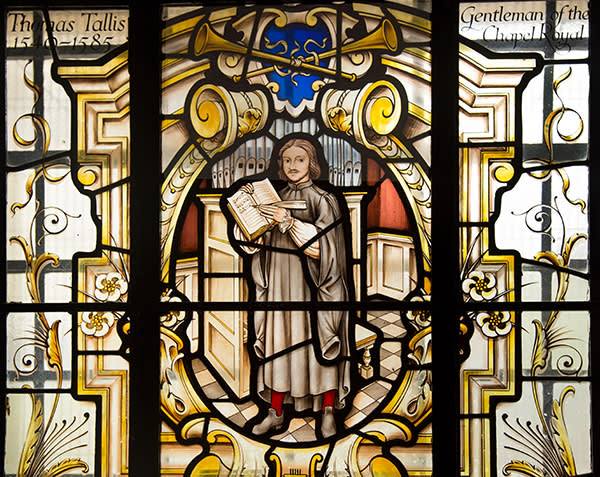
    A composer for all seasons: Tallis enshrined in glass at St. Alfege Church, Greenwich, London

Tag Cloud

Aaron Copland (92) Beethoven (95) Composer (114) Film Music (123) Film Score (143) Film Scores (255) Halloween (94) John Williams (187) KWAX (229) Leonard Bernstein (101) Marlboro Music Festival (125) Movie Music (138) Opera (202) Philadelphia Orchestra (89) Picture Perfect (174) Princeton Symphony Orchestra (106) Radio (87) Ralph Vaughan Williams (85) Ross Amico (244) Roy's Tie-Dye Sci-Fi Corner (290) The Classical Network (101) The Lost Chord (268) Vaughan Williams (103) WPRB (396) WWFM (881)

DON’T MISS A BEAT

Receive a weekly digest every Sunday at noon by signing up here


RECENT POSTS