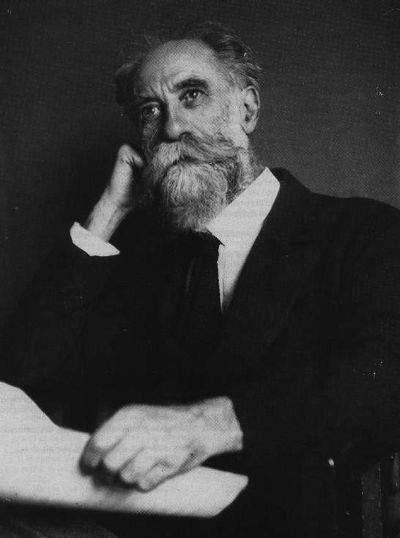
The recordings of his music shall be as numerous as the strands of his beard. This Thursday morning on WPRB, we’ll celebrate the sesquicentennial of Charles Koechlin.
Koechlin, the forgotten French composer who assisted Gabriel Fauré (his teacher) and Claude Debussy, was born on November 27, 1867. We’ll mark the anniversary in high style, with a five hour playlist of representative works – which won’t be easy, since Koechlin composed in such a wide variety of styles. His musical language encompassed impressionism, neo-classicism, polytonality, even quasi-serialism – occasionally within the same piece!
His life was like his music, with many diverse interests jostling for primacy – medieval music, Bach, travel, stereoscopic photography, sports, politics, pantheism, the movies. He was especially interested in early film stars. He wrote works in tribute to Ginger Rogers, Douglas Fairbanks, Charles Chaplin and especially Lillian Harvey (who he basically stalked). Another source of endless fascination was Rudyard Kipling’s “The Jungle Book,” which inspired a series of orchestral works that span most of Koechlin’s creative life.
For as much as he composed – he was very prolific – sadly, Koechlin has been relegated to a footnote in music histories, remembered, if at all, for his orchestrations for others, especially for Fauré’s “Pélleas and Mélisande” and Debussy’s “Khamma.” He also orchestrated Cole Porter’s ballet “Within the Quota.” (Porter was a Koechlin student.) In addition, he wrote a classic treatise on orchestration.
We’ll hear Koechlin’s “Seven Stars Symphony,” each movement inspired by luminaries of the silver screen, complete with ondes martenot, as well as his orchestration of Schubert’s “Wanderer Fantasy,” among other oddities.
Join me for music by the composer everyone forgot to remember, this Thursday morning from 6 to 11 EST, on WPRB 103.3 FM and wprb.com. We go kooky for Koechlin, on Classic Ross Amico.