Tag: WWFM

  • Liszt’s Diabolical Dances Temptation & Piano Fire

    Liszt’s Diabolical Dances Temptation & Piano Fire

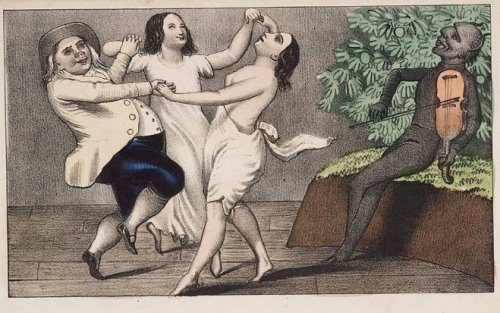
    Franz Liszt (1811-1886) was quite the complex personality. He was a devout Catholic his entire life, even taking minor orders and living in a monastery for a few years at middle age. However, as one of the performer-superstars of his youth, he was also frequently tempted by the pleasures of the flesh. And, as Oscar Wilde observed, “The only way to get rid of temptation is to yield to it.”

    Like many artists of the Romantic era, Liszt was consumed by the supernatural allure and philosophical wranglings of Goethe’s “Faust.” Perhaps something in the Faustian character appealed to him more than most. In his pursuit of loftier ideals, Liszt was certainly aware of his feet of clay. This Sunday night on “The Lost Chord,” we’ll examine the tension between striving artist and earthly pleasures through an hour of Liszt’s diabolical dances.

    We’ll sample from his “Mephisto Waltzes” (all except the first, which is so very well known); also, a “Mephisto Polka,” the “Czardas Macabre,” and a couple of operatic paraphrases, on “Robert le Diable” (treated as a “valse infernale”) and the waltz from Gounod’s “Faust.”

    Some of these are straight-ahead knuckle-busters, full of hair-raising keyboard acrobatics; others aim to gently unsettle, employing the interval of a tritone – known for centuries as “the devil in music” – or blurring into a kind of tonal ambiguity that foreshadows some of the experimental music of the 20th century.

    Liszt, a profound thinker and a grand provocateur, was always questing. That said, he seldom undersold the visceral thrill of a precipitous piano run or the simple pleasure of a good tune.

    Get ready to surrender to temptation with “A Fistful of Mephistos” – an hour diabolical dances by Franz Liszt, on his birthday – this Sunday night at 10:00 EDT, on WWFM – The Classical Network and wwfm.org.

  • Support Classical Music Radio & End Pledge Drives

    Support Classical Music Radio & End Pledge Drives

    For devotees of classical music radio, I understand that a pledge drive can seem a bit like the insurance salesman scene from “Take the Money and Run.”

    https://www.youtube.com/watch?v=Y-mg_NmKKRc

    Alas, membership drives are one of the realities of public radio. We rely on listeners in the community, people just like you, to keep us strong, so that we can go on presenting the most stimulating blend of basic repertoire, worthwhile arcana, and intriguing contemporary music we know how.

    The good news is, you can shorten our impending fall campaign by donating now. If we can raise $35,000 before Wednesday, WWFM will prune its on-air fundraising to just two days. Two days in the company of a bunch of hardened fundraisers? You know you can do that standing on your head.

    We’d be humbled to take your money and stay – on the air, that is. Please, consider making a commitment to keeping us solvent, so that we can all get back to enjoying the liberty of around-the-clock classical music.

    Celebrate 35 years of The Classical Network with your gift today. Simply head over to our website, wwfm.org, hit the big red “Hit 35K!” button, and fill out the form. It’s fairly quick and easy, and it will probably make you feel good. It’s always nice to know that you’ve made a difference.

    Two days in the company of your favorite radio hosts is a lot better than getting locked in the hot box with an insurance salesman. I hope. Thank you for supporting WWFM – The Classical Network!

  • Madness & Piano Movie Music on WWFM

    Madness & Piano Movie Music on WWFM

    This week on “Picture Perfect,” practice makes psychotic, as we listen to music from movies about madness and the piano.

    Laird Cregar plays an unhinged pianist-composer, who, whenever he hears a loud, discordant sound, is compelled to commit murder, in the 1945 film “Hangover Square.” Bernard Herrmann wrote the moody, romantic score, which includes a piano concerto, played by Cregar’s character during the film’s conflagration finale.

    Peter Lorre is an unstable musicologist who is haunted by the disembodied hand of a murdered pianist with a penchant for Brahms’ arrangement of Bach’s Chaconne, in “The Beast with Five Fingers,” from 1946. Max Steiner wrote the music. The piano is played on the film’s soundtrack by Victor Aller, the brother-in-law of Felix Slatkin, and therefore Leonard Slatkin’s uncle.

    Alan Alda plays a frustrated pianist who falls in with a ring of Satanists, in “The Mephisto Waltz” from 1971. This time, Jerry Goldsmith blends Franz Liszt with amplified instruments and electronics to memorably eerie effect. Five years later, Goldsmith would win his only Academy Award for his music to “The Omen.”

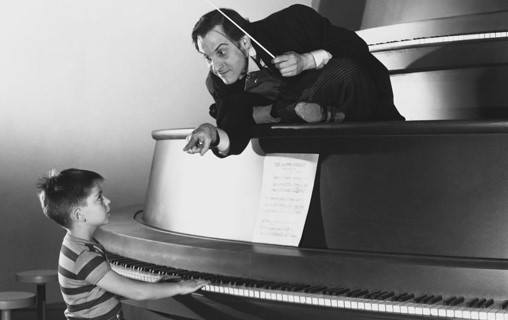
    Finally, Hans Conried plays a dictatorial pedagogue in “The 5000 Fingers of Dr. T,” released in 1953, which holds the distinction of being the only feature film written by Dr. Seuss. The film features outrageous production design (including a gargantuan keyboard for 500 enslaved boys) and whimsical songs.

    The composer was Frederick Hollander, born in London. Hollander came to fame in Germany as Friedrich Hollander. His best-known international success was with “The Blue Angel,” with Marlene Dietrich, who introduced his song, “Falling in Love Again. With the rise of the Nazis, Hollander fled to the United States, where he worked on over 100 films.

    It’s madness and the piano this week, on “Picture Perfect,” music for the movies, this Friday evening at 6:00 EDT, on WWFM – The Classical Network and wwfm.org.

  • Piffaro’s Sacred Winds on The Classical Network

    Piffaro’s Sacred Winds on The Classical Network

    My colleague, David Osenberg, decided he really wanted to do today’s Noontime Concert on The Classical Network. I’m up against a couple of writing deadlines, so that’s fine by me. Dave will welcome Joan Kimball and Robert Wiemken, artistic co-directors of Piffaro, The Renaissance Band. Together, they will introduce a program titled “Sacred Winds: Music for a Spanish Band.”

    Piffaro’s next series of concerts, featuring the award-winning chorus The Rose Ensemble, will take place Friday at 7:30 p.m. at Philadelphia Episcopal Cathedral, Saturday at 7:30 p.m. at Presbyterian Church of Chestnut Hill, and Sunday at 3 p.m. at Christ Church Christiana Hundred, Wilmington, DE. More information is available at piffaro.org.

    I’ll waltz in at around 2:00 today to share some new releases of music by Beethoven and Stephen Dodgson – composer (who, by the way, was a distant cousin of Lewis Carroll). Join Dave for Piffaro at noon, and yours truly from 2 to 4 p.m. EDT. We’ll have music from the Renaissance to the present, on WWFM – The Classical Network and wwfm.org.

  • Vaughan Williams & Sibelius Symphonies on WWFM

    Vaughan Williams & Sibelius Symphonies on WWFM

    Self-indulgence alert!

    This Monday afternoon, we’ll hear two symphonies: Ralph Vaughan Williams’ Symphony No. 8, with its striking use of percussion (no pun intended), and Jean Sibelius’ Symphony No. 6.

    The Vaughan Williams has been playing in my car pretty much incessantly since the composer’s birthday last Thursday. Beyond the “Sinfonia Antarctica” – the Symphony No. 7, with its programmatic associations with the film “Scott of the Antarctic” – we don’t really hear much of Vaughan Williams’ later symphonies. This one is a gem, with its tuned gongs and movement-long showcases for the wind and string sections. It also happens to be the shortest of Vaughan Williams’ symphonies, and, though marked by ambiguity, it seems not to slip into intimations of the unknown (i.e. death) in quite the same way as the Symphonies Nos. 6, 7 & 9 appear to do. That said, the third movement contains a theme that brings to mind the chorale “O Sacred Head, Now Wounded,” used in Bach’s “St. Matthew Passion.” Vaughan Williams wrote the work when he was in his early 80s, between 1953 and 1955.

    Sibelius’ 6th, completed in 1923, always puts me in an autumnal frame of mind, probably in part because of the composer’s suggested motto: “When shadows lengthen.” Sibelius described the work as “cold spring water;” no doubt an antidote to the contemporary “cocktails,” as he called them, being served up by Igor Stravinsky. It certainly opens with some of the composer’s most hypnotic and gorgeous music. Sibelius said of the work, “The sixth symphony always reminds me of the scent of first snow.” We all know winter comes early to Finland.

    We’ll also hear from Hungarian flutist and composer Franz Doppler, an associate of Franz Liszt; Bohemian Baroque master Jan Dismas Zelenka; contemporary Estonian composer Erkki-Sven Tüür; and Russian baritone Dmitri Hvorostovsky, on their birthdays. I hope you’ll join me for autumnal symphonies and more, from 4 to 7 p.m. EDT, on WWFM – The Classical Network and wwfm.org.


    Sardanapalus wants all his pleasures at once

Tag Cloud

Aaron Copland (92) Beethoven (95) Composer (114) Film Music (124) Film Score (143) Film Scores (255) Halloween (94) John Williams (188) KWAX (229) Leonard Bernstein (101) Marlboro Music Festival (125) Movie Music (139) Opera (202) Philadelphia Orchestra (89) Picture Perfect (174) Princeton Symphony Orchestra (106) Radio (87) Ralph Vaughan Williams (85) Ross Amico (244) Roy's Tie-Dye Sci-Fi Corner (290) The Classical Network (101) The Lost Chord (268) Vaughan Williams (103) WPRB (396) WWFM (881)

DON’T MISS A BEAT

Receive a weekly digest every Sunday at noon by signing up here


RECENT POSTS