Tag: WWFM

  • Passover Celebration on WWFM Today

    Passover Celebration on WWFM Today

    Pesach Sameach! Passover begins at sunset.

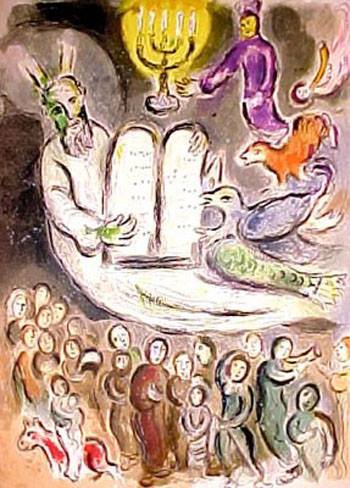
    Join me this afternoon, when among our featured works will be Mario Castelnuovo-Tedesco’s Violin Concerto No. 2, subtitled “The Prophets,” ballet music from Rossini’s “Moses,” and Wojciech Kilar’s “Exodus.”*

    We’ll also celebrate the birthdays today of conductor and composer Victor de Sabata, cellist and composer Auguste Franchomme, and pianist and composer Eugen d’Albert.

    Join me for an afternoon of unleavened entertainment, from 4 to 7 p.m. EDT, on WWFM – The Classical Network, and at wwfm.org.


    For more Passover music, join me tomorrow, immediately following the noontime concert (probably around 1:40 p.m.), for Paul Dessau’s oratorio “Haggadah shel Pesach.”

  • Song of Songs Solomon’s Love in Music

    Song of Songs Solomon’s Love in Music

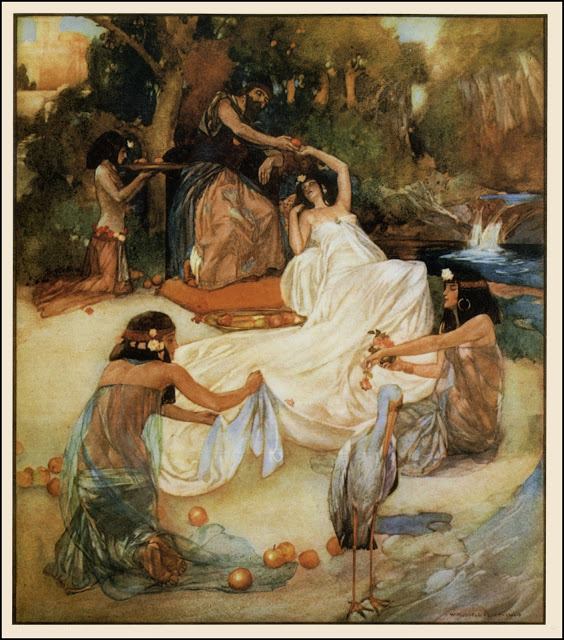
    The Song of Songs. Attributed to King Solomon, this Biblical book contains some of the most ardent poetry ever written. Whether it represents the communion of man and woman, or, as some would have it, something of a more allegorical nature – telling of the relationship, depending upon one’s system of belief, between God and Israel, between God and the Church, or between Christ and the human soul – over the centuries it has inspired some meltingly lovely music.

    Since it is customary to read from the Song of Songs as part of the observance of Passover, we’ll devote “The Lost Chord” this week, on the eve of Pesach, to two settings: one by Sir Granville Bantock – selections from his massive, 2 ½ hour oratorio – and one by Lukas Foss – a more intimate song cycle, in which divine and romantic love unite in understated metaphor.

    What if I told you your temples behind your veil are like the halves of a pomegranate? If you fall for that, there’s plenty more where that came from, on “King Solomon’s Lines,” this Sunday night at 10:00 EDT, on WWFM – The Classical Network and at wwfm.org.

  • TGIF Classical Music Weekend Starts Here

    TGIF Classical Music Weekend Starts Here

    TGIF! Make the transition to the weekend with music by Joseph Ryelandt, Domenico Dragonetti, Harald Saeverud, and Percy Faith, on their birthdays. In addition, we’ll hear pianists/birthday celebrants Robert Casadesus and Leif Ove Andsnes play Chabrier and Grieg, respectively.

    That’s got to be at least two hours, right there.

    Then stick around for “Picture Perfect” and a definitive survey of Elmer Bernstein’s music for Cecil B. DeMille’s “The Ten Commandments.” We’ll be sampling from an exhaustive 6-CD set, released on the Intrada label, in honor of the film’s 60th anniversary.

    I’ll be there, enjoying the music right along with you, this Friday afternoon at 4:00 EDT. “Picture Perfect” begins at 6, on WWFM – The Classical Network and wwfm.org.

  • Yardumian Centennial Philadelphia Composer

    Yardumian Centennial Philadelphia Composer

    Today is the 100th anniversary of the birth of Philadelphia composer Richard Yardumian. Yardumian served as The Philadelphia Orchestra’s composer-in-residence from 1949 to 1964. The orchestra gave first performances of no less than ten of his pieces, beginning with “Desolate City” in 1945. Eugene Ormandy recorded six of them. I remember well playing these during my apprentice years in community radio. The music is attractive, well-made, and often deeply felt, with insights into the composer’s spiritual convictions and Armenian heritage. Why, why, why, Sony, have you never reissued these recordings?

    In the 1990s, Albany Records briefly revived some of the lesser-known American classics that had been championed by Ormandy – among them, works by the equally neglected Louis Gesensway and John Vincent – so my hopes were high to finally acquire those Yardumian recordings on CD. But it was not to be. The series petered out after only three volumes.

    Yardumian, who was largely self-taught as a composer, was 19 when he wrote his most popular piece, the “Armenian Suite.” We’ll hear it this afternoon, alongside “Veni Sancte Spiritus” (“Come, Creator Spirit”), another orchestral work, from 1959. In addition, we’ll mark the birthday anniversaries of composers Louis Spohr and Albert Roussel and conductor Herbert von Karajan.

    At 4:00, I will be joined by Lyn Ransom, founder and music director of VOICES Chorale, now in its 30th season. Ransom will be directing Brahms’ “Ein Deutsches Requiem” in its rarely-heard London edition, performed on four-hand piano, this Saturday at 7:30 p.m., at The College of New Jersey’s TCNJ-Mayo Concert Hall in Ewing Township; and then again, with orchestra, in collaboration with Riverside Symphonia, at Princeton University’s Richardson Auditorium, on June 16th at 8 p.m. Tune in this afternoon to learn more, or check the organization’s website, at http://www.voiceschorale.org.

    I’ll be sharing the music, from 4 to 7 p.m. EDT, on WWFM – The Classical Network and at wwfm.org.

  • Grieg’s Peer Gynt Plus Norwegian Gems on WWFM

    Grieg’s Peer Gynt Plus Norwegian Gems on WWFM

    This Tuesday morning at 10:00, Alice Weiss will host “The Classical Network in Concert,” featuring cellist Gabriel Cabezas, winner of the 2014 Astral Artists National Auditions. On the program will be major works for the instrument by Britten and Shostakovich, as well as transcriptions performed in association with other Astral Artists.

    On account of the earlier broadcast, there will be no noontime concert today, leaving me with a blank canvas on which to paint for the succeeding four hours. Since I’m on earlier in the afternoon on Tuesday, I like to play at least one piece that you generally wouldn’t hear during the day, due to its extraordinary length. Today, I will be dusting off a recording of the complete incidental music composed for the premiere production in 1876 of Henrik Ibsen’s “Peer Gynt,” by Edvard Grieg. I think you’ll be surprised by just how much beauty, mystery, and menace never made it into the popular suites. You’ll also have a chance to brush up on your Norwegian!

    Astonishingly, Grieg found work on the music to be a frustrating experience. He thought it a “terribly unmanageable subject,” and labored against the limitations imposed on him by the management of the theater, which gave him specifications for the duration of each number. “I was thus compelled to do patchwork,” he complained, “hence the brevity of the pieces.”

    Of course, the music was a triumphant success and includes some of Grieg’s best known melodies. However, the original score was not published until after the composer’s death, and is still rarely heard in its entirety.

    As an added bonus this afternoon, we’ll also hear one of the Hardanger fiddle concerts of Norwegian composer Geirr Tveitt. Tveitt, a late proponent of Norwegian nationalism, suffered a terrible loss from which he never emotionally recovered. In 1970, his farmhouse burned to the ground, reducing approximately 300 of his manuscripts – fully four-fifths of his compositional output – to ash. Tveitt, a broken man, drank himself to death, little realizing that, through private recordings, radio archives, and surviving orchestral parts, a sizable portion of these works would eventually be reconstructed.

    Join me today, from noon to 4 p.m. EDT, for music from Norway and more, on WWFM – The Classical Network and at wwfm.org.
Tag Cloud

Aaron Copland (92) Beethoven (95) Composer (114) Film Music (124) Film Score (143) Film Scores (255) Halloween (94) John Williams (188) KWAX (229) Leonard Bernstein (101) Marlboro Music Festival (125) Movie Music (139) Opera (202) Philadelphia Orchestra (89) Picture Perfect (174) Princeton Symphony Orchestra (106) Radio (87) Ralph Vaughan Williams (85) Ross Amico (244) Roy's Tie-Dye Sci-Fi Corner (290) The Classical Network (101) The Lost Chord (268) Vaughan Williams (103) WPRB (396) WWFM (881)

DON’T MISS A BEAT

Receive a weekly digest every Sunday at noon by signing up here


RECENT POSTS