Tag: WWFM

  • Classical Music Jukebox WWFM Procrastinators Amnesty

    Classical Music Jukebox WWFM Procrastinators Amnesty

    Coming up! Music by Dmitri Shostakovich, Domenico Scarlatti, Johan Helmich Roman, Benjamin Britten, Franz Lehar, Ralph Vaughan Williams, Bedrich Smetana, and more.

    Put another dime in the jukebox, baby! I’ll be spinning the platters for the next three hours to help elicit your support, as we continue with our Procrastinator’s Amnesty Membership Drive, from 4 to 7 p.m. EDT, on WWFM – The Classical Network and at wwfm.org.

    Thanks for donating online, or calling us at 1-888-232-1212!

  • Copland’s Appalachian Spring on The Classical Network

    Copland’s Appalachian Spring on The Classical Network

    It’s an aseasonal treat this afternoon, as WWFM concludes its binge festival of “What Makes It Great.” Rob Kapilow will deconstruct Aaron Copland’s “Appalachian Spring,” followed by an uninterrupted performance of the piece, which was recorded in April at Merkin Concert Hall at Kaufman Music Center in New York City.

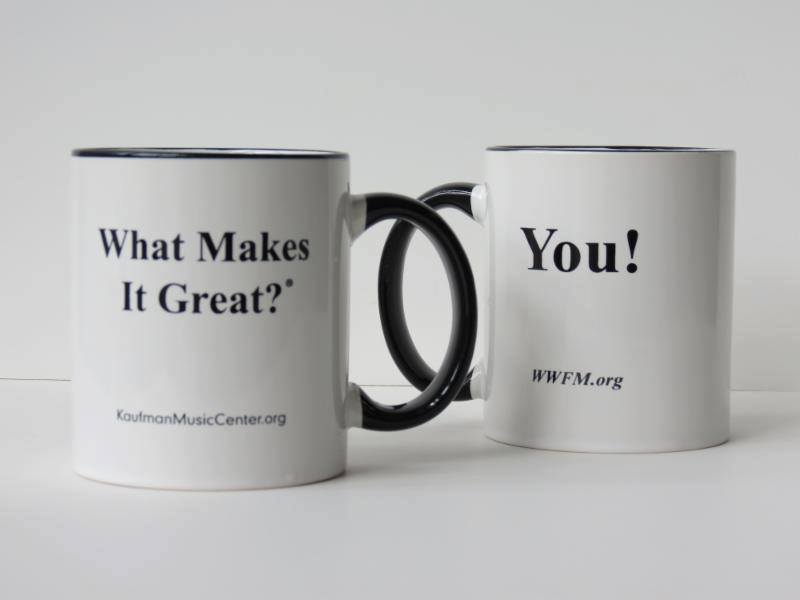
    “What Makes It Great” concludes its binge run today, beginning at 12:00 EDT. Enjoy the upcoming season as a member of The Classical Network. For a donation of $75, we will send you the “What Makes It Great” mug. On one side is the name of the show, “What Makes It Great,” and on the reverse is the answer, “You!” In fact, we’d be happy to send you the mug for your commitment to become a sustaining member of The Classical Network in the amount of $5 a month – that’s a savings of $15! Put it toward the beverage of your choice.

    Of course, what you’re really paying for is all the great music that comes your way each and every day on The Classical Network, including that heard on “Picture Perfect,” “The Lost Chord,” and my recently instated afternoon live air shifts. Be sure to mention how much you enjoy these in the comments section when you make your donation at wwfm.org. Your commitment now could shorten our live membership campaign, which will begin on the morrow. The sooner we reach our goal, the sooner we’ll get back to presenting uninterrupted music.

    Stick around: following Rob’s informative analysis of “Appalachian Spring,” and its exemplary performance, we’ll enjoy a late romantic symphony by Ukrainian composer Boris Lyatoshynsky. I’ll be with you until 4:00, on WWFM – The Classical Network and at wwfm.org.

  • Fanelli The Mummy & Debussy’s Debt

    Fanelli The Mummy & Debussy’s Debt

    Ernest Fanelli is one of those poor, unsung prophets of music history who wrote works brimming with colorful ideas, expressed well ahead of their time, but were unappreciated, unnoticed, or fell short of their potential, only to have later masters capitalize, either wittingly or unwittingly, on their innovations.

    In the case of Fanelli, there is a very good chance his unpublished manuscripts fueled the imagination of Claude Debussy, who in turn influenced the course of not only French music but of broader musical thinking. That’s not to say that Fanelli was of the same caliber of Debussy, but like Hans Rott, whose lone symphony clearly influenced Mahler, he is a forgotten, though essential footnote in the history of a new kind of music.

    In particular, episodes from “The Romance of the Mummy” anticipate not only Debussy and Ravel, but also Paul Dukas and Florent Schmitt, Holst, Sibelius, Respighi, Richard Strauss and even Stravinsky, a figure Fanelli would not have known. That’s not to say all of these composers were familiar with Fanelli’s work – in many cases, it’s simply a matter of music history finally catching up – but Debussy most probably was. Once his music was finally given a public hearing, Debussy did his best to distance himself from Fanelli. Debussy was even known to have done an about-face if he happened to walk into a café and saw Fanelli sitting at the piano.

    Fanelli lived from 1860 to 1917. A French composer of Italian descent, he studied at the Paris Conservatory for a stint – allegedly under Charles-Valentin Alkan (although it’s unlikely, since Alkan had already quit the Conservatory by the time he entered). Later, he returned to study under Léo Delibes. Fanelli was unable to complete either course, due to lack of funds. In the meantime, he eked out a career as a percussionist.

    He was seeking employment as a copyist in 1912, when he showed Gabriel Pierné an example of his handwriting from one of his unpublished manuscripts, written some 30 years earlier. Pierné was so taken by the music itself that he arranged for its belated premiere.

    “The Romance of the Mummy,” based on a novel by Théophile Gautier, tells the tale of an English archaeologist, who exhumes and falls in love with – well, a mummy. Papyrus roles in her mausoleum reveal her back-story and fate. She is Tahoser, who falls in love of Poeri, a handsome Hebrew. The Pharaoh (unnamed, though it would have been Ramses II) has his sights set on Tahoser himself. However, the lovely young woman falls ill when she finds Poeri is in love with Rachel. She is healed by the prophet Moses, who initiates her into the cult of Jehovah. Pharaoh becomes an enemy of the Jewish people. He abducts Tahoser. When he dies in the Red Sea, in circumstances described in the Book of Exodus, Tahoser is crowned Queen of Egypt. Hence, her presence in the pharaoh’s tomb.

    The first set of tableaux is titled “Thebes,” and is made up of the subsections “Before Tehoser’s Palace,” “On the Nile,” and “Triumphal Return of the Pharaoh.”

    It was the conductor Adriano who discovered a second set of tableaux in the music library of Radio France, titled “Festivities in the Pharaoh’s Palace.” The three subsections of the second set are called “In a Room in the Palace – The Naked Jugglers,” “Grotesque Dance of the Egyptian Jesters,” and “Triumphant Hymns – Orgy.” The music received its first performance in the recording we’ll hear tonight, on “The Lost Chord,” a 2002 release, on the Marco Polo label.

    By the time the first set was performed publicly, the composer had already stopped writing music for 18 years. Poor Ernest Fanelli. He is a forgotten pioneer – though undoubtedly others took his innovations to greater heights.

    I hope you’ll join me for “Mummy Dearest” – Ernest Fanelli’s “The Romance of the Mummy” – this Sunday night at 10 EDT, on WWFM – The Classical Network and at wwfm.org.

  • Binge “What Makes It Great” on WWFM

    Binge “What Makes It Great” on WWFM

    It’s GRRRRRRRRRRRRRREAT!

    As part of Fall Membership Month, WWFM is offering the opportunity to binge listen to its popular program “What Makes It Great” through next Tuesday. Tune in today to hear Robert Kapilow deconstruct Robert Schumann’s Piano Quintet in E-flat, as only Rob knows how to do. That will be followed by a complete performance of the piece by pianist Igal Kesselman and the Aeolus Quartet. The show was recorded live in Merkin Concert Hall at Kaufman Music Center in New York City last December.

    Enjoy “What Makes It Great” every weekday at 12:00 EDT (with the exception of Thursday, when it will be heard at 2 p.m.), through next Tuesday. What makes it great? Why, you do, with your pledge of support in any amount. For $75, we will send you a “What Makes It Great” coffee mug. You don’t have to be a coffee lover to enjoy it. I’m a tea-drinker myself; and who doesn’t crave a mug of soup on a crisp afternoon? We’ll also send it your way if you commit to a sustaining membership in the amount of $5 a month – that’s a savings of $15!

    Of course, what you’re really paying for is all the great music that comes your way each and every day on The Classical Network, including that heard on “Picture Perfect,” “The Lost Chord,” and my recently instated afternoon live air shifts. Be sure to mention how much you enjoy these in the comments section when you make your pledge at wwfm.org. Your pledge now could shorten or even negate the need for a live membership campaign. The sooner we reach our goal, the sooner we get back to presenting uninterrupted music.

    Stick around! Following Rob’s informative analysis of Schumann’s quintet, and its exemplary performance, we’ll enjoy, among other things, one of the most grandiose of Richard Strauss’ confessional tone poems, “Ein Heldenleben” (“A Hero’s Life”). I’ll be with you until 4:00, on WWFM – The Classical Network and at wwfm.org.

    And as always, thank you for your support!

  • WWFM Today Strauss & Concordia Concerts

    WWFM Today Strauss & Concordia Concerts

    Immediately following today’s installment of “What Makes It Great,” it’s Richard Strauss’ “Ein Heldenleben” (“A Hero’s Life”), in an acclaimed recording that, to my knowledge, has never been played on this station, with Semyon Bychkov and the West German Radio Orchestra.

    Coming up at 4:00 EDT, stay tuned for a special concert presented by Concordia Chamber Players. The broadcast will feature Mozart’s Clarinet Quintet in A major, K. 581, and Beethoven’s String Quintet in C major, Op. 29. Concordia’s next concert will take place this Sunday at Trinity Episcopal Church, Solebury, PA, (outside New Hope) at 3 p.m. The program will include works by E.J. Moeran, Bohuslav Martinu and Sir William Walton. Find out more at concordiaplayers.org.

    I’ll be with you until 4 today. Keep listening to WWFM – The Classical Network, and pledge your support at wwfm.org. Thanks!

Tag Cloud

Aaron Copland (92) Beethoven (95) Composer (114) Film Music (123) Film Score (143) Film Scores (255) Halloween (94) John Williams (187) KWAX (229) Leonard Bernstein (101) Marlboro Music Festival (125) Movie Music (138) Opera (202) Philadelphia Orchestra (89) Picture Perfect (174) Princeton Symphony Orchestra (106) Radio (87) Ralph Vaughan Williams (85) Ross Amico (244) Roy's Tie-Dye Sci-Fi Corner (290) The Classical Network (101) The Lost Chord (268) Vaughan Williams (103) WPRB (396) WWFM (881)

DON’T MISS A BEAT

Receive a weekly digest every Sunday at noon by signing up here


RECENT POSTS