Tag: WWFM

  • MLK Day Music Inspired by King’s Words

    MLK Day Music Inspired by King’s Words

    “You don’t have to see the whole staircase. Just take the first step.”

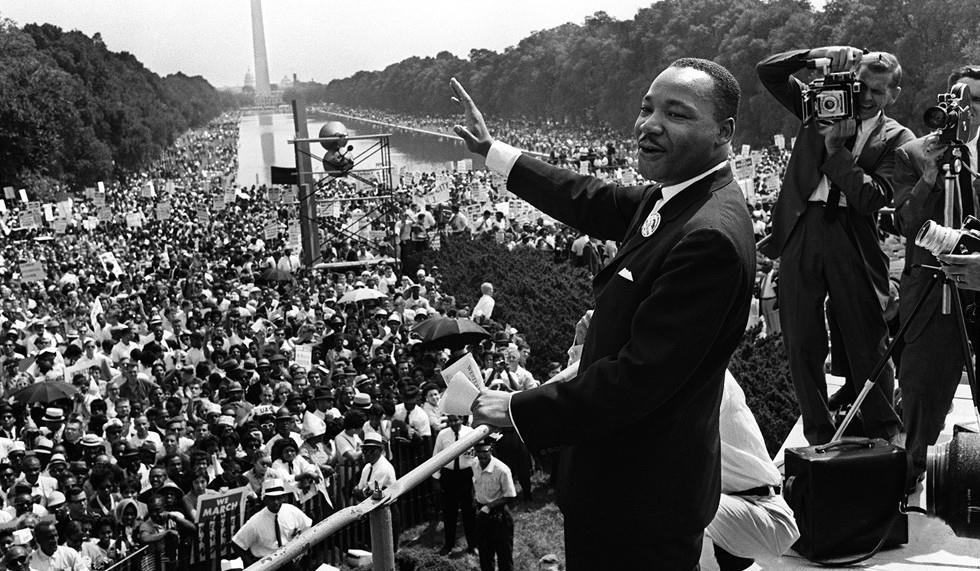
    So said Dr. Martin Luther King, Jr. On this MLK Day, we’ll hear at least two works inspired by King’s speeches.

    “New Morning for the World: Daybreak of Freedom,” by the Pulitzer Prize winner Joseph Schwantner, has become something of a contemporary classic. My preferred performance of the piece is from an out-of-print LP, featuring narration by former Pittsburgh Pirate Willie Stargell. However, last year I played a digital recording, with Raymond Bazemore and the Oregon Symphony conducted by James DePreist. This year, I thought we’d give a try to Vernon E. Jordan, Jr., and the National Symphony Orchestra conducted by Leonard Slatkin. You’ll be able to hear it in this afternoon in the 4:00 hour.

    Then at 6:00, I’ll be sharing a recording of Adolphus Hailstork’s inspiring oratorio “Done Made My Vow,” which also incorporates texts from King’s speeches, with the Baltimore Symphony Orchestra and Morgan State University Choir.

    In between, we’ll mark the birthday anniversaries of Placido Domingo, Henri Duparc, Nikolai Golovanov, Antonio Janigro, and Alexander Tcherepnin.

    The music is King, on this MLK Day, from 4 to 7 p.m. EST, on WWFM – The Classical Network and wwfm.org.

  • Medieval Bestiary Music on The Classical Network

    Medieval Bestiary Music on The Classical Network

    In the Middle Ages, a bestiary was a collection of descriptions and stories about animals, ranging from the mundane to the fantastical, from which moral and theological lessons were gleaned from the natural world. The symbols of the bestiary were likewise absorbed into the conventions of courtly love.

    On today’s Noontime Concert on The Classical Network, the ensemble Marginalia will present “The Book of Beasts: A Medieval Bestiary,” musical evocations of the lion, the panther, the unicorn, the elephant, the phoenix, the pelican, and the dragon, from medieval sources.

    The program, part of a free midday concert series presented by Gotham Early Music Scene (or GEMS), was given at Saint Bartholomew’s Church, 50th Street and Park Avenue, in New York City. Free concerts are held there every Thursday at 1:15 p.m.

    Following the broadcast, stick around, as we’ll continue with an afternoon of zoological and cryptozoological wonders, including Peter Schickele’s “Bestiary,” Jennifer Higdon’s “An Exaltation of Larks,” Lucas Richman: Conductor/Composer’s “Behold the Bold Umbrellaphant” – and, okay, Camille Saint-Saëns’ “The Carnival of the Animals,” among others.

    Take a walk on the wild side, this afternoon from 12 to 4:00 EST, on WWFM – The Classical Network and wwfm.org.

  • Remembering Henry Varlack Sleepers Awake

    Remembering Henry Varlack Sleepers Awake

    I mentioned Henry Varlack today in an earlier post. Varlack was host of “Sleepers Awake,” the overnight show on WFLN in Philadelphia.

    He was also probably my favorite radio announcer. I mean, I loved Dave Conant’s resonance, and I enjoyed listening to Bill Shedden, Terry Peyton, and the rest, but there was something about Varlack’s unconventional timbre and the fact that the guy was on from midnight to 6:00 every night that kind of endeared him to me. Many were the times that the side of a record would run out and you could hear the stylus bumping around, wearing a groove at the end. I’d call him up later, and Varlack would apologize, admitting that he was in the bathroom and he’d miscalculated the time. He may even have fallen asleep once or twice.

    Not incidentally, he also happened to play some of my favorite music in those days, and introduced me to a number of pieces I’d never heard: Alan Hovhaness’ “And God Created Great Whales,” Morton Subotnik’s “Silver Apples of the Moon,” and Robert Schumann’s incidental music to “Manfred,” selections from which I’ll be airing tonight at 10:00 EST on “The Lost Chord,” on WWFM – The Classical Network and wwfm.org. Such was Varlack’s influence.

    I’d never met Varlack in person, when he was described to me by a former WFLN engineer as looking like a black Santa Claus. Our paths eventually crossed at a remote broadcast, and finally, after all those late night phone calls, I was able to shake his hand.

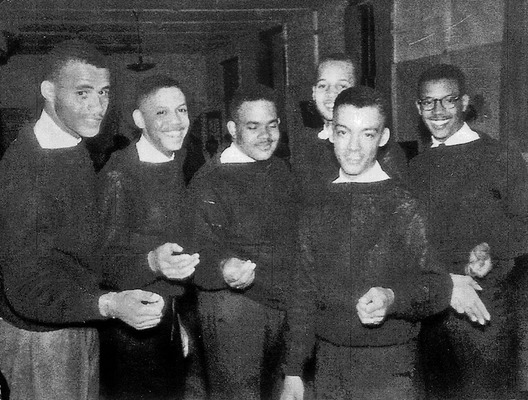
    Trying to find a photo of Varlack online is not an easy matter, since those were the days before social media, but I did find this very interesting picture of him singing in a Doo-Wop group called the Blend-Tones! Varlack is the one in the center, with his eyes closed. When he wasn’t spinning the vinyl, Varlack was also a baseball scout for the Chicago White Sox.

    He impressed me as a very interesting man, and a good-natured one, totally without pretense. I still think of him whenever I hear Gabriel Fauré’s “Pavane,” his signature music for “Sleepers Awake.” Varlack died in 2006 at the age of 65.


    Listen to some of the Blend-Tones’ records here:

    http://doo-wop.blogg.org/blend-tones-c26505866

    Gabriel Fauré’s “Pavane:”

  • John Joubert Remembered on WWFM

    John Joubert Remembered on WWFM

    South African-born British composer John Joubert died on Monday at the age of 91. We’ll lead off the 5:00 hour (EST) remembering him with a performance of his Symphony No. 1 of 1955.

    We’ll also hear some “Variations on a Theme of Handel” (from “Messiah”) by the Argentinean composer Luis Gianneo, whose birthday it is today, and one of Handel’s own concerti grossi.

    Don’t forget, coming up at 6:00, it’s another “Music from Marlboro” – chamber music by György Ligeti and Ernő Dohnányi, from the legendary Marlboro Music Festival.

    It’s all yet to come, between now and 7:00 EST, on WWFM – The Classical Network and wwfm.org.

  • Hungary’s Forgotten Composers: Dohnányi & Ligeti

    Hungary’s Forgotten Composers: Dohnányi & Ligeti

    When it comes to the whole Hungarian nationalist movement, Béla Bartók and Zoltán Kodály would get all the glory. Sure, they did a lot of the legwork, heading out into the field in a race against time to document authentic folk traditions before they were swept away by industrialization. But as director of the Budapest Academy of Music and music director of the Budapest Philharmonic Orchestra, Ernő Dohnányi (1877-1960) would exert as much influence over his country’s musical development as that of his folk music mad friends and contemporaries.

    On the next “Music from Marlboro,” we’ll give Dohnányi his due. We’ll also hear music by György Ligeti, a composer who survived several totalitarian regimes to become one of the leading composers of the second half of the 20th century.

    Dohnányi himself would become the target of character assassination campaigns following World War II. Painted as a Nazi sympathizer by his enemies, he would be investigated and cleared by the U.S. Military Government several times. He has since been defended as a forgotten hero of Holocaust resistance. It was through Dohnányi’s administrations that countless Jewish musicians survived. Also, between the wars, he went to bat for Kodály, a leftist, by refusing to fire him from the Budapest Academy. As a result, Dohnányi too lost his position, although he was later reinstated. Nevertheless, he continued to be eyed with suspicion, and his reputation never fully recovered.

    Equally fatal is the fact that much of his music bears a more cosmopolitan stamp than that of the more blatantly “Hungarian” output of his peers. His composition teacher, the German-born Hans von Koessler (known in Hungary as János Koessler) was a cousin of Max Reger. Of course, Koessler also taught Bartók and Kodály. But Dohnányi was perfectly happy nestled in the world of Brahms. For his international career, he adopted the name Ernst von Dohnányi.

    Dohnányi’s Piano Quintet in C minor, completed in June of 1895, one month before his 18th birthday, earned Brahms’ stamp of approval. We’ll hear it performed at the 1977 Marlboro Music Festival, by pianist Stephanie Brown, violinists Joseph Genualdi and Mayuki Fukuhara, violist Philipp Naegele, and cellist Lisa Lancaster.

    György Ligeti (1923-2006) was born in Transylvania. If anything, his hardships proved even more severe: most of his family was wiped out in the Holocaust, he was conscripted into a forced labor brigade, and he lived for a time under strict communist rule. He survived the violent Soviet putdown of the Hungarian Revolution, and finally escaped with his on-again/off-again wife in a pair of mail sacks, leaping off a night train and crawling for miles through the mud to find safety in Vienna.

    Ligeti was that rare bird: an avant-garde composer whose music could actually inspire affection. He rocketed to broader fame when some of his works were used, without permission, in Stanley Kubrick’s “2001: A Space Odyssey.”

    The first of Ligeti’s three string quartets, subtitled “Métamorphoses nocturnes,” was written in 1953-54, prior to his flight from Hungary. The work was heavily influenced by Bartók; the composer György Kurtág memorably described it as “Bartók’s seventh string quartet.” Ligeti himself characterized that phase of his career as “prehistoric.” Although performances of Bartók’s quartets were banned under the communist regime, Ligeti was familiar with them through the study of their scores.

    Ligeti’s quartet is cast in one continuous movement, but subdivided into seventeen contrasting sections. We’ll hear it performed at the 1996 Marlboro Music Festival by violinists Soovin Kim and Catherine Cho, violist Kirsten Johnson, and cellist Siegfried Palm.

    That’s two contrasting works by Hungarian composers buffeted by war and politics, on the next “Music from Marlboro,” this Wednesday evening at 6:00 EST, on WWFM – The Classical Network.

    Marlboro School of Music and Festival: Official Page


    “I am in a prison: one wall is the avant-garde, the other wall is the past, and I want to escape.” – György Ligeti
Tag Cloud

Aaron Copland (93) Beethoven (95) Composer (114) Film Music (124) Film Score (143) Film Scores (255) Halloween (94) John Williams (188) KWAX (229) Leonard Bernstein (101) Marlboro Music Festival (125) Movie Music (139) Opera (202) Philadelphia Orchestra (89) Picture Perfect (174) Princeton Symphony Orchestra (106) Radio (87) Ralph Vaughan Williams (85) Ross Amico (244) Roy's Tie-Dye Sci-Fi Corner (290) The Classical Network (101) The Lost Chord (268) Vaughan Williams (103) WPRB (396) WWFM (881)

DON’T MISS A BEAT

Receive a weekly digest every Sunday at noon by signing up here


RECENT POSTS