Category: The Lost Chord
-

Laugh in the New Year with Gerard Hoffnung
It’s been quite a year, hasn’t it? Well, 2026 can only be better. Right? RIGHT?
In any case, it’s been said that laughter is the best medicine. Therefore, this week on “The Lost Chord,” we’ll do our best to laugh in the New Year with highlights from the notorious and uproarious Hoffnung Music Festival concerts.
Gerard Hoffnung was a boy when his family arrived in London, refugees from Nazi Germany. In his new home, he cultivated the persona of an English gentleman, though one with a decidedly impish bent. He attained celebrity through his work as a cartoonist, a sparkling panelist, and a public speaker. He was lauded as a brilliant improviser with a dry wit and a masterly sense of timing. He also played the tuba well enough that he was able to tackle the Vaughan Williams concerto.
Following a successful April Fool’s concert in 1956, Hoffnung embarked on the enterprise which, alongside his cartooning, ensured a kind of immortality – the first of the Hoffnung Music Festival concerts. The concerts brought together representatives of England’s finest musical talent to lampoon what, especially at the time, might have been perceived as a rather stodgy art form.
There would be three Hoffnung concerts in all. Alas, the third was presented posthumously. Hoffnung collapsed at his home in 1959, and died of a cerebral hemorrhage three days later, at the age of only 34. An untimely finish for a character who seemed his entire life to be a brilliant, fully-developed, middle-aged man, always at the peak of his form.
I hope you’ll join me as we celebrate Hoffnung’s whimsical legacy. We’ll hear Sir Malcolm Arnold’s “A Grand, Grand Overture,” for orchestra, organ, electric floor polisher, and three vacuum cleaners – the work was dedicated to President HOOVER – and Franz Reizenstein’s “Concerto populare,” billed as “a piano concerto to end all piano concertos,” among others.
It’s a lighthearted playlist calculated to put a smile on your face and lend a boost to your spirits – to say nothing of your immune system. He who laughs last laughs best. So “Have a Ball,” on “The Lost Chord,” now in syndication on KWAX Classical Oregon!
——–
Clip and save the start times for all three of my recorded shows:
PICTURE PERFECT, the movie music show – Friday at 8:00 PM EST/5:00 PM PST
SWEETNESS AND LIGHT, the light music program – Saturday at 11:00 AM EST/8:00 AM PST
THE LOST CHORD, unusual and neglected rep – Saturday at 7:00 PM EST/4:00 PM PST
Stream them, wherever you are, at the link!
https://kwax.uoregon.edu -
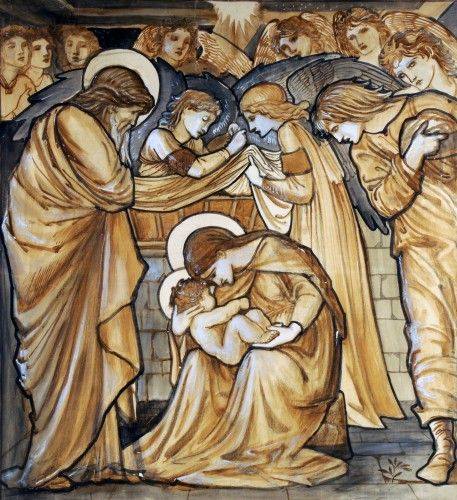
English Nativity Plays on “The Lost Chord”
With Christmas only days away, there’s still much to be done. Even so, this week on “The Lost Chord,” we pause to remember the story of the first Christmas, with music by a couple of English composers inspired by the Nativity.
Alongside Sir Charles Villiers Stanford and Sir Edward Elgar, Sir Hubert Parry was one of the key figures of the so-called “English Musical Renaissance.” He influenced a whole generation of much better-known composers, including Ralph Vaughan Williams and Gustav Holst. We’ll hear his “Ode on the Nativity,” given its first performance on the same concert, at the Hereford Three Choirs Festival in 1912, as Vaughan Williams’ “Fantasia on Christmas Carols.”
Vaughan Williams, the great-nephew of Charles Darwin, and an atheist in his youth, later softened into a kind of “cheerful agnosticism.” He dearly loved the King James Bible, and he especially enjoyed Christmas. Of course, he wrote much music on the subject. In fact, his very last composition was “The First Nowell.” He worked diligently at the piece, inspired by medieval pageants, during his final month, but died suddenly before its completion.
However, even at 85 years-old, RVW retained a remarkable concentration. He managed to pound out the whole thing in short score in only a few weeks. Furthermore, he had fully orchestrated the first two-thirds. The finishing touches were applied by his assistant, Roy Douglas – he of “Les Sylphides” fame.
If you like the “Fantasia on Christmas Carols,” I think you’ll really enjoy this. It’s pastoral music for a pastoral scene. Join me for “A Play in a Manger,” on “The Lost Chord,” now in syndication on KWAX Classical Oregon!
——–
Clip and save the start times for all three of my recorded shows:
PICTURE PERFECT, the movie music show – Friday at 8:00 PM EST/5:00 PM PST
SWEETNESS AND LIGHT, the light music program – Saturday at 11:00 AM EST/8:00 AM PST
THE LOST CHORD, unusual and neglected rep – Saturday at 7:00 PM EST/4:00 PM PST
Stream them, wherever you are, at the link!
https://kwax.uoregon.edu -

It’s the Holidays! Take Time to Smell the Roses on “The Lost Chord”
This week on “The Lost Chord,” we present a Christmas bouquet of sorts.
Hugo Distler’s “Die Weihnachtsgeschichte” (“The Christmas Story”), from 1933, is an otherworldly, a cappella masterpiece, punctuated by seven variations on the carol “Es ist ein Ros entsprungen” (“Lo, how a Rose e’er blooming”). Over the course of some 40 minutes, the work reinvents the Baroque Christmas cantata, after the manner of Heinrich Schütz, and does so quite beautifully, conjuring the calm and quiet of a bygone era. The composer described the piece as “an oratorio with chamber music character.”
Unfortunately, Distler’s life proved anything but calm. A man of conscience, he yet remained in Nazi Germany. He joined the Party with reluctance, when he realized his employment at the Lübeck Conservatory hinged on his doing so. Nevertheless, it did not smooth his path. The war separated him from his family, robbed him of many of his friends, and battered his psyche with nerve-wracking aerial assaults. Job pressures and fear of being conscripted into the German army further contributed to his anxiety.
Furthermore, his devotion to sacred music put him at odds with the authorities, who were intent on twisting the Lutheran Church to its own ends. The Nazis wound up branding Distler’s works “entartete,” or “degenerate.” Unable to reconcile the irreconcilable – serving both God and the Nazis – one day he pushed his bed into the kitchen and turned on the gas, committing suicide in 1942. He was 34 years-old.
Emil Waldteufel, by contrast, enjoyed much success and happiness. Although he was nearly 40 by the time he achieved international fame, his waltzes had long been a mainstay of Paris society during the Second Empire. It was the Prince of Wales – the future King Edward VII – who introduced him to London, where his music came to dominate Queen Victoria’s state balls at Buckingham Palace. One of his best-known works, “Les Patineurs” (“The Skaters’ Waltz”) was introduced there in 1882.
For our purposes, we’ll round out the hour with one of Waldteufel’s most successful waltzes from the other end of the decade, “Roses de Noël.”
The holidays are in bloom this week. I hope you’ll join me for “Christmas Roses,” on “The Lost Chord,” now in syndication on KWAX Classical Oregon!
——–
Clip and save the start times for all three of my recorded shows:
PICTURE PERFECT, the movie music show – Friday at 8:00 PM EST/5:00 PM PST
SWEETNESS AND LIGHT, the light music program – Saturday at 11:00 AM EST/8:00 AM PST
THE LOST CHORD, unusual and neglected rep – Saturday at 7:00 PM EST/4:00 PM PST
Stream them, wherever you are, at the link!
https://kwax.uoregon.edu/ -

Vintage Sibelius on “The Lost Chord”
I have no hesitation in ranking Jean Sibelius as one of my top two favorite composers. He and Vaughan Williams pretty much run a three-legged race. Sibelius was born on December 8, 1865. This week on “The Lost Chord,” we’ll anticipate his 160th birthday with an hour of early recordings of his music.
Robert Kajanus was Sibelius’ good friend, a sometimes rival, and often a drinking buddy. The duo was captured during one of their infamous binges in a painting by the artist Akseli Gallén-Kallela (pictured). Kajanus set down first recordings of a number of Sibelius’ major works, including the underappreciated Symphony No. 3, which we’ll hear in a 1932 performance, with the London Symphony Orchestra.
As a personal aside, it was actually this recording that served as an introduction for me to the composers’ grandson. For a number of years, I owned a second-hand book business in Philadelphia. I suppose it’s hardly surprising that if anyone ventured into the shop there would be probably an 8-in-10 chance that I would be playing Sibelius.
Well, on this particular occasion, the composer’s grandson, Anssi Blomstedt (son of Sibelius’ youngest daughter, Heidi), wandered in during the Kajanus 3rd, which impressed him sufficiently that he struck up a conversation with me. It turned out he is a documentary filmmaker who was actually living in Philadelphia at the time. By further coincidence, Simon Rattle was coming to town to conduct Sibelius’ 5th Symphony. I was able to get Anssi an introduction to Rattle, who invited us to attend a rehearsal. Somewhere in Vanity Fair’s archives there is a photo of Rattle planting a big kiss on Sibelius’ grandson’s forehead.
Anssi later returned the favor by introducing me to Einojuhani Rautavaara, who came to Philadelphia for the premiere of his 8th Symphony. I’ve got a snapshot of me with Rautavaara, and I’m grinning like a Tyrannosaurus rex. I know I’ve posted it before.
Back to tonight’s show: I’ll also include a highly regarded performance of Sibelius’ last major work, the tone poem “Tapiola,” from 1926. The piece takes its name from Tapio, the forest god mentioned throughout the Finnish national epic, the Kalevala, who inhabits the stark pine forests of the wild North. Again, Kajanus gave the piece its first recording, in 1932, but we’ll hear an equally atmospheric, and at times awe-inspiring reading, given seven years later, with the Boston Symphony Orchestra, conducted by Serge Koussevitzky.
Sibelius would live another 30 years after the completion of “Tapiola.” Although he spent a portion of that time laboring at a highly-anticipated 8th Symphony, with the premiere promised to Koussevitzky, he eventually destroyed the manuscript.
We’ll give the last word to one of the heroes of the Kalevala, the swashbuckling Lemminkäinen. Eugene Ormandy was a superb interpreter of Sibelius’ “Four Legends from the Kalevala.” A stereo recording he made with the Philadelphia Orchestra in 1978 must be one of his finest. However, his 1940 recording of the last of the legends, “Lemminkäinen’s Return,” is on a whole other level. It surpasses even Sir Thomas Beecham’s legendary account, in terms of sheer virtuosity and visceral excitement. If there’s a more hell-for-leather performance of the piece, I have yet to hear it.
I hope you’ll join me for “Vintage Sibelius,” on “The Lost Chord,” now in syndication on KWAX Classical Oregon!
————————————————
IMAGE: “Kajustaflan” by Akseli Gallén-Kallela. Pictured (from left to right), the artist, composer Oskar Merikanto, Robert Kajanus, and Jean Sibelius.
All you need to know about Gallén-Kallela and “The Symposium,” and then some, here:
https://www.19thc-artworldwide.org/autumn14/coleman-on-sibelius-gallen-kallela-and-the-symposium -

One Last Dose of Musical Tryptophan on “The Lost Chord”
This week on “The Lost Chord,” we’ll have our final say on the long, gluttonous holiday weekend with Knudåge Riisager’s ballet “Slaraffenland” (usually translated as “Fool’s Paradise”).
Inspired by Bruegel’s painting “The Land of Cockaigne,” the scenario imagines a Promised Land “where roasted pigeons fly around in the air with knives and forks in their backs, and the streets are paved with marzipan and chocolate.” The plot concerns a silly boy who wanders into the country of King Sauce and becomes ill from overindulgence. Along the way, he encounters Robin Hood, the Three Musketeers, Captain Fear, Fountains of Liqueur, Cigarettes, and the Candy Princess.
Riisager was born in 1897 to Danish parents living in Estonia. He studied music at Copenhagen University and then in Paris with Albert Roussel. Though he was a prolific composer, with some 400 works to his name, including symphonies, concertos, chamber music, and songs, he is probably best known, if at all, for his ballets.
Rouse yourself for one last dose of musical tryptophan. Join me for “Fool’s Paradise” – Knudåge Riisager’s “Slaraffenland,” on “The Lost Chord,” now in syndication on KWAX, the radio station of the University of Oregon!
——–
Clip and save the start times for all three of my recorded shows:
PICTURE PERFECT, the movie music show – Friday at 8:00 PM EST/5:00 PM PST
SWEETNESS AND LIGHT, the light music program – Saturday at 11:00 AM EST/8:00 AM PST
THE LOST CHORD, unusual and neglected rep – Saturday at 7:00 PM EST/4:00 PM PST
Stream them, wherever you are, at the link!
https://kwax.uoregon.edu/
——–
IMAGE: A very Bruegel Thanksgiving
Tag Cloud
Aaron Copland (94) Beethoven (95) Composer (114) Film Music (148) Film Score (143) Film Scores (255) Halloween (97) John Williams (196) KWAX (232) Leonard Bernstein (105) Marlboro Music Festival (125) Movie Music (163) Mozart (91) Opera (215) Philadelphia Orchestra (90) Picture Perfect (174) Princeton Symphony Orchestra (110) Radio (90) Ross Amico (244) Roy's Tie-Dye Sci-Fi Corner (290) The Classical Network (101) The Lost Chord (269) Vaughan Williams (107) WPRB (397) WWFM (881)