This week on “The Lost Chord,” on the eve of International Women’s Day, the focus will be on outstanding works by two extraordinary female composers, from comparatively early in their respective careers.
Unfortunately, in the case of Vitězslava Kápralová (1915-1940), it was not to be a long one. One of the great hopes of Czech music, Kápralová undoubtedly would be much better known had she not died of tuberculosis at the age of 25. As it stands, her reputation is only beginning to emerge from the shadow of her teacher and lover, Bohuslav Martinů
Kápralová’s String Quartet was written while she was yet a student at the Prague Conservatory, where her teachers included Vitězslav Novák and Václav Talich. (She studied with Martinů later in Paris.) The work was completed in 1936, when Kápralová was about 21 years-old.
More about Kápralová here, in this article written to mark her centenary in 2015:
https://www.telegraph.co.uk/culture/music/classicalmusic/11365848/The-tragedy-of-Europes-great-forgotten-female-composer.html?fbclid=IwAR26f65euwM_lesL-fSWvTids3argkS6dbtmz5P3ruuP9cCYKUsn1F-IXC4
Ethel Smyth (later DAME Ethel Smyth, 1858-1944) was one of the most vocal advocates of the women’s suffrage movement in England. She overcame early opposition to a career in music on the part of her father to receive the praise of George Bernard Shaw, who called her Mass “magnificent.”
However, her works were often better-appreciated abroad. Her operas, in particular, were embraced in Germany. One of them, “Der Wald,” was the only opera by a woman composer mounted by New York’s Metropolitan opera for over a century!
Smyth served time in prison for putting out the windows of politicians who opposed a woman’s right to vote. She also wrote for the cause “The March of the Women.” When Sir Thomas Beecham went to visit her in jail, he witnessed her conducting through the bars of her window with a toothbrush as her associates gathered for exercise in the courtyard.
Smyth’s “Serenade in D” – a symphony in all but name – was her first orchestral score, composed in 1890, when she was about 32 years-old. In my opinion, it’s better than just about anything composed by her contemporary, Sir Hubert Parry, and much more compelling than the symphonies of Sir Charles Villiers Stanford.
More about Smyth here, in this piece put together in connection with a revival of her opera, “The Wreckers”:
https://www.npr.org/sections/deceptivecadence/2015/07/23/410033088/one-feisty-victorian-womans-opera-revived?fbclid=IwAR0XG4Np46RjSJWuUIYwENZ9zFIdkoQYGL7vncYT7i5qFK5_sREFzI56gKw
I hope you’ll join me for music by these two extraordinary women. That’s “A Woman’s Place is in the Concert Hall” on “The Lost Chord,” now in syndication on KWAX Classical Oregon!
——–
Clip and save the start times for all three of my recorded shows:
PICTURE PERFECT, the movie music show – Friday at 8:00 PM EST/5:00 PM PST
SWEETNESS AND LIGHT, the light music program – Saturday at 11:00 AM EST/8:00 AM PST
THE LOST CHORD, unusual and neglected rep – Saturday at 7:00 PM EST/4:00 PM PST
Stream them, wherever you are, at the link!
https://kwax.uoregon.edu
Category: The Lost Chord
-

A Woman’s Place Is in the Concert Hall on “The Lost Chord”
-
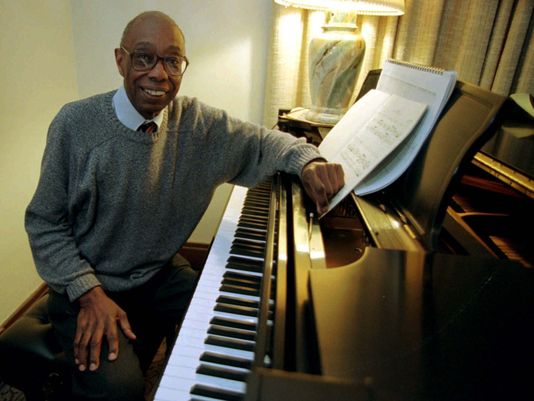
Perambulations with Walker on “The Lost Chord”
It’s crazy that the first time an African American composer would receive the Pulitzer Prize for Music was only in 1996. I remember when it happened. It was a pretty big deal. A special award had been made to Scott Joplin in 1976 – 59 years after Joplin’s death – and there have been some special citations and a number of Black honorees since. In more recent years, it’s not been unusual for composers of all races to be recognized. But it was George Walker who broke the glass ceiling.
This week on “The Lost Chord,” we’ll celebrate this trailblazing artist with a program of four of his original works, including his Piano Sonata No. 2 (with the composer himself at the keyboard), the award-winning “Lilacs” (after poetry of Walt Whitman), “Address for Orchestra” (his first major orchestral work), and “Lyric for Strings” (his most famous music, in its original version for string quartet).
By his own assessment, Walker was a composer more interested in building “elegant structures” than in “creating beauty.” Depending on one’s sensibility, it could be argued that he achieved both.
In an interview given in 2012, he commented, “I’ve always thought in universal terms, not just what is Black or what is American, but simply what has quality.”
I hope you’ll join me for “Perambulations with Walker” on “The Lost Chord,” now syndication on KWAX Classical Oregon!
——–
Clip and save the start times for all three of my recorded shows:
PICTURE PERFECT, the movie music show – Friday at 8:00 PM EST/5:00 PM PST
SWEETNESS AND LIGHT, the light music program – Saturday at 11:00 AM EST/8:00 AM PST
THE LOST CHORD, unusual and neglected rep – Saturday at 7:00 PM EST/4:00 PM PST
Stream them, wherever you are, at the link!
https://kwax.uoregon.edu
——–
A fascinating interview with Walker by Frank J. Oteri, which, among other things, lends an added dimension to Walker’s most frequently performed music (the “Lyric”) and offers insights into his life and musical philosophy. Also, some great photos!
https://nmbx.newmusicusa.org/george-walker-concise-and-precise/ -

Samuel Coleridge-Taylor on “The Lost Chord”
Afro-British composer Samuel Coleridge-Taylor (1875-1912) achieved much in his comparatively short life, attracting the attention and advocacy of Sir Charles Villiers Stanford, Sir Edward Elgar, and Sir Malcolm Sargent.
His cantata “Hiawatha’s Wedding Feast” became a cultural phenomenon between the wars. Sargent conducted the piece annually, from 1928 to 1939, in a costumed, semi-ballet version, featuring close to a thousand performers. Unfortunately, this was among the works the composer had sold outright, his heirs thereby missing out on the royalties. By the time of Sargent’s advocacy, the short-lived Coleridge-Taylor had already been dead for 16 years.
This week on “The Lost Chord,” we’ll hear selections from a complete recording of “Scenes from ‘The Song of Hiawatha,’” one of the earliest to feature rising star Bryn Terfel, released on the Argo label back in 1991. We’ll also hear Sargent’s 1932 recording of Coleridge-Taylor’s “Othello Suite.” The hour will conclude with one of the composer’s musical explorations of his African heritage, the “Symphonic Variations on an African Air,” in a performance conducted by Grant Llewellyn, released on Argo in 1993.
I hope you’ll join me for “Taylor-Made,” music of Samuel Coleridge-Taylor, on “The Lost Chord,” now in syndication on KWAX, the radio station of the University of Oregon!
——–
Clip and save the start times for all three of my recorded shows:
PICTURE PERFECT, the movie music show – Friday at 8:00 PM EST/5:00 PM PST
SWEETNESS AND LIGHT, the light music program – Saturday at 11:00 AM EST/8:00 AM PST
THE LOST CHORD, unusual and neglected rep – Saturday at 7:00 PM EST/4:00 PM PST
Stream them, wherever you are, at the link!
https://kwax.uoregon.edu -
Louisiana Purchases on “The Lost Chord”
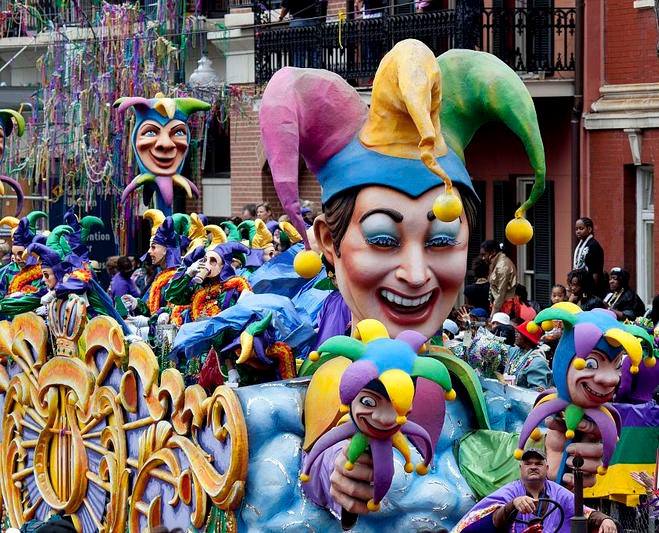
It’s Mardi Gras season! This week on “The Lost Chord,” we’ll adorn ourselves in purple, gold, and green, and carve ourselves some King Cake, as we listen to music from and about New Orleans.
Henry F. Gilbert, a slightly older contemporary of Charles Ives, and a composer of the New England School, was concerned with introducing folk song and the vernacular to the concert hall. His interest in the music of African Americans, then considered controversial, is reflected in works like “The Dance in Place Congo,” from 1908, a programmatic piece on Creole themes, suggestive of Sunday afternoon festivities of off-duty New Orleans slaves gathered in Congo Square.
We’ll also hear a piece by Chicago area composer Edward Joseph Collins, actually titled “Mardi Gras,” from 1923. Collins described the work as “boisterous and bizarre by turns,” evocative of the spirit of Carnival, with its enormous masks and clowns on stilts, colored streamers, confetti, lurid lights, fantastic floats and grotesque costumes.
Three Creole Romantics will offer some insiders’ views, as we hear works by Edmond Dédé, Charles Lucièn Lambert, and Louis Moreau Gottschalk, all figures born in New Orleans.
Laissez les bons temps rouler! I hope you’ll join me for “Louisiana Purchases,” on “The Lost Chord,” now in syndication on KWAX Classical Oregon!
——–
Clip and save the start times for all three of my recorded shows:
PICTURE PERFECT, the movie music show – Friday at 8:00 PM EST/5:00 PM PST
SWEETNESS AND LIGHT, the light music program – Saturday at 11:00 AM EST/8:00 AM PST
THE LOST CHORD, unusual and neglected rep – Saturday at 7:00 PM EST/4:00 PM PST
Stream them, wherever you are, at the link!
https://kwax.uoregon.edu -
Giving Kay His Say on “The Lost Chord”
The time is ripe for the return of Ulysses.
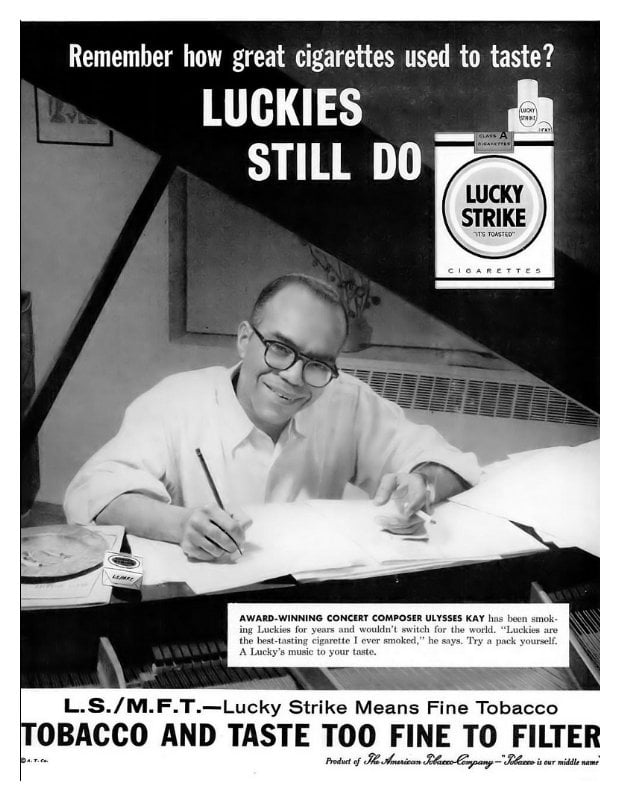
In determining his life’s course, Ulysses Kay (1917-1995), received encouragement from his uncle, King Oliver, and William Grant Still. Among his teachers were Howard Hanson, Paul Hindemith, and Otto Luening. He also attended the American Academy in Rome.
A longtime resident of Teaneck, NJ, he composed music in all genres. This week on “The Lost Chord,” we’ll sample “Tromba” for trumpet and piano, his Concerto for Orchestra, a suite from the semi-documentary “The Quiet One,” and “Six Dances for String Orchestra.”
I hope you’ll join me for “Giving Kay His Say.” Ulysses strings his bow, on “The Lost Chord,” now in syndication on KWAX Classical Oregon!
———-
An interview with Kay conducted by Bruce Duffie:
http://www.bruceduffie.com/kay.html
———-
PHOTO: Kay gets Lucky!
Tag Cloud
Aaron Copland (94) Beethoven (95) Composer (114) Film Music (149) Film Score (143) Film Scores (255) Halloween (97) John Williams (197) KWAX (232) Leonard Bernstein (105) Marlboro Music Festival (125) Movie Music (164) Mozart (91) Opera (215) Philadelphia Orchestra (90) Picture Perfect (174) Princeton Symphony Orchestra (110) Radio (90) Ross Amico (244) Roy's Tie-Dye Sci-Fi Corner (290) The Classical Network (101) The Lost Chord (269) Vaughan Williams (107) WPRB (397) WWFM (881)