This week on “The Lost Chord,” to coincide with Armed Forces Day, we’ll listen to Marc Blitzstein’s “Airborne Symphony.”
The programmatic work, a quasi-oratorio, was written on a commission from the U.S. Army, while the composer was serving in its Air Force. It traces the evolution of flight from its conception in theory to its use in modern warfare.
The piece was envisaged by Blitzstein as a big symphony on the theme of “the sacred struggle of airborne free men of the world… to crush the monstrous fascist obstructionist in their path.” Begun in 1943, at the height of World War II, it would not be completed until 1946, after the conflict had ended.
Leonard Bernstein, a lifelong admirer of the composer (he mounted a performance of Blitzstein’s pro-labor musical, “The Cradle Will Rock,” while still at student at Harvard, and dedicated his own opera, “Trouble in Tahiti,” to him), conducted the premiere virtually while the ink was still wet on the page.
He recorded the piece twice. We’ll hear the second of those recordings, from 1966, with Orson Welles the narrator, vocal soloists, the New York Philharmonic, and the men of the Choral Arts Society.
It may not be the most profound of Bernstein’s recordings, but it surely is one of the most unusual. I hope you’ll join me for “Flight of Fancy” on “The Lost Chord,” now in syndication on KWAX Classical Oregon!
——–
Clip and save the start times for all three of my recorded shows:
PICTURE PERFECT, the movie music show – Friday at 8:00 PM EDT/5:00 PM PDT
SWEETNESS AND LIGHT, the light music program – Saturday at 11:00 AM EDT/8:00 AM PDT
THE LOST CHORD, unusual and neglected rep – Saturday at 7:00 PM EDT/4:00 PM PDT
Stream them, wherever you are, at the link!
https://kwax.uoregon.edu
——–
PHOTO: Blitzstein and Bernstein, dining al fresco
Category: The Lost Chord
-
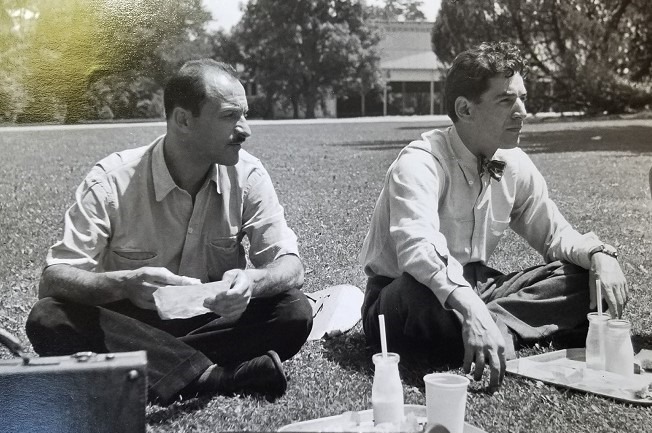
In the Open Air with Marc Blitzstein on “The Lost Chord”
-
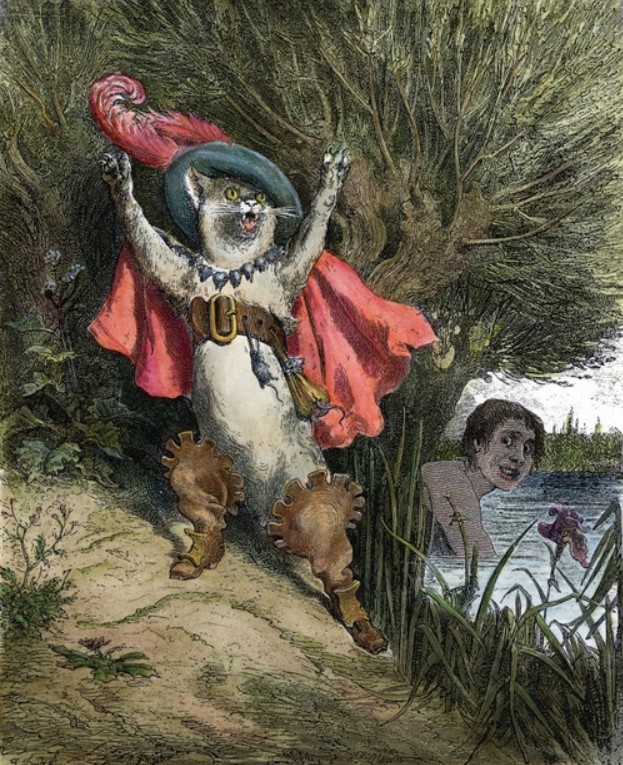
Fancy Feline Footware on “The Lost Chord”
You can tune an orchestra, but you can’t tun-a fish.
This week on “The Lost Chord,” we put the “cat” in Catalan music with selections from Xavier Montsalvatge’s one-act opera “Puss in Boots.”
“Puss in Boots,” Montsalvatge’s first opera, was composed in 1947. We all know the story. The tale, in its best-known guise, was published by Charles Perrault in 1695 as one of the “Tales of Mother Goose.”
A poor miller laments his inheritance. Most of the family property – the mill and the mules – goes to his elder brothers, and all that’s left for him is an unprepossessing cat. He wonders of what use to him a cat could possibly be. He contemplates eating it, perhaps using the skin to make a hat. The cat, however, promptly endears himself, and offers to gain his master a fortune, a kingdom, and the hand of a beautiful princess. All he asks in exchange is a pair of boots to spare his feet, a stylish hat with a plume, a cape, and a sword fashioned out of bone.
Since the cat presents him with a ring from the hand of the princess, the Miller considers it a fair deal, and sets about getting, by hook or by crook, whatever the cat desires.
Throughout the course of the story, with his cunning and superior wits, the cat is able to deliver on everything he promises.
We’ll heard selections from a 2004 recording on the Columna Musica label, with Argentine mezzo-soprano Marisa Martins as Puss (an unusual take on the traditional “trouser role”) and tenor Antonio Comas as the Miller. The Symphony Orchestra of the Gran Teatre del Liceu is conducted by Antoni Ros Marba.
Listen for charming cat-like touches in the strings and the use of piano throughout to emulate the decorative style of 18th century recitative.
That’s “Fur Love and Valor” – highlights from Xavier Montsalvatge’s “Puss in Boots” – on “The Lost Chord, now in syndication on KWAX Classical Oregon!
——–
Clip and save the start times for all three of my recorded shows:
PICTURE PERFECT, the movie music show – Friday at 8:00 PM EDT/5:00 PM PDT
SWEETNESS AND LIGHT, the light music program – Saturday at 11:00 AM EDT/8:00 AM PDT
THE LOST CHORD, unusual and neglected rep – Saturday at 7:00 PM EDT/4:00 PM PDT
Stream them, wherever you are, at the link!
https://kwax.uoregon.edu -
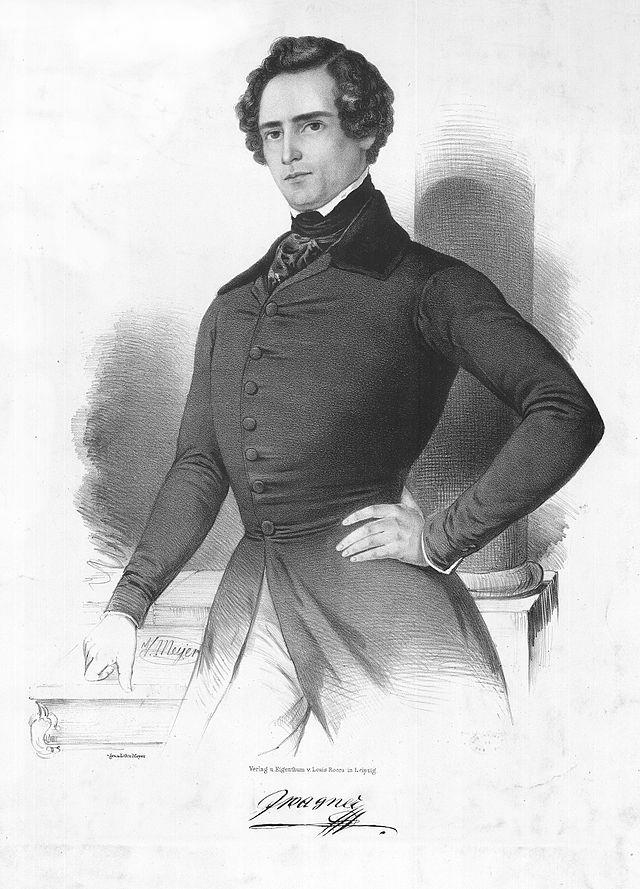
Impetuous Youth on “The Lost Chord”
Wagner wrote symphonies? That’s right. He took a crack at writing two of them, in a Beethovenian style, before finding his niche as a revolutionary opera composer.
This week on “The Lost Chord,” we’ll hear Wagner’s Symphony in E, alongside early attempts by Gustav Holst and Claude Debussy. Judging from their mature works, these three would be among the least likely to attempt sonata form.
Impetuous youth! I hope you’ll join me for “Bold Heads on Young Shoulders” – audacious composers at the start of their careers strive for symphonic mastery – on “The Lost Chord,” now in syndication on KWAX Classical Oregon!
——–
Clip and save the start times for all three of my recorded shows:
PICTURE PERFECT, the movie music show – Friday at 8:00 PM EDT/5:00 PM PDT
SWEETNESS AND LIGHT, the light music program – Saturday at 11:00 AM EDT/8:00 AM PDT
THE LOST CHORD, unusual and neglected rep – Saturday at 7:00 PM EDT/4:00 PM PDT
Stream them, wherever you are, at the link!
https://kwax.uoregon.edu -
So Much for Escapism: Power Corrupts on “The Lost Chord”
This week on “The Lost Chord,” I indulge my inner English major with a program inspired by two plays that explore the relationship of power and corruption – Shakespeare’s “Macbeth” and Eugene O’Neill’s “The Emperor Jones.”
The impulse grew out of my recollection of the rarely-heard ballet by Heitor Villa-Lobos, which originally aired on television in 1957. However, since the score was never published, it was believed lost for decades until rediscovered by the conductor Jan Wagner (who is Venezuelan, despite his Teutonic name). Wagner will conduct the Odense Symphony Orchestra, a Nordic band, in a surprisingly idiomatic performance.
Also on the program will be a half-remembered relic of American musical history, an aria from Louis Gruenberg’s opera, “The Emperor Jones,” sung by baritone Lawrence Tibbett, recorded in 1933.
“The Emperor Jones,” written in 1920, could be a potentially sensitive subject in a more politically correct era. No doubt about it, O’Neill’s tragedy is a product of its time, with plenty of minstrel show dialect, and the uncomfortable use of the N-word.
Already in 1924, Sidney Gilpin, the actor who created Brutus Jones, hedged at playing the character in its first revival, unless O’Neill first changed what he perceived as some of the more offensive passages. O’Neill stood his ground, and Gilpin’s replacement, Paul Robeson, went on to international stardom.
It’s easy to write-off “The Emperor Jones” as an embarrassing relic. Yet there have been some high-profile stagings over the past few years which demonstrate that the play still has much to tell us.
Jones is a former railroad porter and convict, who kills a guard in his escape from prison, and through bluff and bravado establishes himself as emperor of a Caribbean island. He maintains his power through cruelty and exploitation. However, he overplays his hand, and the situation quickly erodes. As his subjects rise up against him, Jones retreats into the jungle and descends into primal fear, haunted by images of his victims.
The play not only parallels some of the themes of “Macbeth,” it also demonstrates the fragility of human reason; how easily under the influence of adrenaline, brought on by raw terror, man is undone by the animal impulses of fight or flight; the psychological impact of guilt; and an insight into tyranny which was remarkably prescient given that fascism would soon overtake Europe.
I don’t know why it never occurred to me before to juxtapose the two plays, but a quick Google search reveals that I am not the first, so there goes my dream of an honorary doctorate.
Also on the show will be selections from rarely-heard incidental music written for two productions of “Macbeth,” by William Walton (for John Gielgud) and Sir Arthur Sullivan (for Henry Irving), respectively.
Power corrupts, on “Power Plays,” on “The Lost Chord,” now in syndication on KWAX Classical Oregon!
——–
Clip and save the start times for all three of my recorded shows:
PICTURE PERFECT, the movie music show – Friday at 8:00 PM EDT/5:00 PM PDT
SWEETNESS AND LIGHT, the light music program – Saturday at 11:00 AM EDT/8:00 AM PDT
THE LOST CHORD, unusual and neglected rep – Saturday at 7:00 PM EDT/4:00 PM PDT
Stream them, wherever you are, at the link!
https://kwax.uoregon.edu
——–
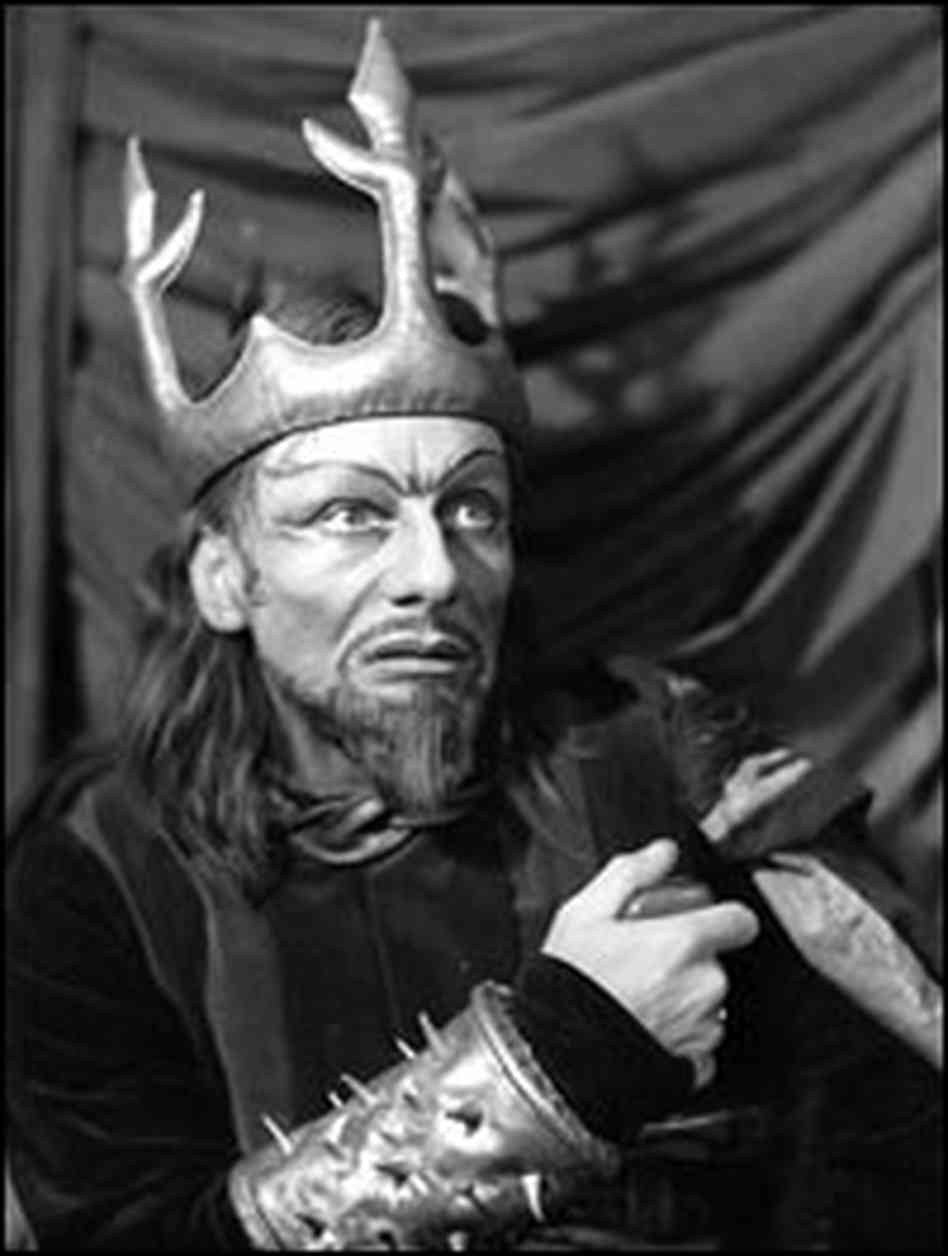
PHOTOS: Gielgud as Macbeth (top) and Tibbett as Brutus Jones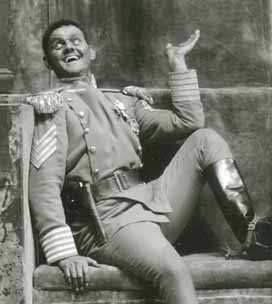
-
Leopold Stokowski on “Sweetness and Light” and “The Lost Chord”
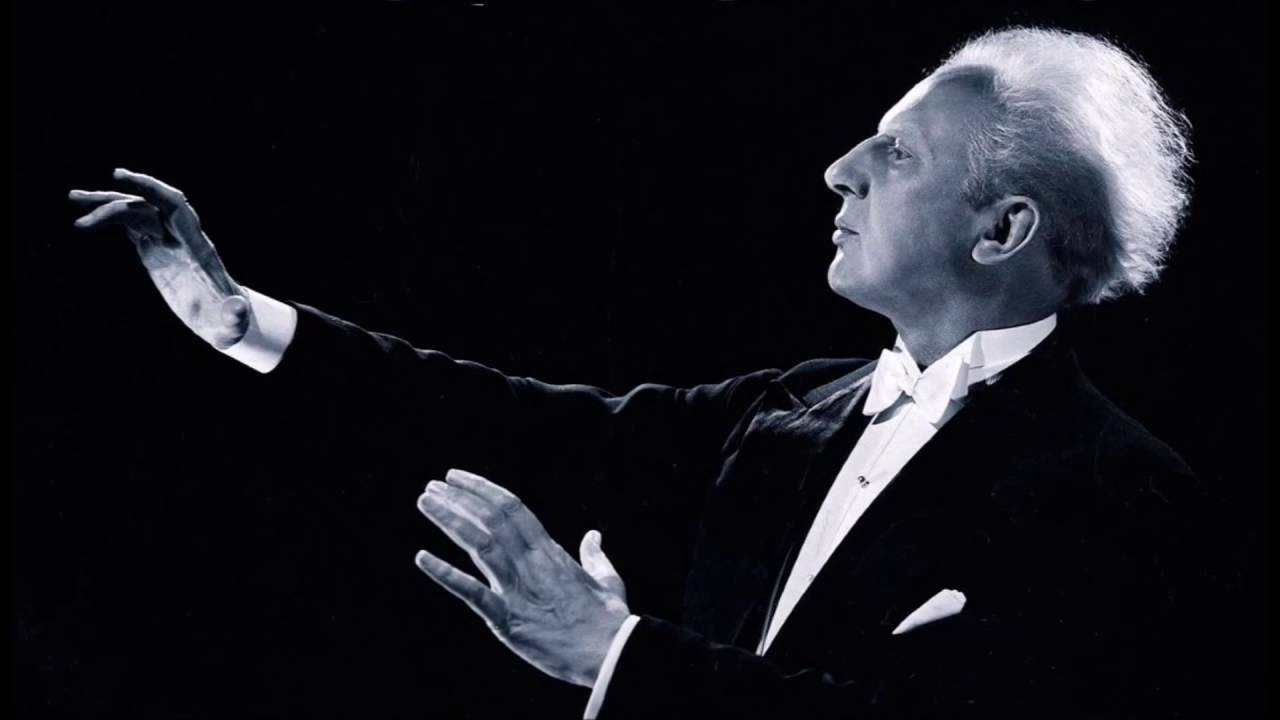
With wild hair, dove-like hands, and a faux middle-European accent (as the son of a Polish-born cabinet-maker who emigrated to and worked in London), Leopold Stokowski certainly knew how to work a crowd. But he also knew his way around a score.
He could be flamboyant in manner, controversial in his interpretations, and an easy target for parody. But he was also magnetic and, at his best, a true magician of the podium.
I hope you’ll join me today for both of my Saturday radio shows as I honor Stokowski on the anniversary of his birth. (He was born on this date in 1882). You’ll find more information at the bottom of this post.
Stokowski was a natural for the movies. He appeared in more than a dozen motion pictures and documentaries and was frequently parodied in cartoons during Hollywood’s golden age. His most enduring film has been Walt Disney’s “Fantasia,” in which he conjures flights of animated fantasy from his art deco perch, and even shakes hands with Mickey Mouse. The recordings made for the actual film pioneered multi-channel stereo.
Stokowski always did have a reputation for embracing experimental technologies to capture or even enhance the fidelity of sound. On stage and in the recording studio, he was meticulous in arranging his musicians to achieve the sonic results he desired. It was really he who established the so-called “Philadelphia sound,” with its celebrated string sonorities, which he managed to replicate to a greater or lesser extent with many of the orchestras he worked with.
The quintessential Stokowski performance often stood apart for its dramatic flair and opulence. He was often at his best in the colorful French and Russian classics, where he really knew how to make the instrumental colors pop. But he also had an insatiable curiosity and a drive to introduce new music and unusual, off-the-beaten-path works.
On the other hand, there were occasions when he could truly astonish by driving a Mozart symphony like a team of wild horses. You truly never knew what this sorcerer was going to pull out of his hat.
One should never come to a Leopold Stokowski performance with an air of complacency, even if one thinks one knows the music inside out. Equally, one should never learn a score from a Stokowski recording. The extent of his recreative powers can only be fully appreciated when listening to him once you’ve heard everyone else. (There was often a lot of creativity in his “recreativity.”)
Some of his inspirations were genius – I love when he holds the chorus at the end of his London Phase 4 recording of Ravel’s “Daphnis and Chloe” Suite No. 2 – and in case it isn’t provocative enough, he actually has the engineers thrillingly boost the sound – but even for me, his swooning additions to his 1970s recording of “Siegfried’s Funeral March” are a bridge too far. Not everything he did will delight everyone, but the guy was not afraid to take chances.
Stokowski, who trained as an organist, possessed intimate knowledge of the keyboard music of Johann Sebastian Bach. At a time when such repertoire would have been comparatively unknown to orchestra subscribers, Stoky brought Bach to the concert hall by way of his own imaginative transcriptions. Hard to believe these were considered controversial at the time.
Clearly, Stokowski was a remarkable figure for so many reasons. Among them was his astonishing longevity. At the time of his death in 1977, at the age of 95, he had signed a contract that would have kept him busy in the recording studio until he was 100. It’s astonishing that so many of his late recordings were as good as anything he had ever done.
In common with Oscar Wilde, Stoky knew there is only one thing worse than being talked about, and that is not being talked about. His ever-evolving origin story. His wealthy marriages. His celebrity love affairs. His elegant bearing and riveting showmanship. It’s not just because of Bugs Bunny that music-lovers still revere him or toss up their hands in incredulity and gasp “LEOPOLD!”
——–
Join me on KWAX Classical Oregon for “Sweetness and Light,” Stokowski conducts music by Ottokar Novacek, Paul Dukas, Fikret Amirov, Johann Sebastian Bach, Wolfgang Amadeus Mozart, and Claude Debussy, this Saturday morning at 11:00 EDT/8:00 PDT.
Then on “The Lost Chord,” Stokowski conducts Wagner in vintage recordings featuring the Philadelphia Orchestra, this Saturday evening/afternoon at 7:00 EDT/4:00 EDT.
Stream them, wherever you are, at the link!
https://kwax.uoregon.edu/
Tag Cloud
Aaron Copland (94) Beethoven (95) Composer (114) Film Music (149) Film Score (143) Film Scores (255) Halloween (97) John Williams (197) KWAX (232) Leonard Bernstein (105) Marlboro Music Festival (125) Movie Music (164) Mozart (91) Opera (215) Philadelphia Orchestra (90) Picture Perfect (174) Princeton Symphony Orchestra (110) Radio (90) Ross Amico (244) Roy's Tie-Dye Sci-Fi Corner (290) The Classical Network (101) The Lost Chord (269) Vaughan Williams (107) WPRB (397) WWFM (881)