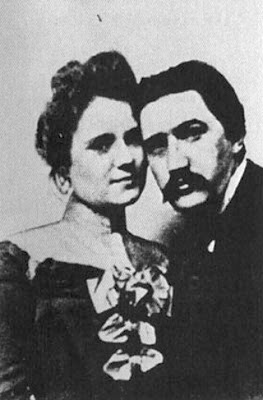
Josef Suk’s 30th year was a tragic one, marked by the deaths of both his young wife, Otilie, and her father, his former teacher, Antonín Dvořák. Not surprisingly, a sense of morbidity colors much of his mature output. The double-loss directly inspired Suk’s “Asrael Symphony,” named for the Angel of Death.
This week on “The Lost Chord,” we’ll take a look at “A Summer’s Tale,” the next step in Suk’s emotional rehabilitation. The work is a five-movement symphonic poem, the second of a four-part cycle that contemplates death and the meaning of life. More affirmative than the grim “Asrael,” which is full of pain, loss, and grief, “A Summer’s Tale” explores the healing powers of nature, in a score that at times reflects the epic romanticism of Gustav Mahler and at others the impressionism of Claude Debussy. It was composed over the course of just six weeks in the summer of 1907. Further tinkering took place over the next year-and-a-half. The work received its premiere in January of 1909.
Suk later described the theme of the piece as “finding a soothing balm in nature.” I hope you’ll join me as we clear a path to “Healing by Nature” – Josef Suk’s “A Summer’s Tale” – on “The Lost Chord,” now in syndication on KWAX Classical Oregon!
———-
Clip and save the start times for all three of my recorded shows:
PICTURE PERFECT, the movie music show – Friday at 8:00 PM EDT/5:00 PM PDT
SWEETNESS AND LIGHT, the light music program – Saturday at 11:00 AM EDT/8:00 AM PDT
THE LOST CHORD, unusual and neglected rep – Saturday at 7:00 PM EDT/4:00 PM PDT
Stream them, wherever you are, at the link!
https://kwax.uoregon.edu/
Category: The Lost Chord
-
Healing by Nature with Josef Suk on “The Lost Chord”
-
Classical Weekend with Classic Ross Amico
With Christopher Nolan’s “The Odyssey” sailing into theaters today, interest in Classical mythology is renewed. I mean, I think it’s always been a fascination for school children, but thanks to that early inculcation, it remains with us for the rest of our lives – sometimes pushed to the backs of our brains, but who doesn’t remember with affection the Greek heroes, their imposing quests and impossible challenges, the fickle gods, the peculiar trysts, the triumphs and turns of fortune, and perhaps most of all, the grotesque monsters?
“The Odyssey” is an excuse for me to revisit these youthful enthusiasms, as I make Classical mythology the focus of all three of my radio shows this weekend (with air times and streaming information posted below).
First, today, on “Picture Perfect,” it’s a mythological mash-up of music from fantasy films, including selections from “Helen of Troy” (Max Steiner), “Clash of the Titans” (Laurence Rosenthal), “Hercules” (Pino Donaggio), and “Jason and the Argonauts” (Bernard Herrmann).
Then, tomorrow morning on “Sweetness and Light,” it’s an ambrosial assortment of pieces inspired by Orpheus and Eurydice, Daphnis and Chloe, Hercules, and a riot of nymphs, satyrs, and fauns, vividly evoked by Jacques Offenbach, Howard Hanson, Cécile Chaminade, George Frideric Handel, Camille Saint-Saëns, and Maurice Ravel.
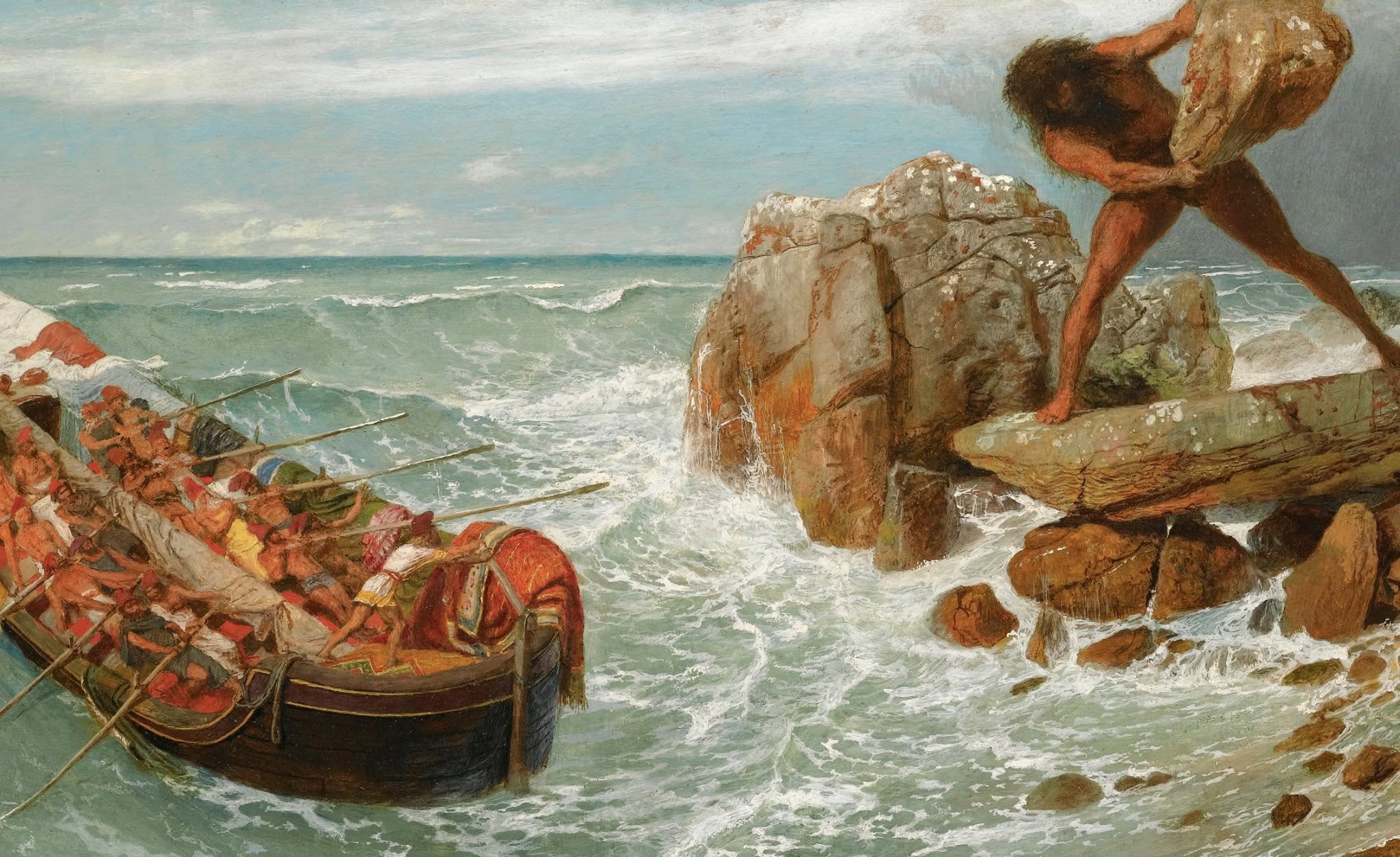
Finally, indomitable Odysseus makes his belated return from the Trojan War to Ithaca on “The Lost Chord,” in works by Ernst Boehe (“Departure and Shipwreck” from the symphonic cycle “From Odysseus’ Voyages”) and Benjamin Britten (the radio play “The Rescue of Penelope,” narrated with gusto by Dame Janet Baker), on “Home Sweet Homer.”
So much for moderation. Join me for a triple helping of Classical classics. I’ll be stringing my bow and launching arrows down a gallery of axe-heads, in celebration of “The Odyssey,” on “Picture Perfect,” “Sweetness and Light,” and “The Lost Chord” – all three originating from KWAX Classical Oregon!
——–
Clip and save the start times of my recorded shows:
PICTURE PERFECT, the movie music show – Friday at 8:00 PM EST/5:00 PM PST
SWEETNESS AND LIGHT, the light music program – Saturday at 11:00 AM EST/8:00 AM PST
THE LOST CHORD, unusual and neglected rep – Saturday at 7:00 PM EST/4:00 PM PST
Stream them, wherever you are, at the link!
https://kwax.uoregon.edu/
——–
IMAGE: “Odysseus and Polyphemus” (1896) by Arnold Böcklin -
Homages to Grieg on “The Lost Chord”
Edvard Grieg was a gentle, generous soul. But he was also something of a rebel-artist who established a personal and national identity outside the dominant Austro-German tradition. As Norway’s most important composer, he provided inspiration not only to Scandinavians, but to artists all over Europe and the United States.
His personality and achievements engendered much affection and loyalty. Tchaikovsky dedicated his “Hamlet Fantasy Overture” to him. Liszt performed his piano concerto. Antonin Dvořák was a friend, and Frederick Delius worshiped him.
This week on “The Lost Chord,” we’ll hear works dedicated to Grieg by some of his composer friends and admirers.
The American composer Edward MacDowell never actually met Grieg, though they shared a certain musical affinity. He contacted the Norwegian to ask permission to dedicate to him his Piano Sonata No. 3, which he subtitled the “Norse.” Grieg was full of compliments about the piece, and he enthusiastically accepted. The two men enjoyed an admiring, though unfortunately short-lived correspondence, since both were already nearing the end of their lives. MacDowell died in 1908, at the age of 47; he was already in the throes of the illness that would claim him at the time Grieg passed in 1907, at the age of 64.
Though Julius Röntgen was born in Leipzig, by his early 20s he had settled in Amsterdam. He went on to become one of the most important figures in Dutch music, establishing the city’s music conservatory and participating in the founding of the Concertgebouw. Röntgen was successful in becoming a good friend not only of Johannes Brahms (no mean feat), but also Grieg, whom he visited in Norway 14 times. The result was a number of works he composed on Norwegian themes. Röntgen dedicated his suite “Aus Jotunheim,” inspired by a hike he had taken with the composer through the Norwegian mountains, to Grieg and his wife, Nina, on the occasion of their 25th wedding anniversary.
Finally, Grieg encountered the tireless Australian pianist Percy Grainger only toward the end of his life, but he was convinced he had found his ideal interpreter. He invited Grainger to perform his Piano Concerto in A Minor under his own direction. Sadly, Grieg died before it could come to pass. Nevertheless, Grainger continued to champion Grieg’s music for the rest of his life. Also, he dedicated a number of folk-inspired works to the memory of the Norwegian master. We’ll hear two historical recordings: one of Grainger playing music of Grieg and then another of the pianist playing one of his own such works.
I hope you’ll join me in celebrating Edvard Grieg with music written for him by composer friends and admirers. That’s “Griegarious,” on “The Lost Chord,” now in syndication on KWAX Classical Oregon!
——-
Clip and save the start times for all three of my recorded shows:
PICTURE PERFECT, the movie music show – Friday at 8:00 PM EDT/5:00 PM PDT
SWEETNESS AND LIGHT, the light music program – Saturday at 11:00 AM EDT/8:00 AM PDT
THE LOST CHORD, unusual and neglected rep – Saturday at 7:00 PM EDT/4:00 PM PDT
Stream them, wherever you are, at the link!
——-
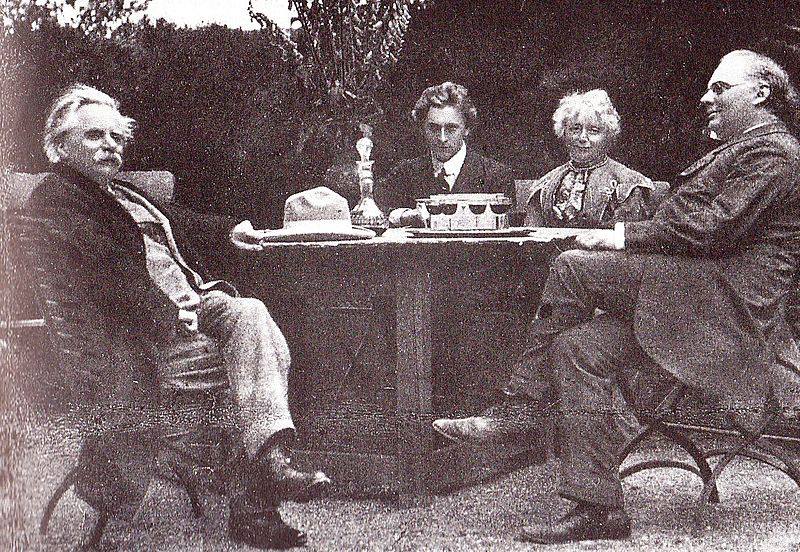
PHOTO: (left to right) Grieg, Grainger, Nina Grieg & Röntgen at Grieg’s home, Troldhaugen, in 1907 -

Spirits of Independence on “The Lost Chord”
At a time when immigration seems to be such a divisive issue, it’s instructive to look back to political cartoons of the 19th and early 20th centuries, when bomb-toting Bolsheviks seemed poised to take down our democracy, the Chinese were inscrutable back-stabbers, the Jews were bearers of poverty and disease, and the Irish were simian-faced hooligans and drunks. Anxiety about outsiders has always been with us, yet somehow we got over each successive alien group, and the country has plugged along just fine.
This week on “The Lost Chord,” we’ll get a little perspective, courtesy of composer Peter Boyer. From 1892 to 1954, more than 12 million immigrants passed through Ellis Island in search of a better life. More than 40 percent of the U.S. population – over 100 million Americans – can trace its roots to someone who came to this country along that route.
Boyer’s “Ellis Island: The Dream of America” incorporates texts from testimonials archived as part of the Ellis Island Oral History Project. They are real words of real people telling their own stories. The work is performed by actors, rather than speakers or narrators, who deliver their monologues in the first person. In a powerful epilogue, each of them comes together to recite a stanza from Emma Lazarus’ poem, “The New Colossus.” It’s so effective – and affecting – I get a little choked up just thinking about it.
You will, too, if you join me for “Spirits of Independence,” on “The Lost Chord,” now in syndication on KWAX Classical Oregon!
——-
Clip and save the start times for all three of my recorded shows:
PICTURE PERFECT, the movie music show – Friday at 8:00 PM EDT/5:00 PM PDT
SWEETNESS AND LIGHT, the light music program – Saturday at 11:00 AM EDT/8:00 AM PDT
THE LOST CHORD, unusual and neglected rep – Saturday at 7:00 PM EDT/4:00 PM PDT
Stream them, wherever you are, at the link!
https://kwax.uoregon.edu
——-
BONUS: The hour will open with Jerry Goldsmith’s “Fireworks.” Happy 4th! -
“Balanced Czechs” on “The Lost Chord”
Neoclassicism in music was a reaction against what was perceived as the garish effusiveness and gooey excesses of late Romanticism.
Contemporary composers, in search of a new lucidity, turned their attention to the 18th century, revisiting its musical processes, though reinterpreting them through a distinctly 20th century prism. Stravinsky was the master, but neoclassicism swept the world.
This week on “The Lost Chord,” we’ll have three cheery examples of Czech neoclassicism, including works by Ilja Hurník (his “Sonata da Camera”), Iša Krejči (his “Serenade for Orchestra,” conducted by Karel Ančerl) and Bohuslav Martinů (his Concerto for Two Violins and Orchestra).
These composers – well, Krejči and Martinů, anyway – manage to balance the clarity of the Enlightenment with an unmistakably Czech national sound.
Hurník’s work is perhaps the purest, in terms of looking back. The term “Sonata da Camera” recalls music of the Baroque and Classical eras, as does the clarity of its instrumentation, involving flute, oboe, cello and harpsichord. Each movement begins as if it were ripped from the pages of history and then gradually squeezed like a lemon, leaving a tangy, contemporary aftertaste.
All of this music is calculated to lift your spirits. I do hope you’ll join me for “Balanced Czechs,” on “The Lost Chord,” now in syndication on KWAX Classical Oregon!
——-
Clip and save the start times for all three of my recorded shows:
PICTURE PERFECT, the movie music show – Friday at 8:00 PM EDT/5:00 PM PDT
SWEETNESS AND LIGHT, the light music program – Saturday at 11:00 AM EDT/8:00 AM PDT
THE LOST CHORD, unusual and neglected rep – Saturday at 7:00 PM EDT/4:00 PM PDT
Stream them, wherever you are, at the link!
https://kwax.uoregon.edu
——-
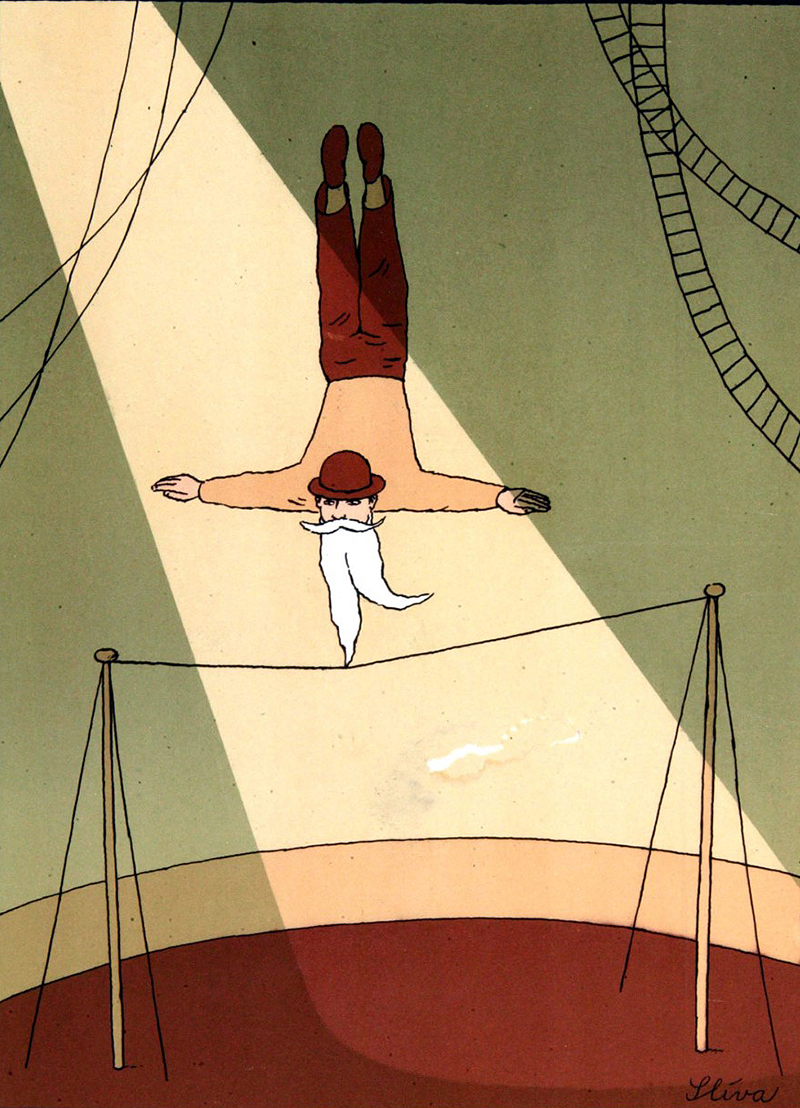
Tightrope walker by Jiří Sliva
Tag Cloud
Aaron Copland (94) Beethoven (95) Composer (114) Film Music (148) Film Score (143) Film Scores (255) Halloween (97) John Williams (196) KWAX (232) Leonard Bernstein (105) Marlboro Music Festival (125) Movie Music (163) Mozart (91) Opera (215) Philadelphia Orchestra (90) Picture Perfect (174) Princeton Symphony Orchestra (110) Radio (90) Ross Amico (244) Roy's Tie-Dye Sci-Fi Corner (290) The Classical Network (101) The Lost Chord (269) Vaughan Williams (107) WPRB (397) WWFM (881)