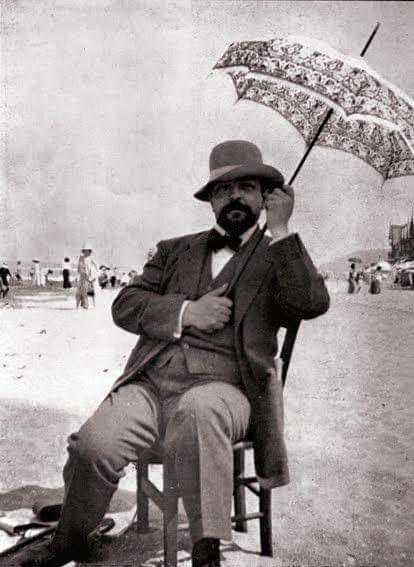
Catch the wave with the composer of “La Mer.” Today, to celebrate the anniversary of the birth of Claude Debussy (1862-1918), I hope you’ll consider joining me for my Saturday radio shows, “Sweetness and Light” and “The Lost Chord.”
Regarded as one of France’s greatest composers, and one of the foundational figures in 20th century music, Debussy was the most famous representative of a style known as Impressionism (although he himself loathed the term). What’s in a name?
No matter how you choose to classify it, he wrote a lot of beautiful music, and I’ve selected what I think are some of his most delightful pieces (for “Sweetness and Light”), as well some of his lesser-heard ones (for “The Lost Chord”).
On “Sweetness and Light” (11:00 EDT/8:00 PDT), we’ll enjoy orchestrations of his piano works by other hands, as well as the composer’s own arrangement of “La plus que lente” for small orchestra (including cimbalom!).
Then on “The Lost Chord” (7:00 EDT/4:00 PDT), we’ll hear “Six épigraphes antiques” (“Six Ancient Epigraphes”), orchestrated by Ernest Ansermet, and his Prix de Rome award-winning cantata “L’enfant prodigue” (“The Prodigal Son”), in a recording featuring Jessye Norman, José Carreras, and Dietrich Fischer-Dieskau.
Interested in Debussy? We’ve got you covered. Join me in lauding Claude on “Sweetness and Light” and “The Lost Chord,” on KWAX Classical Oregon!
Stream both programs, wherever you are, at the link:
https://kwax.uoregon.edu/
Category: The Lost Chord
-
Wolf Pack: Friends and Associates of Wolfgang Amadeus Mozart on “The Lost Chord”
This week on “The Lost Chord,” with my head full of Mozart from this year’s Bard Music Festival (“Mozart and His World,” at Bard College in Annandale-on-Hudson, NY, through tomorrow), I recall a show I put together in 2006 of music composed by a few of Mozart’s friends and associates.
The program includes a Trio in F major for three basset horns attributed to Anton Stadler, the clarinetist who inspired Mozart to write his great masterworks, the Clarinet Concerto and the Clarinet Quintet. Mozart regarded Stadler as an intimate friend. However, it’s been suggested Stadler may have betrayed that trust. In fact, there’s a letter from Mozart’s wife, Constanze, which reveals the clarinetist claimed to have lost some Mozart manuscripts when his suitcase stolen. Among them – some trios for basset horn! You connect the dots.
But what really reminded me of the show was music of Franz Xaver Süssmayr, who famously completed Mozart’s Requiem. Süssmayr’s “Sinfonia turchesca” will be featured on a Bard concert tonight at 7:00. (Concerts from the Fisher Center at Bard are available for livestream. I’ll include a link below.) The “Sinfonia turchesca” is tricked out with a battery of drums, cymbals, and triangles, to be played “in the Turkish style,” as was all the rage in those days. The Battle of Vienna of 1683 proved to be the beginning of the end of centuries of Turkish hostilities. Turkish percussion instruments were sent as diplomatic gifts to the various European courts. The Ottoman influence informed such works as Mozart’s “Turkish” Concerto, “The Abduction from the Seraglio” (to be heard complete at Bard tomorrow, with livestream option), Haydn’s “Military” Symphony, and the janissary interlude in the finale of Beethoven’s 9th.
Finally, we’ll hear selections from a rediscovered singspiel by the company that gave us “The Magic Flute,” including the first Tamino (composer Benedikt Schack), the first Sarastro (Franz Xaver Gerl), “Flute” conductor (Johann Baptist Henneberg), “Flute” impresario, librettist, and Papageno (Emanuel Schickaneder), and Mozart himself. The story shares in common with “Flute” a divided family – in this case, two brothers – representing the powers of good and evil; parallel romantic couples of contrasting dispositions – one spiritual, and the other of an earthier bent; temples and purification rituals; an enchanted weapon; and arcane Masonic and alchemical symbolism.
“The Philosopher’s Stone” was recorded in 1999 by Martin Pearlman and Boston Baroque for the Telarc label, and the work’s a blast. (I had the privilege to hear a few of the duets sung live at Bard last weekend.) We’ll have time for selections from Act I.
Aaa-OOOO! It’s an hour of music by those who ran wild with Wolfgang Amadeus Mozart. I hope you’ll join me for “Wolf Pack” on “The Lost Chord,” now in syndication on KWAX Classical Oregon!
——-
Clip and save the start times for all three of my recorded shows:
PICTURE PERFECT, the movie music show – Friday at 8:00 PM EDT/5:00 PM PDT
SWEETNESS AND LIGHT, the light music program – Saturday at 11:00 AM EDT/8:00 AM PDT
THE LOST CHORD, unusual and neglected rep – Saturday at 7:00 PM EDT/4:00 PM PDT
Stream them, wherever you are, at the link!
https://kwax.uoregon.edu
For livestreams of “Mozart and His World from the Fisher Center from Bard (concerts from Olin Hall, across campus, are unavailable), visit:
https://fishercenter.bard.edu/what-we-do/bard-music-festival/
——-
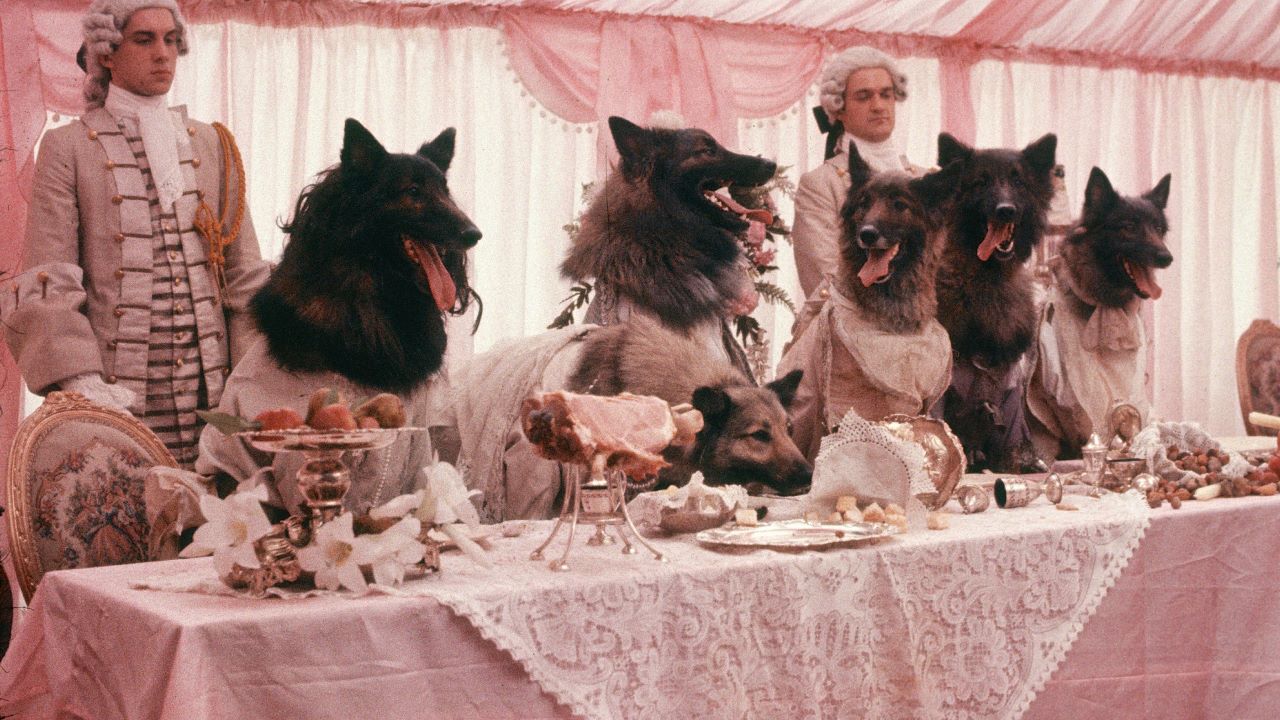
Still from “The Company of Wolves” (1984) -
Vintage Wagner on “The Lost Chord”
I’ve been celebrating the sesquicentennial of the “Ring” on my radio shows this weekend. The four installments of Wagner’s famed operatic tetralogy were performed on quasi-consecutive days for the first time in the newly-constructed Festspielhaus at the inaugural Bayreuth Festival on August 13-17, 1876.
I’ll conclude my three-part homage on “The Lost Chord,” with an hour of vintage recordings, two of them “Ring”-related and the other captured on the premises at Bayreuth.
American baritone Lawrence Tibbett never actually sang the role of Wotan on stage, in the context of a “Ring” cycle. However, he did record “Wotan’s Farewell and Magic Fire Music,” magnificently, in 1934, with the Philadelphia Orchestra and Leopold Stokowski.
Karl Muck was a casualty of anti-German sentiment during his time as music director of the Boston Symphony Orchestra, which, unfortunately, happened to coincide with the First World War. Be that as it may, he was held in the highest regard by fellow musicians and thought by many to be one of Wagner’s finest interpreters. We’ll hear a fascinating 1927 recording of the Transformation Music and the beginning of the Grail Scene from Act I of “Parsifal,” made at the Festspielhaus in Bayreuth.
The recording employs the original bells designed by Wagner, which would be melted down by the Nazis for ammunition during the Second World War. So this will be a rare opportunity to experience the “Parsifal” Wagner actually knew. Muck was principal conductor of the Bayreuth Festival since 1903. He conducted “Parsifal” at Bayreuth 14 times between 1901 and 1930.
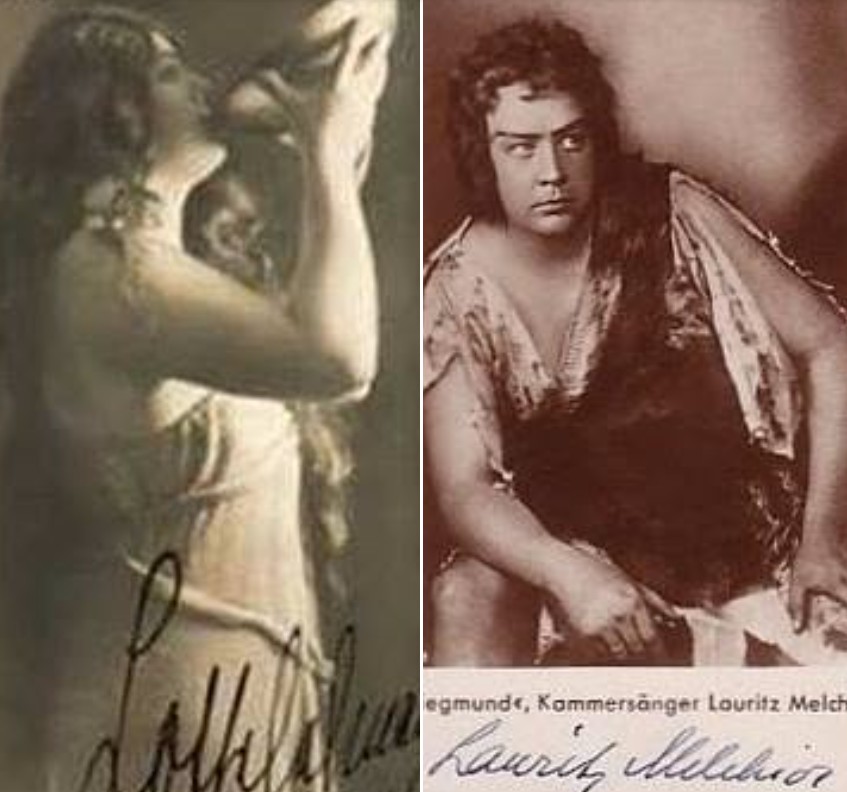
Finally, we’ll return to “Die Walküre” to wrap things up on a buoyant note with Siegmund and Sieglinde’s love music from Act I, which concludes with the lovers fleeing together into the welcoming spring. Nine months later, Sieglinde gives birth to Siegfried, the saga’s hero-without-fear. Lotte Lehmann strikes sparks with legendary Danish heldentenor Lauritz Melchoir in a 1935 recording with Bruno Walter and the Vienna Philharmonic.
The power of these performances remains undiminished by the passage of time. I hope you’ll join me for another Wagner power hour on “Vintage Wagner,” on “The Lost Chord,” now in syndication on KWAX Classical Oregon!
——-
Clip and save the start times for all three of my recorded shows:
PICTURE PERFECT, the movie music show – Friday at 8:00 PM EDT/5:00 PM PDT
SWEETNESS AND LIGHT, the light music program – Saturday at 11:00 AM EDT/8:00 AM PDT
THE LOST CHORD, unusual and neglected rep – Saturday at 7:00 PM EDT/4:00 PM PDT
Stream them, wherever you are, at the link!
https://kwax.uoregon.edu
——-
PHOTOS: Lotte Lehmann as Sieglinde and Lauritz Melchior as Siegmund -
Wagner Out the Wazoo on “Picture Perfect,” “Sweetness and Light,” and “The Lost Chord”
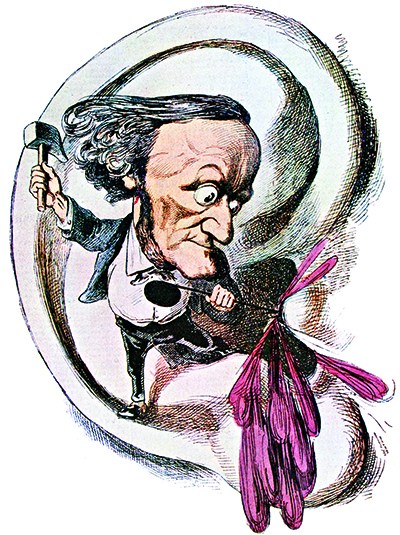
In 1876, the four operas – or music dramas (the composer’s preferred term) – of Wagner’s “Ring Cycle” were performed together for the first time, from August 13 through August 17, at the inaugural Bayreuth Festival, in the Festspielhaus (a theater of the composer’s design) in Bayreuth, Germany. The Bayreuth Festival has continued as a mecca for Wagnerites down to the present day.
To mark the 150th anniversary of the “Ring,” all three of my radio shows this weekend will tie in, in one way or another, with this most grandiose and influential undertaking.
First, today on “Picture Perfect,” we’ll have music from four films in which Erich Wolfgang Korngold served as ghostwriter for onscreen composers, providing a ballet for Errol Flynn’s in “Escape Me Never” (1946), a tone poem for Charles Boyer in “The Constant Nymph” (1943), and a cello concerto for Claude Rains in “Deception” (1946). More to the point, Korngold actually appears onscreen – hastily made-up when the actor hired for the purpose didn’t show – to play conductor Hans Richter in the Wagner biopic “Magic Fire,” for which he adapted selections from, yes, the Ring Cycle.
Then tomorrow morning, on “Sweetness and Light,” it will be the unlikeliest “light music” program, as we listen to piano transcriptions by Carl Tausig and Louis Brassin, the “Siegfried Idyll” (probably the sweetest thing Wagner ever wrote), humorist Anna Russell’s classic routine “The Ring of the Nibelungs (An Analysis),” and a cheeky work for piano four-hands by Gabriel Fauré & André Messager, in which they distill somber motifs from the cycle into a frivolous ballroom dance.
Finally, tomorrow afternoon/evening (depending on where you are), it will be an hour of historic recordings of “Die Walküre” – the second of the “Ring” operas (er, music dramas) – by Lawrence Tibbett, with Leopold Stokowski and the Philadelphia Orchestra, in 1934, and Lotte Lehmann and Lauritz Melchior, with Bruno Walter and the Vienna Philharmonic, in 1935. Also, we’ll hear Karl Muck conducting selections from Wagner’s “Parsifal” at the actual Festspielhaus, in 1927. The recording will feature actual bells of Wagner’s design, which were later melted down for munitions by the Nazis.
Hojotoho! Get out your party hats (helmets with horns and wings, of course), as we celebrate the 150th anniversary of the “Ring” this weekend, on KWAX Classical Oregon!
Stream the shows, wherever you are, at the times below:
PICTURE PERFECT, the movie music show – Friday at 8:00 PM EDT/5:00 PM PDT
SWEETNESS AND LIGHT, the light music program – Saturday at 11:00 AM EDT/8:00 AM PDT
THE LOST CHORD, unusual and neglected rep – Saturday at 7:00 PM EDT/4:00 PM PDT
Here’s the link!
https://kwax.uoregon.edu -
“England à la Russe” on “The Lost Chord”
Serge Diaghilev, impresario of the Ballets Russes, commissioned some of the most enduring ballet scores of the 20th century, from such composers as Claude Debussy (“Jeux”), Maurice Ravel (“Daphnis and Chloe”), Manuel de Falla (“The Three-Cornered Hat”), and Igor Stravinsky (“The Firebird,” “Petrushka” and “The Rite of Spring”).
Less well known is the fact that two Englishmen were also approached.
This week on “The Lost Chord,” we’ll listen to works by Constant Lambert and Lord Berners – both men so diverse in their interests, and possessing such outsized personalities, it isn’t really possible to do justice to either in the time allotted.
Lambert was a brilliant polymath. In addition to his considerable talents as a composer, he was a conductor, arranger, and writer, as well as the lover of Margot Fonteyn. Alas, alcoholism and workaholism conspired with undiagnosed diabetes to hasten his demise at the age of 45.
His ballet, “Romeo and Juliet,” presented as a play-within-a-play, turns Shakespeare’s tragedy of star-crossed lovers on its head, with the leads falling hard in a backstage romance with happier results. Lambert would go on to greater things, but the ballet is undeniably an impressive piece of work for a 20 year-old.
Similarly, Lord Berners’ interests lie all over the place, but his was a much more relaxed character. Unfailingly productive as a composer, a painter, and a writer, nonetheless he never lost sight of the fact that life would be his magnum opus. And Berners lived well.
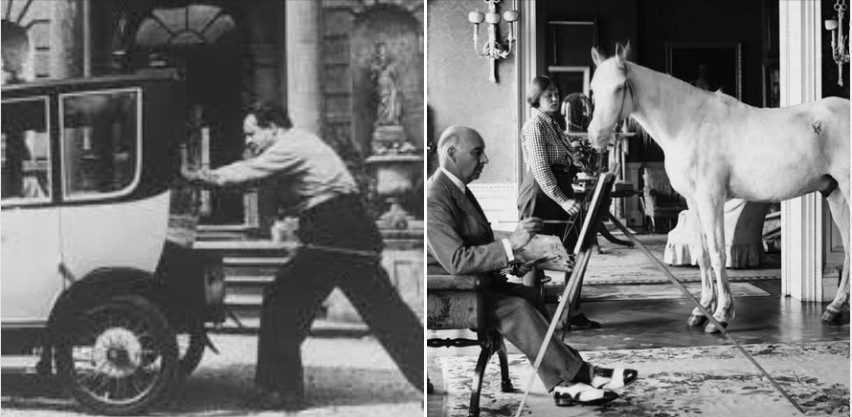
Furthermore, his fortune ensured that he would never be taken to task for any of his whimsical behavior. This included having a 140-foot folly tower constructed on his estate (partly to annoy the neighbors) and keeping a horse and a giraffe to invite to his indoor and outdoor tea parties.
Berners wrote novels, painted portraits (always sure to include a moustache, whether the sitter had one or not), and composed a respectable amount of music, especially for the ballet.
For the Ballets Russes, he wrote “The Triumph of Neptune,” which became a great favorite of Sir Thomas Beecham. Sacheverell Sitwell provided the scenario, which concerns a sailor who is shipwrecked en route to Fairyland, and George Balanchine supplied the choreography.
That’s a heady mix of hornpipes and pas de deux. I hope you’ll join me for “England à la Russe,” on “The Lost Chord,” now in syndication on KWAX Classical Oregon!
——-
Clip and save the start times for all three of my recorded shows:
PICTURE PERFECT, the movie music show – Friday at 8:00 PM EDT/5:00 PM PDT
SWEETNESS AND LIGHT, the light music program – Saturday at 11:00 AM EDT/8:00 AM PDT
THE LOST CHORD, unusual and neglected rep – Saturday at 7:00 PM EDT/4:00 PM PDT
Stream them, wherever you are, at the link!
https://kwax.uoregon.edu
——-
PHOTOS: Berners, no doubt contemplating the placement of a moustache (right); and Lambert pushing Berners car
Tag Cloud
Aaron Copland (94) Beethoven (95) Composer (114) Film Music (148) Film Score (143) Film Scores (255) Halloween (97) John Williams (196) KWAX (232) Leonard Bernstein (105) Marlboro Music Festival (125) Movie Music (163) Mozart (91) Opera (215) Philadelphia Orchestra (90) Picture Perfect (174) Princeton Symphony Orchestra (110) Radio (90) Ross Amico (244) Roy's Tie-Dye Sci-Fi Corner (290) The Classical Network (101) The Lost Chord (269) Vaughan Williams (107) WPRB (397) WWFM (881)