Thanksgiving is always a good excuse to play American music, and this year, in light of all the organization has been through recently, I thought I’d devote an hour to recordings of the Atlanta Symphony Orchestra.
The musicians and management recently reached an agreement, with the help of outside federal mediators, after ten months of contract negotiations that culminated in a two-month player lockout. The two sides arrived at a four-year deal, and the orchestra is back to work. As the major symphonic organization in the Southeastern United States, this is indeed a cause for thanksgiving.
This Sunday night on “The Lost Chord,” we’ll hear two works co-commissioned by the symphony from representatives of the so-called “Atlanta School,” composers frequently championed and recorded by the orchestra and its music director, Robert Spano.
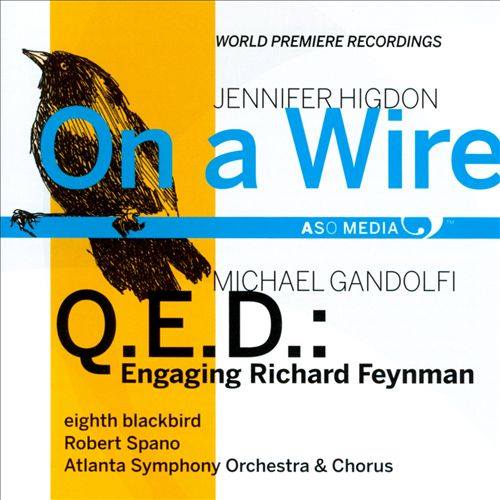
Jennifer Higdon, now one of the most successful of American composers, a Pulitzer Prize winner who teaches at the Curtis Institute of Music, studied conducting with Spano at Bowling Green. She wrote a concerto grosso of sorts for the New Music sextet eighth blackbird (which identifies itself, modestly, in the lower case). The group performs with the symphony in “On a Wire.” The composer asks the listener to imagine six blackbirds, sitting on a wire.
Birds also play a role in Michael Gandolfi’s “Q.E.D.: Engaging Richard Feynman,” inspired by the Nobel Prize-winning physicist.
Gandolfi’s piece doesn’t focus on scientific inquiry. Rather it takes as its starting point two anecdotes shared by Feynman in interviews with the BBC, which the composer discovered on YouTube.
The first concerns a challenge put by an artist friend of Feynman suggesting that as a scientist he cannot truly appreciate the beauty of a flower. Feynman counters that scientific knowledge, a greater understanding of the flower, only adds to its beauty, rather than detracts.
The second grows out of an anecdote concerning Feynman’s boyhood ignorance of the name of a certain kind of bird, a brown-throated thrush, and his realization that a name tells nothing about the bird, but rather something about the people who named the bird. He concludes, “Now, let’s look at the bird.”
The piece, scored for chorus and orchestra, is organized into two sections made up of settings of texts by various poets illustrating their respective themes, including those of Gertrude Stein, Emily Dickinson, Walt Whitman, Ralph Waldo Emerson, Siegfried Sassoon, and the Irish Republican Joseph Campbell (not to be confused with the mythologist).
Both works appear on an album issued on the orchestra’s ASO Media label.
I hope you’ll join me for “Georgia Peaches,” American music performed by the Atlanta Symphony Orchestra, this Sunday night at 10 ET, with a repeat Wednesday evening at 6 – or that you’ll listen to it later as a webcast at http://www.wwfm.org.
Leave a Reply to kqxs lテエ xiテェn ト雪コッk NテエngCancel reply