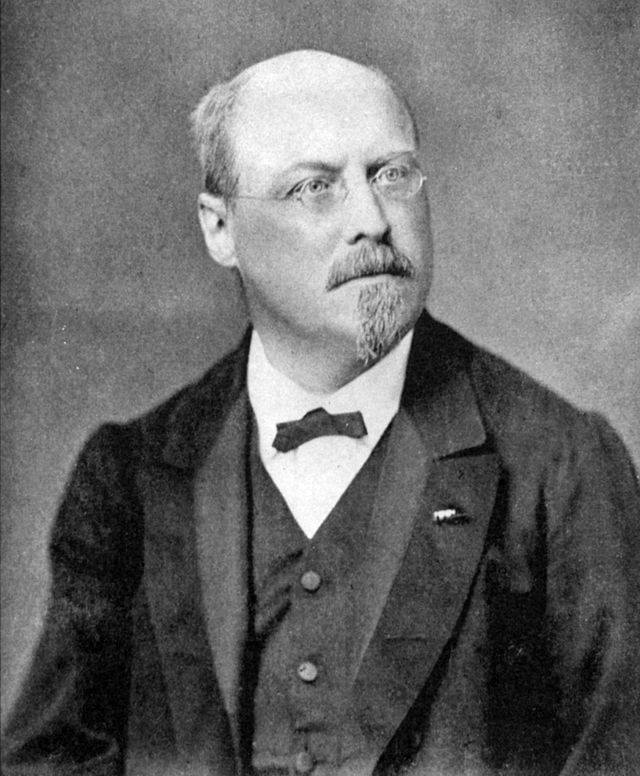
There’s one story about the German-Swiss composer Joachim Raff that I find so endearing. When Raff learned that Franz Liszt would be playing in Basel, he traveled by foot from Zurich (a distance of nearly 50 miles), through a driving rain, only to discover upon reaching the venue that the concert had sold out.
Word reached Liszt of the young man’s predicament, and the great pianist, in yet another of his legendary acts of generosity, had a chair put up on the stage so that Raff would be able to enjoy the recital – which he did, sitting there, grinning like an idiot, amidst a widening pool of water.
Raff became Liszt’s assistant at Weimar, where he orchestrated a number of the elder composer’s works, until Liszt gained the technique and confidence himself; after which time, Liszt went back and revised many of the earlier pieces. In turn, Liszt staged the premiere of Raff’s opera “King Alfred” (though, because of an illness in the family, he had to hand over the conducting duties to Raff himself).
Raff must have been a singularly likable figure. His was the rare instance of a composer who was accepted in both camps, on either side of the seemingly unbridgeable divide that separated the “absolute” music of Mendelssohn and Schumann and the “program” music – the so-called “Music of the Future” – of Liszt and Wagner.
In 1878, Raff became the first director of the Hoch Conservatory in Frankfurt, where he hired Clara Schumann, among the eminent faculty, and initiated a class for female composers.
During his lifetime, Raff was one of the best-known German composers. It’s unfortunate that so little of his music endures in the public memory (beyond, perhaps, the “Cavatina” for violin and piano), but the symphonies, in particular, have not aged well.
Raff’s practice was to choose a promising program – for instance, in the Symphony No. 5, the “Lenore” Symphony, he selected an overheated ballad by Gottfried August Bürger, about a maiden who is swept away amidst jeering specters by the phantom of her former lover – and then he would negate all the drama by rendering the symphony in classical form. In other words, the story would be straightjacketed in order to suit the requirements of form, rather than the other way around – which would be easier to forgive if the symphony weren’t nearly an hour long.
However, he did leave behind some very impressive music. You just really have to look for it. I hope you enjoy these “diamonds in the Raff”:
Piano Concerto in C minor:
“Ode to Spring”:
Happy birthday, Joachim Raff (1822-1882).
Leave a Reply