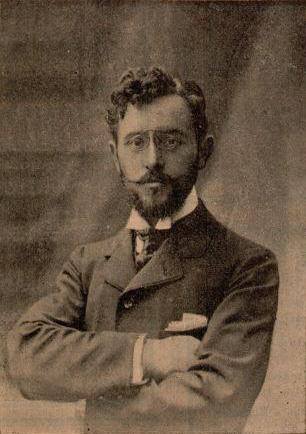
This Sunday night on “The Lost Chord,” we bask in the opulent Orientalisms of Florent Schmitt.
Florent Schmitt, who lived from 1870 to 1958, studied at the Paris Conservatory, where Gabriel Fauré, Jules Massenet, and Théodore Dubois were among his teaches. He befriended Frederick Delius while Delius was in Paris and prepared the vocal scores of a number of his operas.
Schmitt was also a music critic, who attained a degree of notoriety for shouting out his assessments from the audience. As a composer, he was remarkably successfully, his works among the most frequently performed French music during the early decades of the 20th century.
His reputation plummeted in the years following the Second World War, and it wasn’t really until the past few decades that his music began to be revived in any significant manner, with a number of fine compact disc recordings of his work currently on the market.
One of the most recent of these was issued on the Naxos label, with the Buffalo Philharmonic, conducted by JoAnn Falletta. The disc features the symphonic etude, “The Haunted Palace,” after Edgar Allan Poe, and incidental music written for a production of Shakespeare’s “Antony and Cleopatra.” We’ll be listening to the first of the two suites.
Schmitt was a winner of the Prix de Rome in 1900. The later neglect of his music may have been in part due to his willingness to cooperate with the Vichy regime during the Nazi occupation of France, as well as a marked change in musical fashion from the kind of opulence characteristic of his music, with one foot in the world of Debussy and the other in the world of Wagner and Richard Strauss.
Even so, Stravinsky was an early admirer, saying of Schmitt’s ballet, “The Tragedy of Salome,” that the work gave him greater joy than any he had heard in a long time. Certain elements of the ballet anticipate analogous experiments in Stravinsky’s “The Rite of Spring.”
One of Schmitt’s most celebrated works is his setting of “Psalm XLVII.” Despite its Biblical source, the work has little to do with ecclesiastical matters. Rather, the composer was chiefly inspired by ceremonial acclamations of the Ottoman Sultan, which he had witnessed himself in Istanbul in 1903. He appropriates, and interprets, the text as an expression of Oriental triumph, in the opening and closing “O Clap your hands all ye people,” and languor, with a soprano soloist singing, “He hath chosen our inheritance for us, the beauty of Jacob whom He loved.” We’ll hear the BBC National Orchestra and Chorus of Wales conducted by Thierry Fischer.
I hope you’ll join me for “Schmitt Happens” – recordings from the Florent Schmitt revival – this Sunday night at 10 ET, with a repeat Wednesday evening at 6; or that you’ll listen to it later as a webcast at wwfm.org.
Exhaustive website devoted to all things Florent Schmitt: http://florentschmitt.com/
Leave a Reply