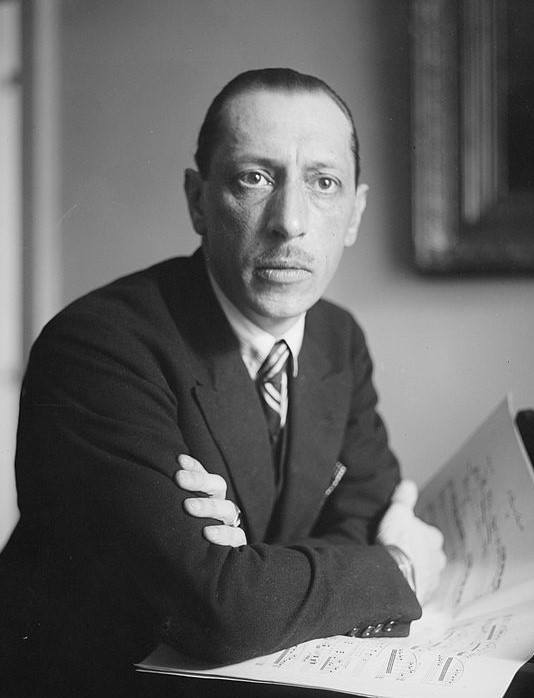
When Igor Stravinsky unveiled his “Four Norwegian Moods” in 1945, Pierre Boulez was appalled. Stravinsky had been a kind of god to him. The young man had been dissecting the score to “The Rite of Spring” under Olivier Messiaen at the Paris Conservatory. That the Master who had revealed to the world the unvarnished brutality of “The Rite” had retreated to a pastiche of Edvard Grieg, of all people – it was unforgivable. Boulez and his classmates booed vigorously.
Boulez must be spinning in his grave right now, as Stravinsky and Grieg will reunite for this week’s “Music from Marlboro.”
With a wintry mix in the forecast, our featured work for the hour will be Grieg’s String Quartet in G minor. Grieg wrote his quartet in 1877-78 while living on a farm in Hardanger. It’s a rare long-form piece from a composer generally typecast as a miniaturist.
From his letters, we know that Grieg was frustrated by his propensity for shorter works. “Nothing that I do satisfies me,” he wrote, “and though it seems to me that I have ideas, they neither soar nor take form when I proceed to the working out of something big.”
In addition to giving Grieg the opportunity to flex his creative muscle, the quartet may also reveal something of autobiographical significance. The work opens with a motto lifted from one of Grieg’s songs, “The Minstrel,” on a text by Henrik Ibsen. The poem tells of Hulder, a spirit from Norse mythology, who dwells in waterfalls and lures aspiring musicians with the promise to reveal art in music. However, in return for this invaluable gift, Hulder robs its recipient of both happiness and peace of mind.
Claude Debussy was also dismissive of Grieg’s music, which he famously derided as “pink bonbons filled with snow.” (What is it about the Norwegian’s music that could have so galled the Gauls?) That said, it has been convincingly demonstrated that Debussy owed more than a little to Grieg in the writing of his own String Quartet in G minor and in some of his piano miniatures.
We’ll hear a performance of the Grieg quartet from the 2002 Marlboro Music Festival, featuring violinists Ayano Ninomiya and Sharon Roffman, violist Teng Li, and cellist David Soyer.
Beyond its overt Norwegianisms, what really put Boulez over the edge about the “Four Norwegian Moods” was Stravinsky’s embrace of neoclassicism. Boulez, an austere disciple of the serialist techniques advocated by Arnold Schoenberg and his circle, would later conduct and record Stravinsky’s very neoclassical “Pulcinella.” Perhaps he softened his stance somewhat in light of Stravinsky’s late conversion to the serial cause.
In any case, one wonders what Boulez would have made of the “Octet for Wind Instruments.” Composed in 1922, this is the work with which Stravinsky really threw down the gauntlet as neoclassicism’s foremost champion.
We’ll hear it performed at Marlboro in 1968 by flutist Paula Robison, clarinetist Larry Combs, bassoonists Sol Schoenbach and Thomas Woodhams, trumpeters Henry Nowak and Ronald Anderson, and trombonists John Swallow and Richard Rodda, all directed by Leon Kirchner.
The weather outside is frightful. Cozy in with an abominable bouillabaisse for Boulez, on the next “Music from Marlboro,” this Wednesday evening at 6:00 EST, on WWFM – The Classical Network and wwfm.org.
Marlboro School of Music and Festival: Official Page
Leave a Reply