Here comes my annual post on Christoph Willibald Gluck (1714-1787).
For a man whose surname means “happiness,” he certainly could be a mercurial fellow.
Once, during an appearance at London’s Haymarket Theatre, Gluck strode onstage, not to sit down at a keyboard or to wow his audience on a stringed instrument. Instead he picked up two sticks and started to play an array of glasses filled with different levels of water – to the accompaniment of symphony orchestra. That’s just the kind of guy he was.
Another time, when conducting, a double-bassist hit a wrong note, and Gluck got down on the floor and crawled on his hands and knees through the tangle of humanity until he reached the offender and gave him a violent pinch. That too was the kind of guy he was.
He once had his piano carried out to a field to demonstrate that he enjoyed composing in nature. Perhaps this is just the kind of behavior one should expect from the composer of “Dance of the Blessed Spirits.”
We are forever hearing about Gluck – if we hear about him at all, that is – as being a reformer, and in truth his influence on the future of opera was incalculable. He shunned floridity for its own sake. Despite his evident love of nature, he was not a sensualist. He rebelled against the superficial effects of “opera seria,” with its showy arias ornamented beyond recognition by star castrati, to arrive at something closer to naturalism.
With Gluck, words and music bore equal weight. Drama was of the foremost importance. He tossed out the dry recitative to create a more continuous flow in the action. Performers took a back seat to emotional truth. The effect was kind of a chaste grandeur, simplicity at the service of theatrical power. Works like “Orfeo ed Euridice” and “Alceste” were radical for their time.
Gluck’s influence runs through Mozart to Weber, Berlioz and Wagner. Yet today his works are less frequently performed than those of any of his followers.
Find out more about Gluck in “Gluck the Reformer” (featuring John Eliot Gardiner, William Christie and others):
Happy birthday, Gluck. Please don’t pinch me if I got it wrong!
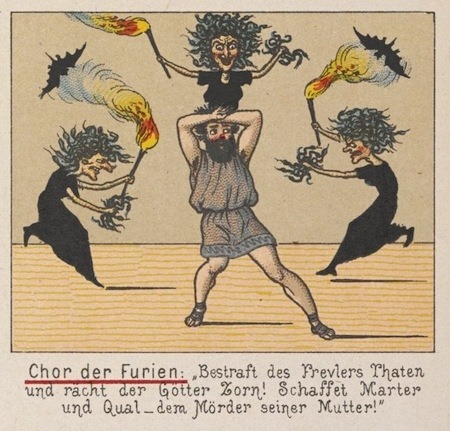
Chorus of the Furies from “Iphigénie en Tauride” (1778)
Leave a Reply