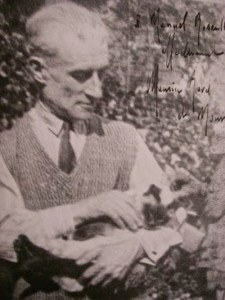
It’s a Mallarmé marmalade, served up on French toast, on the next “Music from Marlboro.”
While, for the most part, Claude Debussy and Maurice Ravel maintained a certain degree of respect for one another, both men were very possessive of Stéphane Mallarmé.
Debussy had changed the course of music history with his dreamy translation into sound of Mallarmé’s poem, “L’après-midi d’un faune.” Musicians at the fin de siècle all sat up and took notice – aligning themselves into factions pro and con – but reportedly Mallarmé himself was not all that thrilled, believing the music inherent in his verse to be sufficient. Once he actually attended a performance of the work, however, you might say he changed his tune.
It’s understandable, then, that Debussy would feel a certain sense of ownership when it came to setting Mallarmé to music.
Debussy’s “Prélude à l’après-midi d’un faune” appeared in 1894. Mallarmé died in 1898. The first complete edition of Mallarmé’s poems did not appear until 1913. 1913, you’ll recall, was a revolutionary year in the arts, with controversies stirred by the Armory Show in New York City, Schoenberg’s Skandalkonzert in Vienna, and the premiere of “The Rite of Spring” in Paris.
It was against this backdrop that the Debussy-Ravel rivalry would intensify. Ravel, proclaiming that Mallarmé was the greatest of all French poets, determined to secure the rights to set two of his poems, beating Debussy, who had applied for the same, to the punch. Though publicly Ravel remained good-humored about the coincidence, Stravinsky observed that the two composers did not speak to one another for a year.
In the event, both set Mallarmé’s “Soupir” (“Sigh”) and “Placet futile” (“Futile Petition”). Opinion was divided as to their success. Stravinsky thought Ravel’s settings his favorites among all the composer’s works. (Of course, Ravel had dedicated the first of the songs to him.) Stravinsky even referenced “Placet futile” when he came to write “A Soldier’s Tale.” On the debit side, Charles Koechlin complained that if you didn’t already know Mallarmé’s poems, you couldn’t possibly understand the texts.
The two songs had originally been planned as a balanced set, but then Ravel decided to add a third, “Surgi de la croupe et du bond” (“Rising from the Crupper and Leap”), which he described as the strangest and most hermetic. That, he dedicated to Erik Satie.
Though Ravel had not heard Schoenberg’s “Pierrot Lunaire,” composed the previous year, there must have been something in the air. Ravel was eager to explore the coloristic possibilities of a chamber ensemble in supporting Mallarmé’s symbolist texts. For the final song, he would stretch his harmonic syntax beyond the bounds of tonality.
Graciously, Debussy ended their estrangement by complimenting Ravel for possessing “the most refined [musical ear] there ever has been.”
We’ll hear Ravel’s “Trois poèmes de Mallarmé,” performed by mezzo-soprano Mary Westbrook-Geha and an ensemble of eleven instrumentalists at the 1989 Marlboro Music Festival. Then we’ll give Debussy his due, with a performance of his revolutionary String Quartet in G minor, performed by violinists Joseph Lin and Judy Kang, violist Richard O’Neill, and cellist David Soyer, on tour at the Isabella Stewart Gardner Museum in Boston in 2002.
I hope you’ll pardon my French, on this week’s “Music from Marlboro,” Wednesday evening at 6:00 EDT, on WWFM – The Classical Network and wwfm.org.
Marlboro School of Music and Festival: Official Page
PHOTOS: Gentlemen, choose your weapons!
Leave a Reply