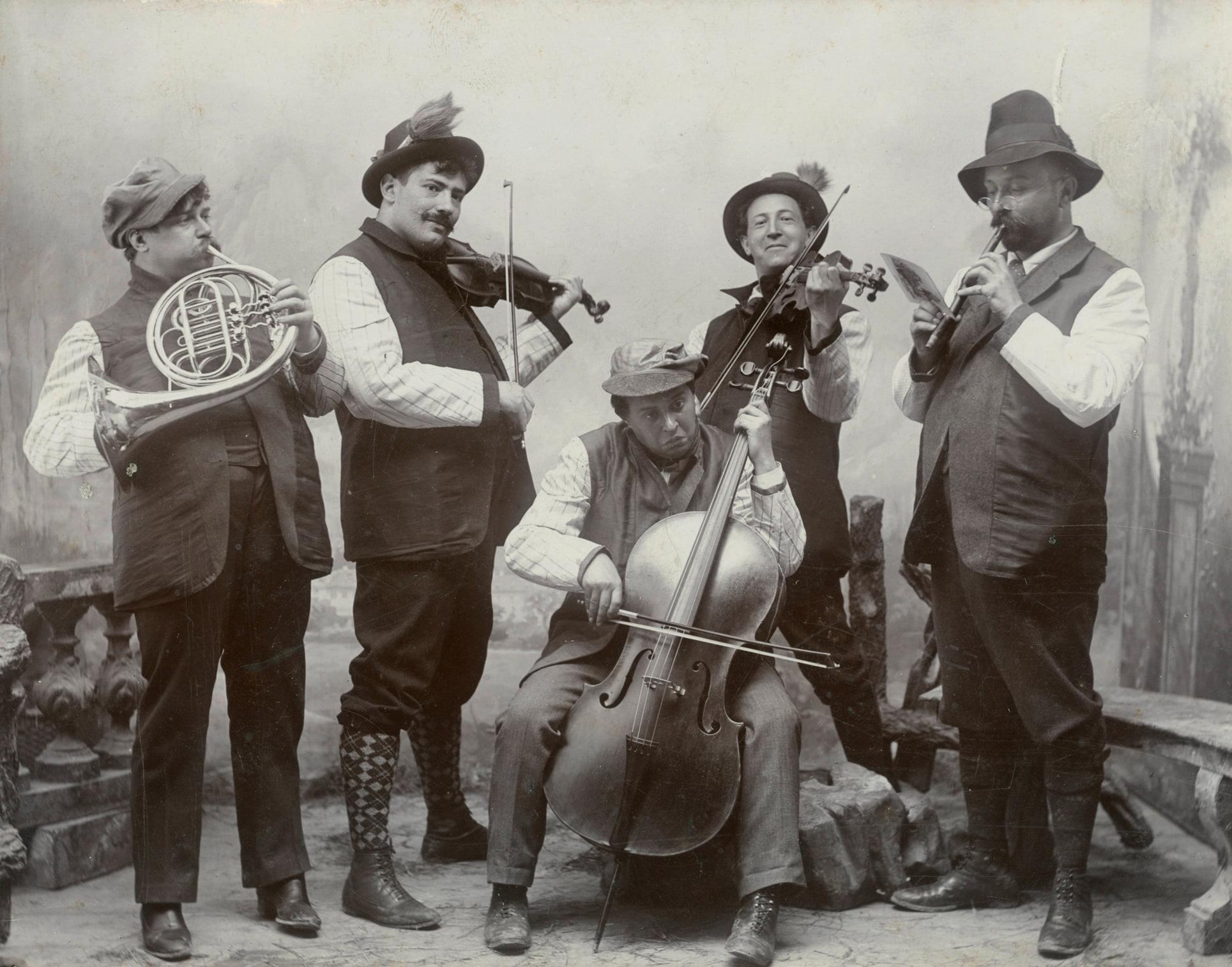
Fritz Kreisler, the sweet-toned confectioner and purveyor of violin bonbons, and Arnold Schoenberg, the dour high priest of twelve tone music. Vienna’s fin-de-siècle odd couple reunite on this week’s “Music from Marlboro.”
Both artists were born in Vienna, only five months apart – Schoenberg on September 13, 1874, and Kreisler on February 2, 1875. Kreisler’s father was a doctor. Schoenberg’s sold shoes.
Both had Jewish parents. Kreisler, whose mother was Catholic, was baptized into the faith at the age of 12. Schoenberg converted to Lutheranism at 24. However, just when it would have been most dangerous to do so, he roared back to Judaism and – with the rise of Hitler in 1933 – defiantly embraced his heritage.
In general, Kreisler seems to have enjoyed the easier life. He had a more comfortable start and a happier disposition. As a musician, he was content to entertain.
Schoenberg was a revolutionary and probably a bit of a hard-nosed contrarian. He had a turbulent marriage, seldom smiled for photos, and indulged in expressionist painting. Also, he was superstitious. He especially suffered from triskaidekaphobia, fear of the number 13.
On the other hand, he did orchestrate his share of Viennese operettas, arranged Strauss waltzes for performance with his friends, played tennis with George Gershwin, and was a fan of Hopalong Cassidy.
Both men came to be regarded in some circles as mountebanks. Kreisler ruffled a few feathers when he let slip that many of the 18th century “rediscoveries” he had used to charm audiences, critics and musicologists were not in fact rediscoveries at all. Nor did they date from the 18th century. When the professionals complained, Kreisler made like Vinnie Barbarino. Wha-? Schoenberg triggered kneejerk reviews and outright hostility with his dismantling of tonality.
Nevertheless, both also acquired some serious musical credentials. Kreisler gave the world premiere of the Elgar Violin Concerto and became a favorite recital partner of Sergei Rachmaninoff. Schoenberg blossomed into one the most influential composers of the 20th century.
In 1941, Kreisler was hit by a milk truck, which fractured his skull and put him into a coma. Like something out of an early Woody Allen comedy, when he awoke he could only communicate in Latin and Greek. Thankfully, the effect was only temporary.
It is Kreisler’s music that continues to communicate most effectively. We’ll hear his String Quartet in A minor, from 1922, performed at the 2013 Marlboro Music Festival by violinists Danbi Um and Nikki Chopi, violist Sally Chisolm, and cellist Lionel Cottet.
That will be followed by Schoenberg’s Chamber Symphony No. 1 of 1906, a pre-serial work that nevertheless pushes harmony to the brink. It was presented at Marlboro in 1982 by an ensemble of fifteen players directed by Leon Kirchner.
Was the glass half empty or the milk truck half full? Kreisler lived a good long life. He died in 1962 at the age of 86. Schoenberg died on his 76th birthday, Friday the 13th, 1951. Earlier in the day, he had been informed by his astrologer that 7 plus 6 equals 13.
No matter how you tally, the performances will be top-notch on the next “Music from Marlboro,” this Wednesday evening at 6:00 EDT, on WWFM – The Classical Network and wwfm.org.
Marlboro School of Music and Festival: Official Page
PHOTO: Fritz Kreisler (second from left) and Arnold Schoenberg (cello) in 1900
Leave a Reply