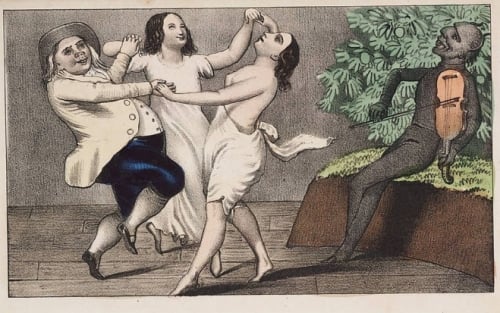
Franz Liszt (1811-1886) was quite the complex personality. A devout Catholic his entire life, he even took minor orders and lived in a monastery for a few years in middle age. However, as one of the performer-superstars of his youth, he was also frequently tempted by the pleasures of the flesh. And, as Oscar Wilde memorably observed, “The only way to get rid of temptation is to yield to it.”
In common with many artists of the Romantic era, Liszt was fascinated by the contradictions inherent in the character of Faust, the dissatisfied man of learning who sells his soul to the devil as a means to increase his knowledge through worldly experience.
Perhaps something in the Faustian character appealed to Liszt more than most. In his pursuit of loftier ideals, Liszt was certainly aware of his feet of clay. This Sunday night on “The Lost Chord,” we’ll experience the friction between striving artist and earthly pleasures in a selection of Liszt’s diabolical dances for the keyboard.
We’ll hear several of his “Mephisto Waltzes,” a “Mephisto Polka,” the “Czardas Macabre,” and two operatic paraphrases, on “Robert le Diable” (a “valse infernale”) and Gounod’s “Faust.”
Some of these are straight-ahead knuckle-busters, hair-raising feats of prestidigitation; others aim to gently unsettle with the interval of a tritone – known for centuries as “the devil in music” – or by blurring into a kind of tonal ambiguity, foreshadowing musical experiments of the 20th century.
A profound thinker and a grand provocateur, Liszt, like Faust, was always questing. That said, he seldom undersold the visceral thrill of a precipitous piano run or the simple pleasure of a good tune.
Get ready to surrender to temptation with “A Fistful of Mephistos” – an hour diabolical dances – this Sunday night at 10:00 EDT, on WWFM – The Classical Network and wwfm.org.
Leave a Reply