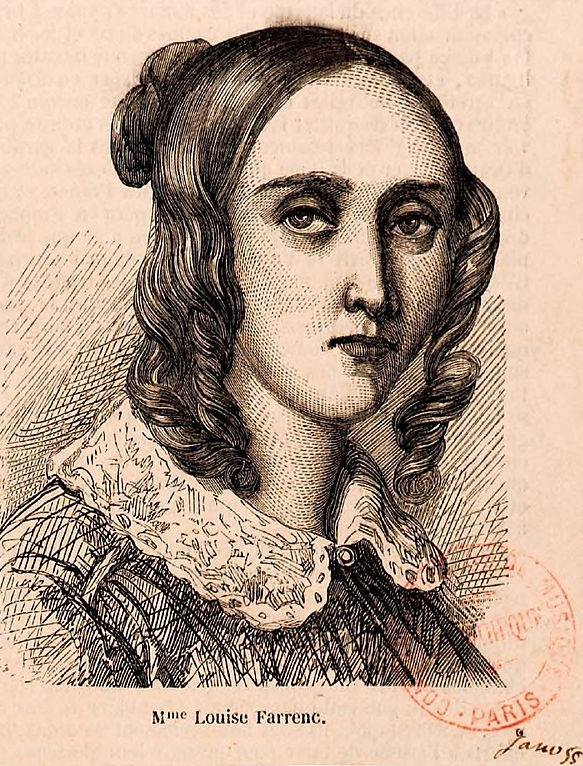
Nearly 150 years after her death, composer Louise Farrenc is finally coming into her own. Farrenc (1804-1875) was the only female musician on the faculty of the Paris Conservatory during the whole of the 19th century. Of course, she was only allowed to teach women.
This Sunday night on “The Lost Chord,” we’ll hear Farrenc’s remarkable Third Symphony, on a program of music by three neglected French Romantics.
A pupil of Moscheles (teacher of Mendelssohn) and Hummel (who studied with Mozart), Farrenc was a formidable pianist, who also took private lessons with Conservatory professor Anton Reicha. She paused in her career as a performer in order to start a successful publishing house, with her husband, Éditions Farrenc, which flourished for nearly 40 years.
Beginning in 1842, Farrenc was finally accepted it into the Paris Conservatory, as a professor. There, she taught piano, but not composition. However, her stature was such that she was able to demand – and receive – equal pay.
We’ll also hear music by Augusta Holmès (1847- 1903), French composer of Irish ancestry. Holmès received encouragement from Liszt and Wagner, as well as multiple marriage proposals from Saint-Saëns (which she declined). She became a pupil of César Franck. It’s said that Franck’s Piano Quintet enshrines the teacher’s ardent longing for his student. Saint-Saëns, who participated in the work’s scandalous premiere, was not amused.
Holmès will be represented by her symphonic poem “Andromède,” from 1883. Andromeda, you may recall from Greek mythology, is the daughter of Cassiopeia, who incurs the wrath of the gods when she brags of Andromeda’s extraordinary beauty (comparing her favorably to the Nereids). Andromeda is chained to a rock as a sacrifice to a sea serpent, but rescued from her fate by Perseus, who arrives just in the nick of time, astride the winged horse Pegasus and bearing the severed head of the Gorgon Medusa, with which he turns the serpent to stone.
Finally, Marie Gandval (1830-1907) studied with Flotow, then Chopin, and later Saint-Saëns. Saint-Saëns dedicated his Christmas Oratorio to her. She was the most frequently performed composer on concerts of the Société Nationale de Musique. The Société was founded by Saint-Saëns with an aim to promote orchestral music, which he found underserved in opera-mad France, where orchestras were tied to the theatres. Grandval herself was a composer of opera and choral music, but tonight there will be just enough time for her “Deux pièces” for oboe, cello and piano.
Look for the women on “Cherchez la Femme,” this Sunday night at 10:00 EDT, on WWFM – The Classical Network and wwfm.org.
Leave a Reply