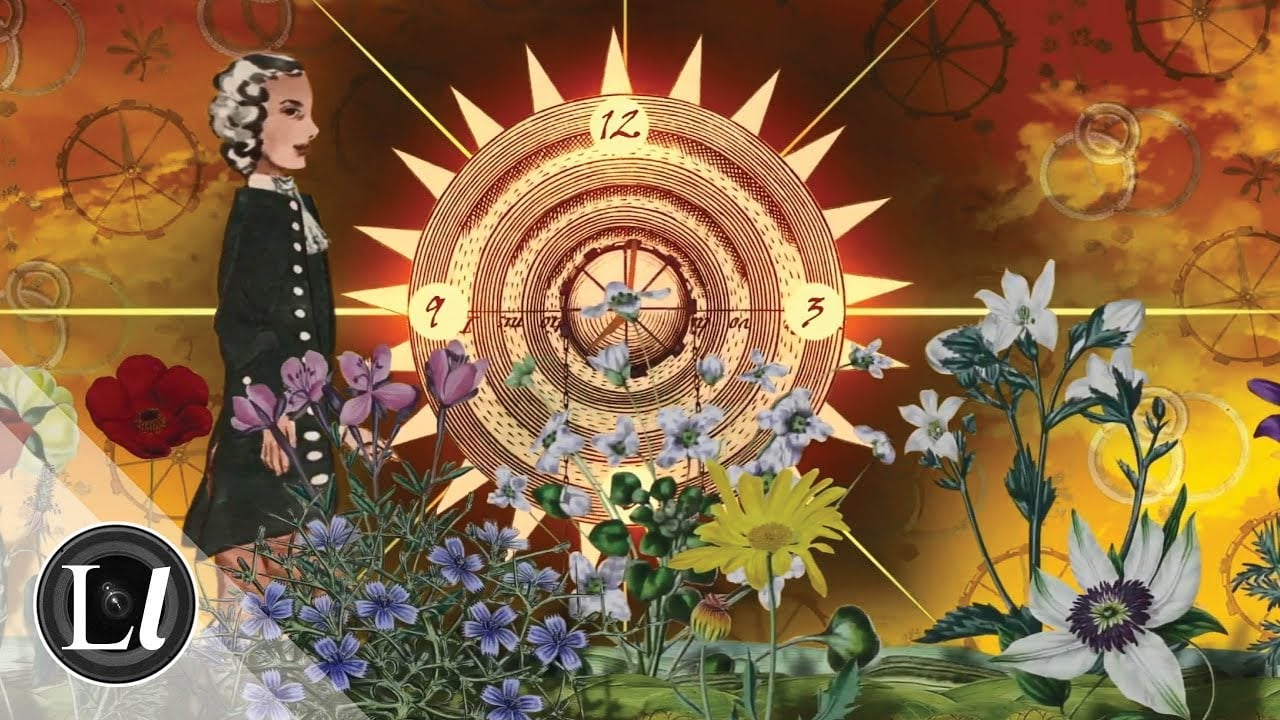
After several nights of frost, I suppose it’s pointless to try to figure out how to reset my floral clock. I hope you have more success tonight, as we “fall back” to standard time.
Jean Françaix completed his “L’Horloge de flore” (“The Flower Clock”) in 1959, on a commission from principal oboist of the Philadelphia Orchestra, John de Lancie. The suite falls into seven movements, each of which corresponds with a flower whose blooms open at a certain time of day.
The first floral clock was formulated by Carl Linnaeus back in 1748. His idea was “old school” and therefore, depending on vagaries of weather, season, and latitude, subject to many idiosyncrasies. One should never coordinate one’s schedule around a floral clock.
The flowers in more recent clocks tend to be merely decorative, with large, mechanical hands making their way around a mostly floral face. Where’s the fun in that? I may as well just stick with my Kit-Cat clock.
To further add to your fount of useless knowledge, Jean Françaix’s surname is of Flemish origin. He always pronounced the “x.” English-speaking radio announcers, on the other hand, almost always pronounce it in the French manner, as “Fron-SAY.”
Over the years, I have used the “x” on most occasions. Unfortunately, then I wind up feeling sheepish about it and am compelled to explain, so that listeners don’t think I’m a total idiot. Just pedantic. I confess, there have been times when I haven’t felt like dealing with it and just said “Fron-SAY.” Lord knows, I’ve done more transparently idiotic things.
Interestingly, I just learned that Michael Jackson had a floral clock at his Neverland Ranch (presumably of the more modern variety). Even a broken clock is right twice a day. When you wake up tomorrow morning and it’s still the middle of the night, just remember: the time change brings with it an extra hour of autumn!
Françaix, “L’Horloge de flore”
More about Carl Linnaeus’ Flower Clock
Keep the “sex” in Françaix (said “Fron-SEX”)!
Leave a Reply to https://1win-aviator.amibak.kz/Cancel reply