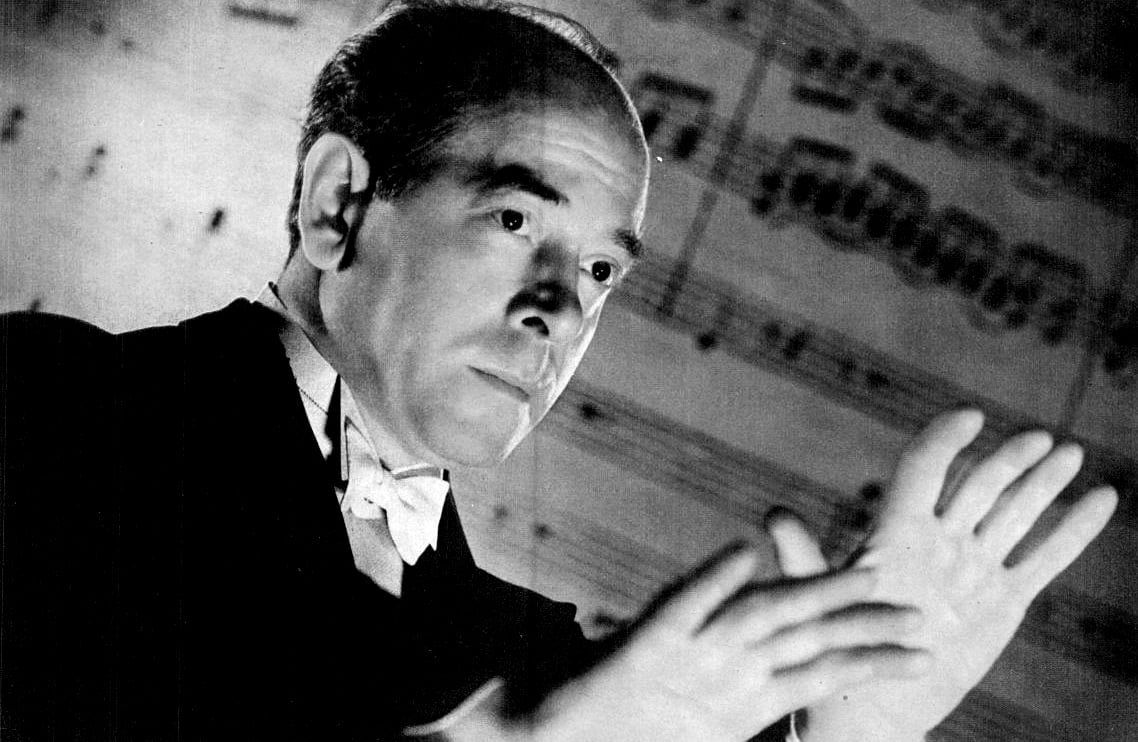
What’s the big deal about this guy, Jenő Blau? Well, you probably know him better by his adopted name, Eugene Ormandy.
Ormandy, a Hungarian-born violinist who studied with Jenő Hubay (for whom he was named), became a naturalized American citizen in 1927. Ultimately, he wound up directing The Philadelphia Orchestra for 44 years. In that capacity, he became one of the world’s most-recorded conductors.
However, in some respects, he remains a vastly underrated one.
In May, I breathlessly announced my acquisition of “Eugene Ormandy: The Columbia Legacy,” a 13-pound box set of 120 compact discs, newly remastered from original analogue sources, recorded between 1944 and 1958. I am just over halfway through my first, attentive journey through its contents, and I have no hesitation in proclaiming it the release of the year.
At worst, there a handful of performances that never take flight as perhaps they should, and one or two interpretive misfires (I hasten to add, the execution is always impeccable), but by a staggering margin, the quality of the music-making documented in this set is both stunning and revelatory.
It astounds me that any of the old saws about Ormandy being “workman-like,” a mere custodian of Stokowski’s “Philadelphia sound,” and too commercially successful ever to be taken seriously have not been exploded, once and for all.
However, it remains obvious that, even with the evidence now freshly before their ears, some critics remain blinded by their preconceptions. How else to explain the blinkered, damning-with-faint-praise reception in the venerable British music magazine Gramophone and in The New York Times?
The box is a knockout. Yes, the recordings are in mono, but there’s a vitality to the music-making that lights up the room. I’d be first in line for a sequel, in the form of an authorized box of Ormandy’s Columbia stereo recordings.
But take your time, Sony Classical. There’s still plenty here for me to enjoy.
One of my favorite Ormandy records was also one of his later ones, this one made for EMI. Throughout his career Ormandy succeeded in selling Sibelius’ “Four Legends from the Kalevala,” a collection of tone poems inspired by the Finnish national epic the “Kalevala,” for the early masterpiece that it is.
The legendary Philadelphia strings in Vaughan Williams’ “Fantasia on a Theme by Thomas Tallis”
Hindemith, “Concert Music for Strings and Brass” (the movements uploaded individually into a playlist)
Ivan Davis joins Ormandy and the Philadelphians for Liszt’s “Hungarian Fantasy,” slightly abridged:
Bruckner “Te Deum” with Temple University Choir
World premiere performance of Samuel Barber’s Violin Concerto
Shostakovich Symphony No. 4
Reinhold Glière’s “Russian Sailor’s Dance”
Rachmaninoff Piano Concerto No. 2, with Eugene Istomin
Ormandy conducts “Scheherazade” (complete). This is the Philly Orchestra I remember from my college years.
Debussy, “Reverie”
Saint-Saens’ Symphony No. 3 “Organ”
Happy birthday, Eugene Ormandy (1899-1985)!
Leave a Reply to moonashop.kzCancel reply