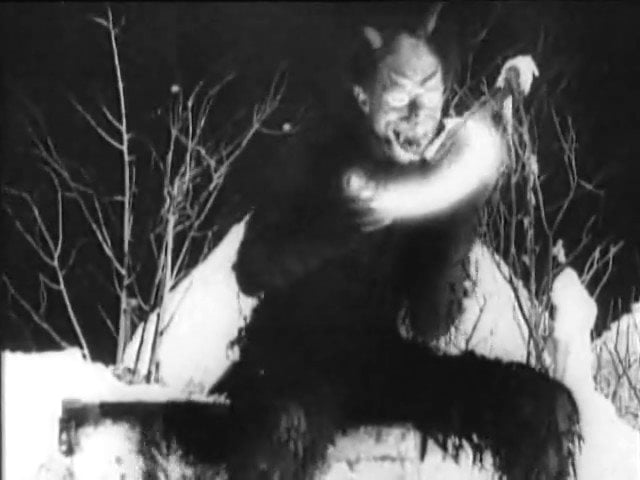
Only ten days into the month of December, and you’re already played-out on all the tinsel and consumerism? Reinvigorate your Christmas spirit with Nikolai Rimsky-Korsakov and Władysław Starewicz!
Rimsky-Korsakov’s “Christmas Eve” was given its first performance at St. Petersburg’s Mariinsky Theater on this date in 1895. The opera, based on a story from Nikolai Gogol’s collection “Evenings on a Farm Near Dikanka,” is part fairy tale and part farce. Gogol’s source material is steeped in Ukrainian folklore.
In Ukraine, Christmas Eve is a solemn occasion, marked by fasts and sacred services. Meatless dishes are served for Holy Night supper. But there are also carols. And the caroling is no simple singing of Christmas songs! Similar to the mumming traditions of the British Isles, there is also a fair amount of play involved, with ritualistic dancing and even the participation of a live goat. As in the West, pre-Christian symbols and rituals are embraced in the celebration of Christmas, to lend cheer to the shortest days and hope for a fertile spring.
With this in mind, is it any surprise that Gogol’s story tells of the theft of the moon by the Devil, amorous peasants secreting themselves in burlap sacks, and a ride through the air, on the Devil’s back, to collect the Tsarina’s slippers?
My preferred recording of Rimsky-Korsakov’s “Christmas Eve” is still the one from 1948, conducted by Nikolai Golovanov:
In 1912, Starewicz, Polish-born Russian pioneer of stop-motion animation, directed a live-action adaptation of the tale, called “The Night Before Christmas.” Here it’s silent, so you’ll have to provide your own soundtrack. At least the intertitles are translated:
More wondrous still is Starewicz’s animated classic, “The Insects’ Christmas,” from 1911. It’s not Christmas until beetles skate to Tchaikovsky’s “The Seasons.” Watch it now and be astonished!
Starewicz directed a number of films on subjects that were also made into operas, by Rimsky, Tchaikovsky, Mussorgsky, and Glinka, including adaptations of “Russlan and Ludmilla” (1913), “The Snow Maiden” (1914), “The Sorotchninsk Fair” (1918), and “May Night” (1918).
With the holidays awash in silver and gold, I’ll be soaking in horilka for Christmas.
Z Rizdvom Khrystovym!
Leave a Reply