One hundred years ago, in the same week as the debut of Carl Nielsen’s Symphony No. 5, another war symphony received its first performance. Ralph Vaughan Williams’ “A Pastoral Symphony” was given its premiere on January 26, 1922.
What’s that? “A Pastoral Symphony,” a war symphony? From the pen of Uncle Ralph???
Vaughan Williams may very well be enshrined in our collective memory as the embodiment of rural contentment. But that aspect of the composer, while clearly appealing to some (among whom I count myself), tends to limit his currency. Which is a shame – especially in this, his sesquicentennial year – as it really is only one facet of a larger, more complicated personality.
A good many of RVW’s bucolic reveries are tinged with a sense of lost innocence, and in more ambitious works like the Third Symphony, there is a haunted undercurrent that belies its idyllic moniker.
The very title is an invitation to misunderstanding. As the composer emphasized, what he attempts to convey in the symphony is “not really Lambkins frisking at all, as most people take for granted.”
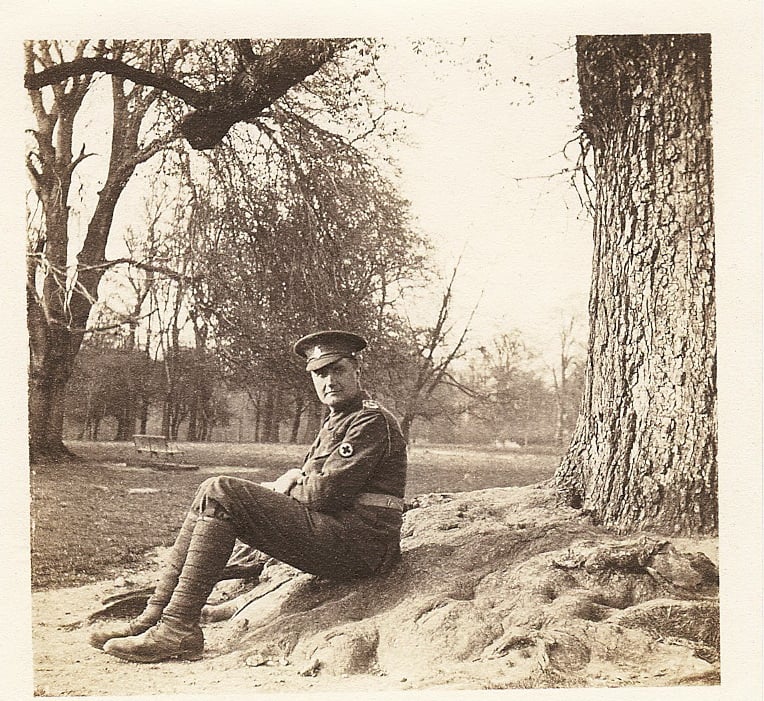
Vaughan Williams served with the Royal Army Medical Corps in France during the First World War – service from which he could easily have been exempted on account of his age (he was 42 years-old), but he was insistent about doing his part. His duties in this capacity placed him on the front lines, as he recovered wounded and dying soldiers from areas under heavy bombardment. Some of these rescues took place at night, in no-man’s land, as he staggered with an unwieldy stretcher over uneven ground in total darkness.
At the end of a day, he would drive his ambulance up to the top of a hill to take in the Corot-like landscape at sunset, while listening to a bugler practice the “Last Post.” The execution could be a little rough at times. Once, instead of an octave, the bugler accidentally hit the interval of a seventh. The trumpet solo in the second movement of “A Pastoral Symphony” recollects this experience. The work is pastoral, all right. As peaceful as the dead.
At 45, Vaughan Williams became a second lieutenant in the Royal Garrison Artillery. Prolonged exposure to shell fire from the 60-pounder guns took its toll on his hearing and likely contributed to his deafness later in life. On one occasion, he also drove 200 horses on a retreat, to get them out of harm’s way.
He saw his share of horrors, to be sure. He also lost too many friends. A number of these were promising young artists, like the composer George Butterworth, cut down at the Battle of the Somme at the age of 31. Butterworth was the primary reason for Vaughan Williams ever tackling an orchestral symphony to begin with. (You’ll recall, the First Symphony, “A Sea Symphony,” was a large-scale work for chorus and orchestra.) Butterworth was indispensable in guiding the composition of RVW’s Symphony No. 2, “A London Symphony,” which Vaughan Williams dedicated to him.
It’s sobering to contemplate that had Vaughan Williams himself died in the conflict, he would have been a two-symphony composer. As it was, he lived to complete nine. He died in 1958, only months after the premiere of his Ninth Symphony, at the age of 85.
RVW cast his “Pastoral Symphony” in four movements, “all of them slow.” That may be, but I always think of the galumphing third movement, which the composer described as a slow dance, as rather Falstaffian.
The last movement includes a wordless part for soprano. It comes to us like the song of a distant milkmaid. But there is also something ghostly about it. Perhaps the composer intended to suggest that the distance in this case is not merely spatial, but temporal. Agrarian innocence has been gassed, shredded by bullets, and shelled to pieces.
Imagine someone born in 1872, who lived into the mid-20th century, and all the changes he must have experienced in his lifetime. I often reflect on composers of that generation and how quickly the old world must have faded for them. Hell, the older I get, the more it’s happening to me.
Vaughan Williams, like his Hungarian counterparts, Béla Bartók and Zoltán Kodály, recognized that the world was accelerating and that many of his country’s traditions were hanging on by a thread. It is part of what spurred RVW and his colleague, Gustav Holst, to hit the muddy back roads of the provinces, to document as many folk songs as they could, before they were all swept away, ground up and swallowed by an increasingly homogenous, mechanized world. Vaughan Williams may not have foreseen television, or chain stores, or pop culture, or the internet, but he knew that transformation was in the air.
On its surface, English pastoralism is warm and sentimental. It provides a nostalgic escape, an illusory security in tradition. But in works like “A Pastoral Symphony,” it can also serve as a kind of elegy, a memorial for a faded world.
“A Pastoral Symphony,” conducted by Sir Adrian Boult in 1968. Boult conducted the work’s first performance on this date in 1922.
George Butterworth, “A Shropshire Lad,” from 1912. The composer was 27 years old. Four years later, he was felled by a sniper’s bullet.
Leave a Reply to Mega Moolah ItaliaCancel reply