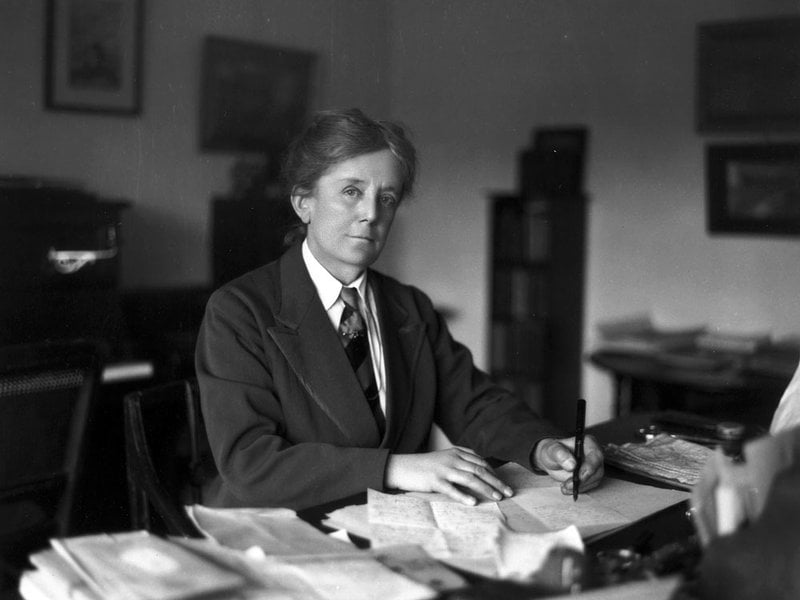
Well, I finally finished reading Dame Ethel Smyth’s memoirs a few days ago. In fact, I wrote this the following morning, but am only just getting around to smoothing it out.
While I wouldn’t modify my assessment that, for a published work, Smyth takes up an awful lot of space bringing in way too many names of people we never get to know, so that it becomes a chore for the reader to try to keep most of them straight – as I indicated, the memoirs have been distilled from multiple volumes, so the effect might have been exacerbated in part by the book’s editors (who try to make up for it with the inclusion of a glossary of “biographical notes”) – I did indeed find the concluding sections especially poignant.
Smyth struggled her entire life to get her music heard, and in my opinion, she did an amazing job for the era, and with so much stacked against her. Her foremost impediment, of course, was that she was a woman, which automatically restricted her acceptance in a male-dominated profession. I mean, women didn’t even have the right to vote. (At a point, she would become passionately involved with the women’s suffrage movement.)
She also enjoyed actually having a life. So while by no means unproductive, she made time whenever she could to engage in sport and walk with her dogs and plant her garden and bicycle and visit with friends. For these reasons, among others, she preferred to live outside the musical center of London, which she found both physically and psychologically restrictive. She couldn’t bear the thought of prolonged city life. She adored her pets, and her account of her relationship with her last sheepdog, Pan the Fourth, will move anyone who has ever loved an animal.
Of course, she also had other distractions. She virtually walked away from composition for two years to devote herself to the cause of women’s suffrage in England (for which she served time in prison for knocking out windows with stones). And personality-wise, she was always very forthright and wouldn’t take no for an answer. I would argue, for the era, it helped her more than it hurt her, but she felt it alienated some who might have helped her. Certainly it did not put off Thomas Beecham or Henry Wood or Bruno Walter or any number of other important musical figures who championed her music along the way.
Unquestionably, she was a celebrity. If her contemporaries heard comparatively little of her music, they knew of her character and exploits. Furthermore, she wrote prolifically, issuing ten autobiographical volumes (from which the one-volume “Memoirs” was extracted). She received a laudatory entry in the 1908 edition of “Grove’s Dictionary of Music and Musicians,” for her 50th year. In 1922, she became the first female composer to be honored with a damehood. And in 1934, at 75, a festival was organized of her music, which again was conducted by Beecham. Unfortunately, by then, she was stone deaf.
She pursued opera in a country without a strong operatic tradition, and therefore spent too much time in foreign lands, especially Germany, chasing down and creating opportunities. Her opera “Der Wald” was heard at New York’s Metropolitan Opera before it was ever heard in England. She had two of her operas all set to go in reputable opera houses in Germany, when Archduke Ferdinand was assassinated in Sarajevo, precipitating World War I. This was very bad luck indeed. But as Smyth observes, “Life has taught me one thing: when people fail to get over (or round) obstacles, it is never wholly the fault of other people.”
In fact, she is as clear-eyed about any personal shortcomings as she is the external factors that weighed against her. She is reflective and articulate, as any memoirist must be. There is an eerily prescient passage in which she speculates as to whether or not her music will ever be revived in future years.
“… [I]t amuses me to think that someday after my death, when all traces of my sex have been reduced to ashes at the Woking Crematorium (so handy!) someone will very likely take me up as a stunt – no extravagant assumption, seeing what subjects attain Stunt Rank these days! Then, together with the assembling of my musical remains, this Annex will be available, and the Stunt Raiser, lifting his eyebrows, can either burst out laughing (“O, come! You can’t put that across in England!”) or he can have those pages made into a fan and therewith fan the flame of the Stunt. And thus, someday, I may make friends, musically, with those I cannot get at in my lifetime.”
Keep in mind, this was an era when neglected scores were not digitized or maintained, but left to molder, if not in archives or libraries, then at home in drawers or on high shelves. She also muses wistfully that reviews that appeared in the foreign press were all but inaccessible to those of influence in her native land.
But she remained philosophical, and always grateful. The chapter “A Life Summed Up” conveys it best. “Blessed with friends, with health, spared the most wearing, the most disheartening form of the inevitable struggle for existence, what has or has not been achieved the days have been gloriously spent in the open. And if, digging from morn till eve, one has not unearthed exactly what one expected, all the while the treasure was being found.”
Smyth died on May 8, 1944, at the age of 86. What would she think now that so much of her music has been recorded, I wonder? All these years later, I am moved to think that she would never know. I am not one to promote music merely for political reasons, or to suit current trends in fashion. Smyth was a composer of merit, who felt acutely that she had something genuine to say. Her assessment was backed up by enough notable musicians of her time. Certainly, she was impeded by professional politics and social norms and current events and severe illness and just plain bad luck.
But even with all that stacked against her, she managed to make her mark. Ethel Smyth was a force to be reckoned with. And now, in the present day, the stage is set for a fairer assessment of her worth.
Leave a Reply to aviatorspribeotzyvyigrokov.kz/ru/Cancel reply