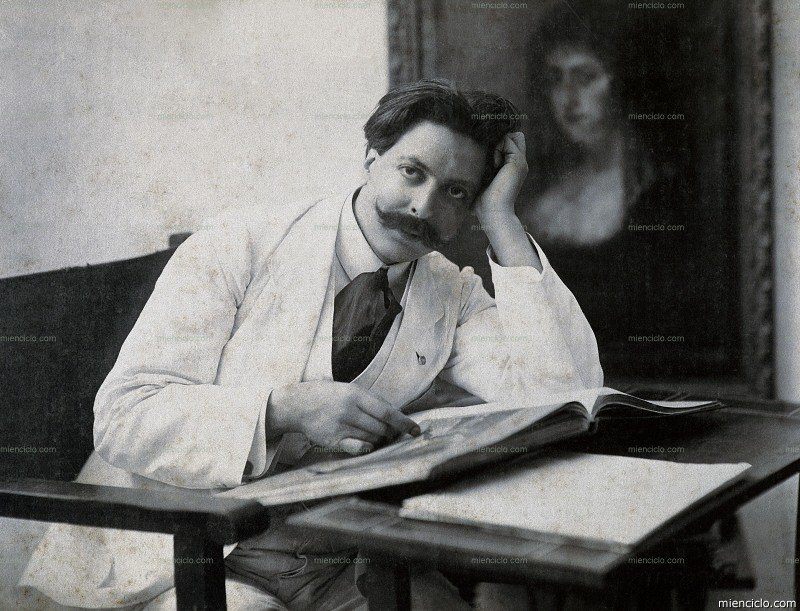
Yesterday, I wrote about the untimely death of Enrique Granados in connection with his delayed return from the U.S., after being invited to the White House by Woodrow Wilson following the sensational debut of his opera “Goyescas” at the Metropolitan Opera. Granados’ ship was torpedoed in the English Channel by a German U-boat, and the composer drowned when attempting to save his wife.
Granados was born on this date in 1867. He is best-remembered, of course, for his delectable piano miniatures, which contain music of great beauty and sensitivity. He’s sometimes described as “the Spanish Chopin.” I prefer to think of him as “the Spanish Grieg.” And that is not in any way to damn him with faint praise. He may be my favorite Spanish composer.
Here’s a pleasing recital by Pablo Matías Becerra (including “Valses poéticos,” Spanish Dance No. 2 “Oriental,” “El pelele,” Spanish Dance No. 7 “Arabesca,” “Allegro de concierto,” and “Escenas románticas”)
Anyone looking to gain a more comprehensive overview of the scope of Granados’ compositional output could do worse than to seek out three volumes of his orchestral works recorded by Pablo González and the Barcelona Symphony Orchestra and National Orchestra of Catalonia, on the Naxos label.
Also, a piece for piano, organ, and three choruses, called “Song of the Stars,” lost for nearly a century.
None of the orchestral pieces rise to the level of the piano music, in my opinion, but they all contain some very charming, wholly neglected music. One of the volumes includes a half-hour symphonic poem, “Dante” (little charm here, perhaps, but plenty of drama), which will surely modify your view of the composer.
Just before Granados’ fateful homeward journey from New York, he made some live-recorded player piano rolls for the Aeolian Company’s “Duo-Art” system. Here are two of them.
Granados playing “The Maiden and the Nightingale” from “Goyescas”
And the Spanish Dance No. 5 “Andaluza”
In 1909, he began a piano concerto. This was interrupted by “Song of the Stars” and the operatic version of “Goyescas.” The concerto would be left unfinished at the time of Granados’ death.
In 2011, the sketches were rediscovered and a realization undertaken. Keep in mind, the completed work is purely conjectural, the first movement built on two surviving fragments. The other movements were adapted from existing Granados works: the Spanish Dance No. 2 “Oriental” and “Capricho español” (for Movement II) and “Allegro de concierto” (for Movement III). Here’s a performance in concert.
An ironic footnote: one of the Granados’ sons, also named Enrique, became a champion swimmer, who competed in the 1952 Summer Olympics.
Happy birthday, Enrique Granados. And gracias.
Alicia de Larrocha plays “Goyescas,” in its original guise
The operatic version
Leave a Reply