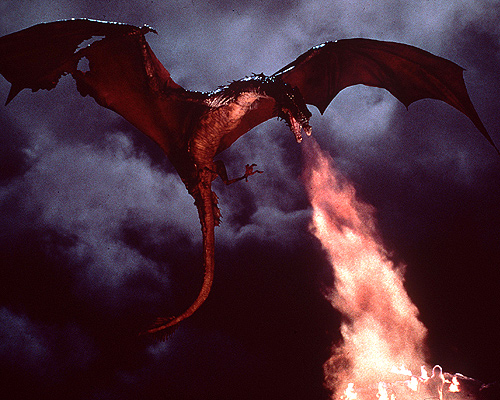
Prepared to get all fired up. This week on “Picture Perfect,” there be dragons!
Who doesn’t enjoy a good dragon movie? Unfortunately, there are so few of them. Inevitably, the stories fail to live up to the production design, the special effects, and, yes, often the music.
One score that Universal Pictures definitely took to, like a dragon to its hoard, was that for “Dragonheart” (1996). The film starred Dennis Quaid, with Sean Connery supplying the voice of the film’s dragon, Draco. The studio loved the music so much that it was used in its movie trailers for years, so don’t be surprised if you recognize it, even if you never saw the film. The composer was Randy Edelman.
Alex North wrote one of the finest dragon scores for “Dragonslayer” (1981). “Dragonslayer” caused a bit of stir on its release, since it was an early foray by Disney into more mature territory. The film featured shocking (for the time) onscreen immolations and dismemberment.
The story is a fairly generic sorcerer’s apprentice tale. However, the dragon, Vermithrax Pejorative, easily carries the movie, which also features a late performance by Sir Ralph Richardson as the master sorcerer. The composer reused portions of his rejected score for Stanley Kubrick’s “2001: A Space Odyssey.” A number of critics, including Pauline Kael, praised the result.
The film was nominated for an Academy Award for its outstanding visual effects, but lost out to “Raiders of the Lost Ark.” George Lucas’ Industrial Light and Magic provided the effects for both. In my humble assessment, Phil Tippett’s “go motion” dragon has yet to be surpassed.
Many years later, Disney competitor DreamWorks released “How to Train Your Dragon” (2010), a wholly computer-animated film. The story is one of forbidden friendship between a young Viking and a scaly representative of his tribe’s hereditary foes. Despite the Viking characters and setting, the score has an overt Celtic flavor and the actors speak with a Scottish burr (!). The music was by John Powell.
Purely animated films are often more successful in creating an organic, believable world than those supposedly “live action” films that place actors in front of green screens and surround them with video game pyrotechnics. Only director Peter Jackson could have devised a way to pad J.R.R. Tolkien’s classic bedtime story, “The Hobbit,” into three bloated installments, darkening the tone, tying it in with lore from Tolkien’s “The Silmarillion,” and self-consciously anticipating the events in the equally self-indulgent film versions of “The Lord of the Rings.”
Howard Shore supplied the music for all of the Middle Earth movies. He was recognized with three Academy Awards – one for “The Fellowship of the Ring,” in 2001, and two for “The Return of the King” in 2003, for which he also provided the Best Original Song. We’ll hear a selection of his music for the second of the films inspired by “The Hobbit,” subtitled “The Desolation of Smaug” (2013). The part of the dragon, by the way, was voiced by Benedict Cumberbatch.
Feel the burn! Fire your imagination and rekindle your affection for dragons, on “Picture Perfect,” music for the movies, this Saturday evening at 6:00 EST, on WWFM – The Classical Network and wwfm.org.
Leave a Reply to altogelCancel reply