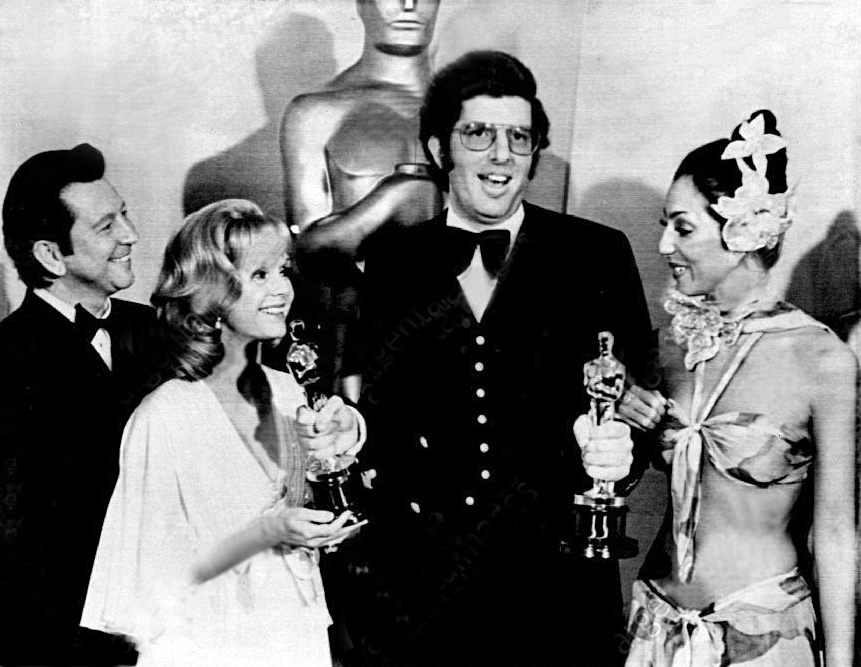
50 years ago today, Marvin Hamlisch made history at the 46th Academy Awards, when he became the first person ever to win in three music categories at the same Oscars ceremony. Hamlisch was honored with the awards for Best Original Score and Best Original Song (with Alan and Marilyn Bergman) for “The Way We Were,” and also in the rather cumbersomely-named category “Best Scoring: Original Song Score and Adaptation or Scoring: Adaptation,” for “The Sting.”
Hamlisch’s use of ragtime as the basis for his music for “The Sting” contributed enormously to the Scott Joplin revival of the 1970s. Suddenly everyone was pecking out “The Entertainer” on their pianos. Nevermind the fact that the prevalence of Joplin’s music in the film was anachronistic for a caper set during the 1930s; the music perfectly complemented the bright and breezy hijinks of Paul Newman and Robert Redford.
Hamlisch was only the second artist, after Richard Rodgers, to win all five of the major awards: Emmy (4), Grammy (4), Oscar (3), Tony (1), and, most unusually for a musical, the Pulitzer Prize for “A Chorus Line.”
Hamlisch thanked Joplin in his “Sting” acceptance speech. Later, when the nominees for Best Original Score were read, Cher made a repeated hash of Hamlisch’s name, until corrected by Henry Mancini. But Hamlisch had the last laugh, when he in turn acknowledged her as “Sheer.”
The presenters for the song-and-adaptation Oscar were Donald O’Connor and Debbie Reynolds. John Huston introduced Mancini and Cher. As a nice bonus, John Williams was also honored with two more nominations, pre-“Jaws.” Williams won his first Oscar, for adapting the music for “Fiddler on the Roof,” in 1972.
The ‘70s were a very good decade for Joplin, who died in 1917 at the age of 48. In 1970, Joshua Rifkin’s first LP of Joplin piano rags became a classical bestseller for Nonesuch Records. The same year, the composer was inducted into the Songwriter’s Hall of Fame. In 1973, Gunther Schuller revived period orchestrations of Joplin’s works for another recording, “The Red Back Book,” which won a Grammy.
Joplin’s opera, “Treemonisha,” was finally given its first complete staging in 1972. And in 1976, Joplin received a citation from the Pulitzer Prize committee “for his contributions to American music.” Of course, by then, he had already been dead for 59 years.
More than anything, it was the use of his rags on the soundtrack for “The Sting,” and the resulting Top-40 status of “The Entertainer” (which reached number 3 on the Billboard charts), that brought Joplin roaring back into the popular consciousness.
Intriguingly, after Hamlisch’s death in 2012, it was revealed that he had been poised to succeed Peter Nero as music director of the Philly Pops, leaving us in the Philadelphia area to muse on what might have been.
More than just a singular sensation, Marvin Hamlisch was the one.
Leave a Reply