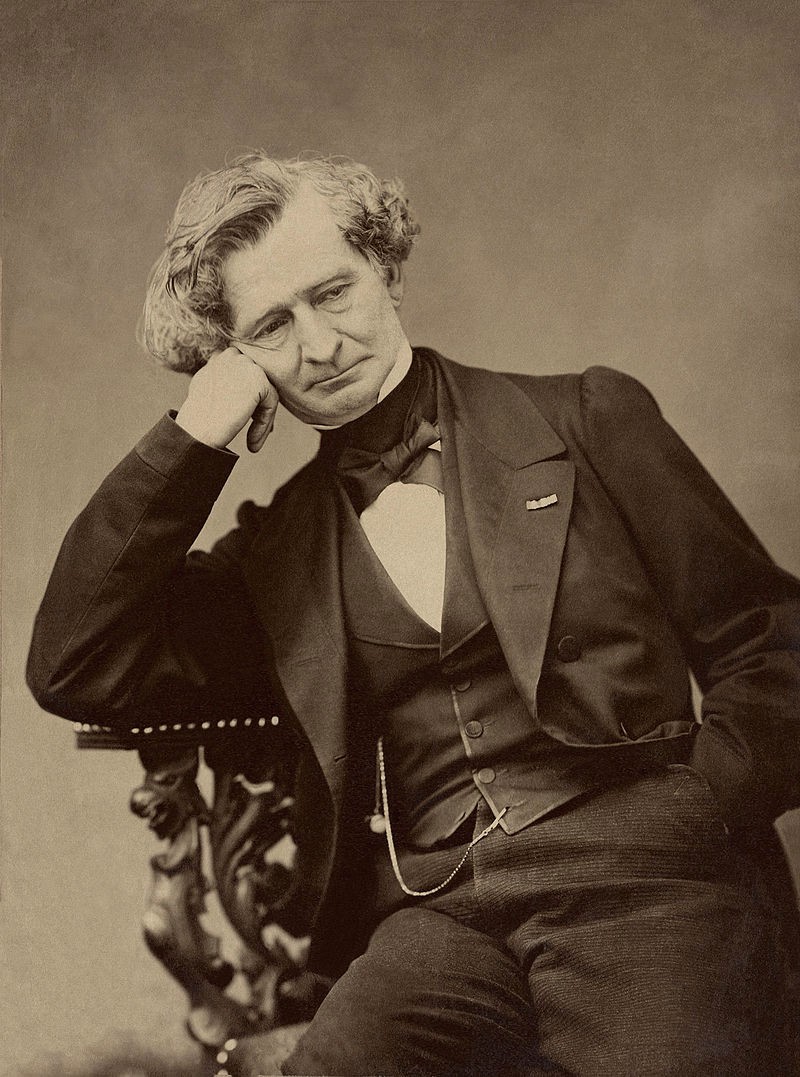
I read a lot of Berlioz over the past year. (He was the composer of focus at last summer’s Bard Music Festival.) If his Memoirs make one thing clear, it’s that people, with all their foibles and bureaucracies, are always the same. And when it comes to Berlioz’s music, haters gonna hate.
Granted, Berlioz’s music is like nobody else’s, so forward-looking at times that it still makes listeners accustomed to the more rational works of his predecessors (Beethoven was still viewed askance in some circles) and milder contemporaries (Mendelssohn was a friend) uneasy. He never mastered the finer points of theory, they grumble. He makes too much noise. He’s just plain weird. Well, yeah, maybe. But those things are also what make him great.
Of his large-scale compositions, perhaps there is no greater retort to the Berlioz agnostic than “L’enfance du Christ” (“The Childhood of Christ”). The work is rare in Berlioz’s canon in that it wasn’t uniformly lambasted by the Parisian critics when it was given its debut in 1853. In fact, his detractors lauded this kinder, gentler style, and identified it as a welcome shift in Berlioz’s development; which Berlioz, of course, declared to be nonsense. The style merely suited the subject, he said, and had he written “L’enfance” twenty years earlier, he would have approached it in precisely the same manner.
The work came to him easily, if in somewhat of a piecemeal fashion. Berlioz rolled it out gradually, with one of the best-known numbers, “The Shepherds’ Farewell,” originally conceived as an organ piece for a friend. This he soon transformed into a choral setting, which he impishly introduced under the assumed name of a fictitious 17th century composer, Ducré. The audience at the first performance was enchanted. At least one old woman was heard to remark, “Berlioz would never be able to write a tune as simple and charming as this little piece by old Ducré.”
Next to be composed was the tenor aria, “Le repos de la sainte famille” (“The Repose of the Holy Family”). This and “The Shepherd’s Farewell” are two of the most striking movements of the entire work. It’s easy for “Le repos,” especially, to get stuck in one’s head. Then again, my head is full of flypaper for this sort of thing.
Berlioz added an overture and called it “La fuite en Egypte” (“The Flight into Egypt”). The premiere was so successful that he was encouraged to create a companion piece, “L’arrivée à Sais” (“The Arrival at Sais”), which included parts for Mary and Joseph. “Le songe d’Hérode” (“Herod’s Dream”), the first panel of the completed triptych, was the last to be composed.
Though Berlioz himself was not religious, he had a lifelong appreciation for the beauty of religious music (as long as it didn’t conclude with a fugue, a fashion he found ludicrously academic and generally out of keeping with the subject at hand).
This composer, who achieved notoriety for his lurid evocations of witches’ sabbaths, brigands’ orgies, and headlong galops into the abyss of Hell, described “L’enfance du Christ” as a “sacred trilogy.” It is perhaps the least outlandish of his major works. It has maintained its popularity and is still performed around Christmas. Not too long ago, you might even encounter it on American classical radio. In 2024, I wish you luck with that. At the risk of mixing my biblical references, the struggle against Philistinism never ends.
Happy birthday, Hector Berlioz!
“The Shepherds’ Farewell”
“Le repos de la sainte famille”
Leave a Reply