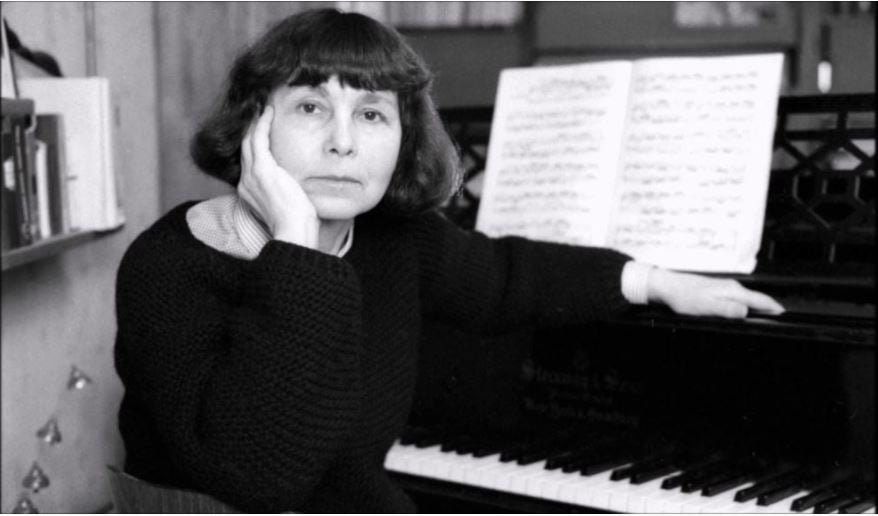
We have lost a major composer in Sofia Gubaidulina. Of the same generation as Alfred Schnittke, Edison Denisov, Nikolai Kapustin, and Rodion Shchedrin, Gubaidulina was driven in her art to address big questions and to communicate what she believed were essential truths – not least among them, faith in God and the transformational power of music. She did so with an adventurous technique (her mature works are full of numerical and structural symbolism), imagination (intellectual constructs are never at the expense of emotion or depth), and an exceptional ear for texture, timbre, and color. There was little about her that could be dismissed as run-of-the-mill.
Having lived for nearly 60 years under a regime that frowned on too much individuality, she pushed hard against the outside of the box. Her works earned her an international reputation as one of the most important composers to emerge from the USSR during the second half of the 20th century.
Gubaidulina discovered music at the age of 5. She would go on to study at the Kazan Conservatory. The other great interest of her childhood was spirituality, especially as expressed in the works of the great composers – Bach, Mozart, and Beethoven. Her fascination with religion and spirituality was something she knew intuitively to keep to herself while living in the Soviet Union.
Music became her escape from socio-political strictures. During her time at the conservatory, there were actually raids on the dormitories, during which scores by decadent Western composers (and Stravinsky!) would be confiscated. Her own music was denounced as “irresponsible.”
Privately, she was encouraged by Shostakovich. She found a safe outlet for her particular brand of modernist expression in writing for film. Of mixed ethnicity (her father was Tatar), she founded a folk instrument ensemble, Astreja, in the mid-‘70s. In 1979, she was blacklisted for unauthorized participation in festivals of Soviet Music in the West.
She came to international attention in the late ‘80s thanks to Gidon Kremer, who championed her violin concerto, “Offertorium.”
Gubaidulina’s highly individual music is steeped in mystical spiritualism. Her works are informed by a kind of longing for human transcendence, a yearning for greater truths central to our being. But she seldom searched the same way twice.
Since 1992, she made her home in Hamburg. Her awards and honors were many.
Gubaidulina was 93 years-old. R.I.P.
“Canticle of the Sun” for cello, chamber choir and percussion (1997)
“Fachwerk” for bayan, percussion and string orchestra (2009)
“Concerto for Two Orchestras” for orchestra and jazz band (1970)
“The Wrath of God” (2019)
Leave a Reply