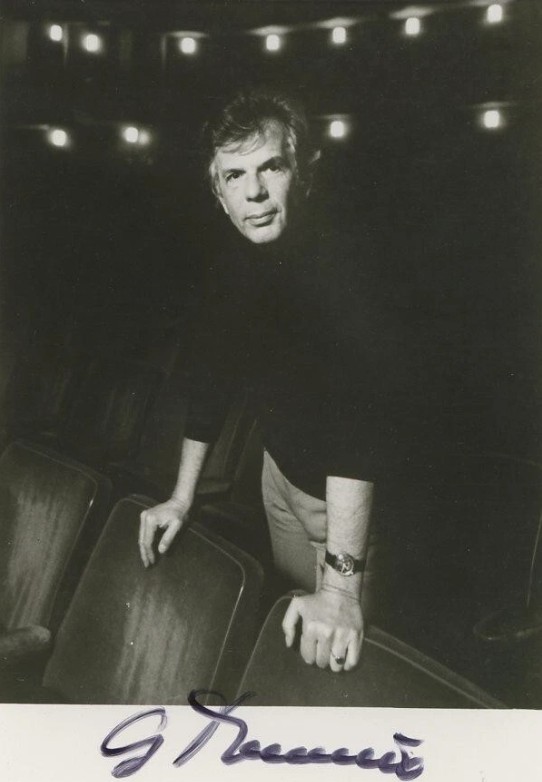
For some reason, Christoph von Dohnányi didn’t come to Philadelphia much. I can recall he came through on tour once, probably with the Cleveland Orchestra. I’m sure he must have come through more than that, but if he did, I never heard him live. He was music director in Cleveland from 1984 to 2002 (having conducted the orchestra for the first time in 1981) – enough to keep anyone’s hands full, I suppose. But I knew him from his recordings, naturally.
He had an interesting lineage. His grandfather was the eminent Hungarian composer, pianist, conductor, and educator Ernst von Dohnányi (born Ernő). His uncle, on his mother’s side (also his godfather), was the theologian and anti-Nazi dissident Dietrich Bonhoeffer. A number of his family members were part of the German Resistance movement during World War II. Several, including his father and uncle, were detained in concentration camps and executed when Dohnanyi was 15.
The young Dohnányi set out on an academic career with an intention to study law, but in common with so many musicians who pursued that course, in the end succumbed to the siren lure of music.
In 1951, he first came to the United States to study with his repatriated grandfather at Florida State University. The elder Dohnányi had actually met and played with Brahms.
Christoph is now being widely lauded for having “restored” to the Cleveland Orchestra to its former excellence, following the lackluster tenure of Lorin Maazel, who succeeded George Szell (who of course made the orchestra). Maazel was appointed music director over the voluble protests of its musicians. Be that as it may (or may not; was the orchestra ever bad?), Dohnányi learned firsthand how difficult it was to emerge from the shadow of a legend. He once quipped, “We give a great concert, and George Szell gets a great review.”
Dohnányi defined the difference between them: Szell, a notorious martinet (my words, not his), drilled the musicians mercilessly and drove them with a palpable sense of inner intensity. Dohnányi, on the other hand, assimilated the lessons he learned in the opera house, beginning as an assistant to Georg Solti in Frankfurt, not worrying so much about bar-lines, but following the example of singers in allowing the music to breathe.
Eventually, he would become music director in Frankfurt. He also held posts at the opera houses of Lübeck and Hamburg. Later, he brought staged opera to Cleveland.
Among his orchestra positions, he was chief conductor of the Staatsorchester Kassel and the WDR Symphony Orchestra Cologne. Following Cleveland, he was principal guest conductor, and then principal conductor, of London’s Philharmonia Orchestra. In 2004, he became chief conductor of the North German Radio Symphony Orchestra, a position he held until 2010.
Of course, he guest conducted all the great orchestras of the United States (including Cleveland), as well as most of them in Europe, and also the Israel Philharmonic. Throughout, he remained active in opera.
Although wholly devoted to music, he was not a flashy conductor and preferred to keep a low profile. He acknowledged that he was a strong leader, but he was never one for razzle dazzle.
Dohnányi died on Saturday. Today would have been his 96th birthday. R.I.P.
Interestingly, I note that I don’t have all that many of Dohnányi’s recordings in my own collection, although I have had dealings with many of them over the course of my career in radio. Of the ones I do own, I have great affection for his first recording of Mendelssohn’s “Die erste Walpurgisnacht,” with the Vienna Philharmonic Orchestra and Chorus. He’s the conductor on favorite recordings of the Busoni Piano Concerto (with Garrick Ohlsson) and the Philip Glass Violin Concerto (with Gidon Kremer). I also have the recording of Alban Berg’s “Wozzeck” he made with his wife, Anja Silja. I’m sure there are more, but not many. The comparative neglect is attributable to my deficiency and not his.
Dohnányi made a number of recordings of the works of Antonin Dvořák (including the Symphonies Nos. 6, 7, 8 & 9, the Piano Concerto, and the “Slavonic Dances”). These received heavy air play for decades, especially by a certain host who shall remain nameless, during my years at the local classical music radio station. Since today is also Dvořák’s birthday anniversary, here’s a link to his recording of the Symphony No. 7.
He was also a champion of Hans Werner Henze. Thanks to Mather Pfeiffenberger for directing me to this link to orchestral fragments (Adagio, Fugue and Maenads’ Dance) from “The Bassarids.” In 1965, Dohnányi conducted the premiere of Henze’s “Der junge Lord” (which he also recorded).
https://www.youtube.com/watch?v=lJd8EQZc7XY
Of course, he was widely acclaimed for his Brahms. Here’s a live performance of Brahms’ 1st in Hamburg, from 2007:
Leave a Reply