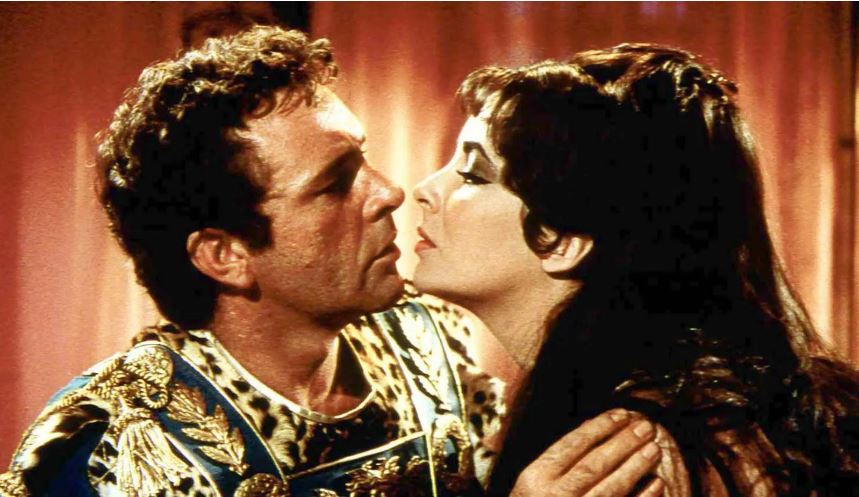
Elizabeth Taylor and Richard Burton made no fewer than a dozen films together, but it was their tempestuous personal life that made them a source of ceaseless fascination. This week on “Picture Perfect,” enjoy a diverse assortment of musical selections from their movies.
Regardless of their relative merits, the films of Liz and Dick could be counted on to feature scores by some very fine composers, not the least of whom was Alex North. North is probably most celebrated for his music for “Spartacus.” He would seem a natural fit, then, to write the music for “Cleopatra” (1963).
“Cleopatra” is the film that first paired Burton and Taylor, on and off-screen. Contrary to popular belief, the epic teaming made a mint. It was the highest-grossing release of its year. However, it simply wasn’t enough to cover the costs of production, marketing, and distribution. “Cleopatra” nearly bankrupted 20th Century Fox. Despite its reputation, there’s still much to enjoy, perhaps most of all in its music.
For a true sense of North’s versatility, we’ll also sample selections from “Who’s Afraid of Virginia Woolf” (1966), based on the play by Edward Albee. Both Burton and Taylor’s performances were nominated for Academy Awards. Taylor would win – her second Oscar – but despite seven nominations over the course of his career, Burton would never be so honored. It’s not any easy film to watch. There’s always a sneaking suspicion that Liz and Dick were merely playing versions of themselves. The comparatively understated music is full of Baroque touches and characterized by a chamber-like intimacy.
The dysfunctionality continues, as allegedly “The V.I.P.s” (1963) was inspired by the real-life love triangle of Vivien Leigh, Laurence Olivier, and Peter Finch. The story is set at London Heathrow Airport, where flights are delayed because of a dense fog. The film was written by Terrence Rattigan, and co-starred Louis Jourdan, Maggie Smith, Rod Taylor and Orson Welles. Margaret Rutherford won an Academy Award for Best Supporting Actress.
The composer was the Miklós Rózsa. Rózsa is perhaps most associated in people’s minds with his work on historical and biblical epics. Here it’s the film’s costars that are larger than life.
We’ll conclude with music from the Shakespearean romp, “The Taming of the Shrew” (1967), Franco Zeffirelli’s fleet adaptation that also introduced the world to Michael York. The roles of Katherina and Petruchio suit Liz and Dick most satisfyingly.
The composer was Nino Rota. Zeffirelli and Rota would score a bulls-eye with their Shakespearean follow-up, “Romeo and Juliet,” released the following year. That film became an international hit, and Rota’s love theme immortal.
Ironically, Taylor and Burton’s final filmed collaboration was a 1973 television movie, “Divorce His, Divorce Hers.” The two, of course, would divorce in real life, only to remarry less than 16 months later, though their second union was short-lived. The exes would pair for one last time, ten years later, for a staged revival of Noel Coward’s “Private Lives,” which was witheringly received.
It’s a bouquet of dysfunction, but a chocolate box of classic film scores for the films of Taylor and Burton, on “Picture Perfect,” music for the movies, this Saturday evening at 6:00 EDT, on WWFM – The Classical Network and wwfm.org.
Leave a Reply