It’s been said that the best Christmas music was written by Jews. The statement is in reference, I’m sure, to the many outstanding Jewish composers and lyricists of the mid-20th century.
Think about it: “The Christmas Song (Chestnuts Roasting),” “Silver Bells,” “I’ll Be Home for Christmas,” “Winter Wonderland,” “Let It Snow! Let It Snow! Let It Snow!,” “Do You Hear What I Hear?,” “Home for the Holidays,” “Rudolph the Red-Nosed Reindeer,” and that heavyweight champ among Christmas songs, “White Christmas.” All were written or co-written by Jews.
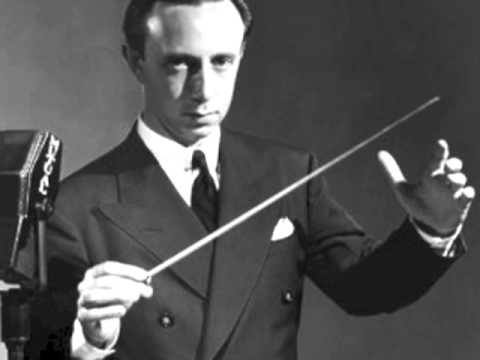
I think of this in reference to the birthday today of Morton Gould (1913-1996). Gould put together some delightful suites of traditional carols, which he recorded at least twice. Above and beyond his contributions to the Christmas season, Gould did so much to make classical music “popular.” Listeners who enjoyed Gould weren’t made to feel as if they were listening to something that was good for them. They were listening to music they enjoyed. Gould was most always accessible, tuneful, brightly orchestrated, and rhythmically exciting.
Sure, he wrote for the concert hall, but he also wrote for Broadway. He wrote for film, he wrote for radio, he wrote for television. His arrangements were always highly professional, and his original music polished to a sheen. Unfortunately, this very professionalism often led to his being underrated as a serious a composer. No one was more surprised than he when he was belatedly recognized with a Pulitzer Prize for Music, for his “Stringmusic,” in 1995. He was 81 years-old.
His music could hang on a gimmick, as in his “West Point Symphony,” which employs a marching machine, his “Tap Dance Concerto,” for dancing soloist, or his late children’s piece, “The Jogger and the Dinosaur,” which incorporates a rapper. But he could also, on occasion, engage in genuine experimentation. Take his “Jekyll and Hyde Variations,” in which he employs serial techniques, bending them to his own distinctively Gouldian ends.
And lest you chalk up the Jewish Christmas song to cold, commercial calculation (a harsh way of looking at the fact that a composer has to eat), consider Irving Berlin. Berlin was born into a religious family in Russian, where Christmas brought with it the justified fear of drunken pogroms. Though admittedly more secular in his maturity, Berlin came to regard Christmas in America as a warm domestic tradition.
Beautiful music is beautiful music. These artists are hardly defined by their contributions to Christmas, of course, but American Gentiles would do well to think on them with a special degree of gratitude. What would the season be without “White Christmas?” God bless America, God bless Irving Berlin, and happy birthday, Morton Gould.
Gould’s “Serenade of Carols”
https://www.youtube.com/watch?v=k0E_PG0obqw
Berlin’s “White Christmas”
https://www.youtube.com/watch?v=w9QLn7gM-hY
An article on this very topic:
http://jewishworldreview.com/1214/jewz_xmas.php3
PHOTOS: Gould conducts; Berlin scrawls
Leave a Reply