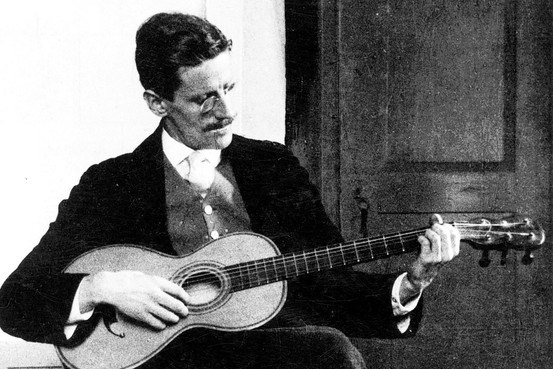
June 16 is Bloomsday, the date on which the events in James Joyce’s novel “Ulysses” are supposed to have taken place in 1904. The day is marked by celebrations world-wide, as Joyceans get together to reenact, eat, play music, drink and of course read.
A year or two ago, I semi-secretly worked my way through Joyce’s magnum opus. I say semi-secretly, because I always found “Ulysses” to be an extraordinarily pretentious book, and I’d rather walk around with it in a brown paper bag than come across as the kind of person who would flaunt that he is reading “Ulysses.”
Joyce inspires in me, as I’m sure he does in many, an uncomfortable mix of admiration and annoyance. Do I think he was a genius, as many assert? No. Do I think he was an extraordinarily clever man, who worked very hard to achieve his vision? Yes – though I don’t claim to be an authority on the matter. There’s no questioning his talent.
I always wondered, how could Joyce betray the exquisite prose he produced in “Dubliners,” with its achingly beautiful story, “The Dead,” for the inscrutable hieroglyphs of his later work? “Ulysses” is very impressive, no doubt, but the truth is, for me anyway, it is not very compelling. There is nothing in it to make you want to pick it up again, beyond the undeniable fascination in seeing someone change the course of literary history.
So how do you get through it? I won’t get into why you should read “Ulysses” (and I’m not saying you should), but if it is on your bucket list (and how I hate the term), here are a few suggestions:
(1) It’s helpful to have a reference guide on-hand, but don’t become too reliant on it. You’re never going to get everything out of it on a first read. If you try, you will lose the thread and you’ll die exhausted in the labyrinth. If you read the beginning, you may scoff at the notion – the book is difficult but not impenetrable – but trust me, you’ll be looking for a shoal to rest your weary legs by the time you get to “Proteus” (Chapter 3).
(2) If you’re lucky enough to find a good “Ulysses” reading group, the battle will be half won. You’ll have peers to urge you on. Avoid if possible the kind of readers you think you might want to throttle. If you’re lucky enough to be in the Philadelphia area, consider taking a “Ulysses” course at the Rosenbach Museum (which houses the actual manuscript). If you can take the one with Carol Loeb Shloss, who is also on the faculty of the University of Pennsylvania, you will find it vastly rewarding. Even if in the end you don’t wind up loving the book, you are guaranteed to gain a new respect for it.
(3) Whenever you hit a rough patch, try reading the book aloud. It really does help. Marilyn Monroe understood this instinctively. Joyce was Irish, and even though he did his damnedest to dismantle the language of Empire, he couldn’t help but love the sound of words.
Of course, every Bloomsday the Rosenbach pulls out all the stops, with a full day of readings from the book by local celebrities and enthusiasts. This year, the museum is hosting a week’s worth of related events. Today is the last day, but you can find a full description here:
https://www.rosenbach.org/learn/events/bloomsday-festival-2015
Here’s how Bloomsday is being celebrated around around the world:
One final note: as music-lovers, you may be interested to know that Joyce’s work is overflowing with musical references. Even his structures, in some instances, are influenced by musical forms. There is no shortage of information to be found on the internet, but I’m linking in this site, since it mentions a number of works by composers inspired by Joyce:
http://www.spotifyclassical.com/2011/08/music-from-works-of-james-joyce.html
Hope your day is a Bloomin’ good one.
PHOTO: Sing it, Sunny Jim
Leave a Reply