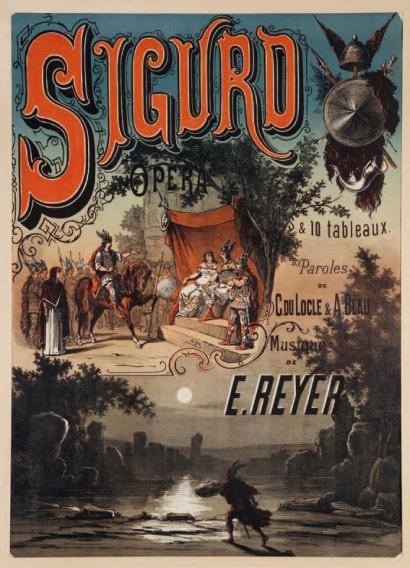
While Debussy and the French Impressionists led a revolt against Wagnerism in music, there were others among their countrymen who were enthralled by the power of Wagner’s vision.
One of these was Ernest Reyer (who was born Rey, but added the “er” to appear more Germanic). Reyer set his own version of the Siegfried story, as related in the Scandinavian Volsunga Saga, which, by way of the “Nibelungenlied,” also provided the basis for Wagner’s “Ring.” But Reyer’s approach to the tale was in the tradition of French grand opera.
The resultant “Sigurd,” composed between 1862 and 1867, was very popular with the French during its initial production at the Paris Opera in 1885. Earlier plans to present it there had fallen through, so that the work received its world premiere in Brussels in 1884. It was also heard in Covent Garden, Lyon, Monte Carlo and, before the end of the century, the French Opera House in New Orleans and La Scala Milan.
What’s interesting is that in the end Reyer’s music seems to bear more resemblance to Berlioz than it does to Wagner. Unable to live on the proceeds from his operas, he actually succeeded Berlioz as music ciritic at the Journal des débats.
Reyer’s early musical studies were overseen by his aunt, Louise Farrenc, the only woman on the faculty of the Paris Conservatory (beginning in 1842!). He rubbed shoulders with Gustave Flaubert and Théophile Gautier (writing operas on texts of both), but he felt equally at home playing dominoes with the peasantry of Provencal. He claimed that the best source of inspiration was his pipe.
Happy birthday Ernest Reyer (1823-1909).
Overture to “Sigurd”:
Sigurd’s entrance:
Leave a Reply