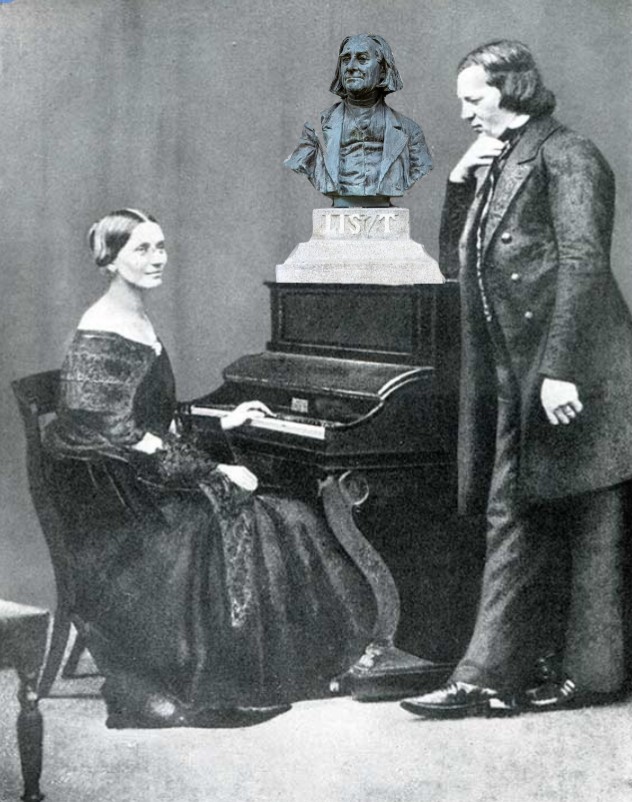
The other day I was pulling together selections for my annual “June Weddings” show on “Sweetness and Light” (my light music program, which streams Saturday mornings at 11:00 EDT/8:00 PDT from KWAX Classical Oregon), and one of the pieces that sprang to mind – that I was unable to include – was Robert Schumann’s “Widmung,” or “Dedication,” after a poem of Friedrich Rückert. Schumann wrote the song for his bride, Clara.
The couple had wanted to marry for years, but Clara’s father – Friedrich Wieck, Robert’s former teacher – bitterly opposed the match, so violently in fact that the matter landed everyone in court.
At the time of their first meeting, Robert was 20 years-old and was invited into the Wieck household as a live-in student. Clara was 11. Clearly circumstances were problematic.
The minute Clara turned 18, she accepted Robert’s proposal of marriage. The elder Wieck declined to grant his permission, and the young couple was compelled to bring suit against him. In the end, the judge ruled in the lovers’ favor, and the two were at last able to wed, in 1840, one day before Clara’s 21st birthday – at which point she would no longer have needed her father’s consent!
Ah well. In the interim, after he had been tossed out of the house, Robert’s passion for Clara was sublimated into ardent love letters and bursts of creative energy. He composed reams of piano music at white heat up until the year of their marriage. Thereafter, he wrote for piano and orchestra, always with Clara in mind.
The two maintained a joint diary, and the entries are frequently touching. The Schumanns, like any married couple, had their issues, but they clearly loved one another very much. They became one of the great power couples of their time, with Robert a composing dynamo and Clara one of the outstanding concert pianists of her day. More than 20 years after Robert’s death, she became a professor at the Hoch Conservatory in Frankfurt. Her 61-year concert career played a huge role in molding public taste in so far as what we have come to expect, down to the present day, from a piano recital.
“Widmung” caught the fancy of Franz Liszt, who always liked the Schumann’s a great deal more than they liked him. For whatever reason, he really rubbed Clara the wrong way. Essentially, everything about his approach to music ran counter to what she and her husband believed the art form should be. But it wasn’t always the case.
Clara first met Liszt in 1838, prior to her marriage, when she was 19 years-old. Like everyone else, she was in awe of the pianist’s superhuman technique, but it also made her feel inadequate, especially when they played piano four-hands.
For his part, Liszt was very complimentary. In a letter to his mistress, Marie d’Agoult, he wrote, “Her compositions are truly remarkable, especially for a woman. They contain a hundred times more inventiveness and real feelings than all former and present fantasias by Thalberg.” Sigismond Thalberg was one of Liszt’s chief rivals. But this wasn’t simply “trash talk.” Liszt was consistently impressed by both Schumanns.
In 1840, he dedicated his “Transcendental Etudes” to Clara. She continued to include his music on her concert programs until 1847. Sadly, familiarity bred contempt, and increasingly she came to find everything about him abhorrent. She didn’t like that he was a showboat. She recoiled when he took liberties with the scores he played. And she was totally put off by the indelicacy with which Liszt described her husband’s Piano Quintet as “typically Leipzig.”
Liszt, clueless, continued to make friendly overtures, championing Robert’s music. Robert, for his part, responded cordially. Liszt published a long essay in praise of the artistry of both Schumanns in 1855, but Clara remained implacable.
As the War of the Romantics began to heat up in 1860, with heightened antagonism between the Brahmsians (including the Schumanns) and the New German School (followers of Liszt and Wagner), contact became rare.
In 1884, Clara wrote to Liszt with the aim of copying the correspondence he maintained with her husband, who had died in 1856. Liszt responded that he hadn’t saved any of the letters. That essentially ended all interaction between them.
45 years earlier, in 1839, Schumann completed his “Fantasie in C major,” during the period when Clara’s father forbade any contact between them. Schumann wrote to Clara, “The first movement is the most passionate I have ever composed; it is a profound lament on your account.”
Ironically, it was Liszt who received the dedication. Liszt returned the favor by dedicating his own Piano Sonata in B minor to Schumann in 1854.
Clara confided to her diary, “Today, Liszt sent me a Sonata dedicated to Robert and some more pieces, together with a polite note. But those pieces are so creepy! Brahms played them to me and I felt really miserable… This is only blind noise – no more healthy thoughts, everything is confused, one cannot see any clear harmonies! And, what is more, I still have to thank him now – this is really awful.”
Of course, Robert, at 44, had already lost his grip on sanity and was by then confined to an asylum.
Here’s the wedding gift he composed for Clara, from the collection “Myrthen,” or “Myrtles,” Op. 25.
And what Liszt made of it – much to Clara’s horror, I’m sure – played by Van Cliburn in 1958.
A year into the marriage, Clara reciprocated with an anniversary present for Robert, “Liebst du um Schönheit” (“If you love for beauty”), also after Rückert, included in her Lieder, Op. 12.
It’s Robert Schumann’s birthday, so do enjoy his Fantasie in C major.
Such dedication in these dedications!
Leave a Reply