I’ve got some followers that I know are big readers. Myself, I am reading something all the time, but unfortunately I am rather slow under the best of circumstances, and since I read mostly at bedtime these days (thank you, internet), I often find myself pushing back against drooping eyelids. I used to read in the morning also, in the days before I had a laptop. Previously, what happened at work – where I kept my desktop – stayed at work. When you have two reading sessions built into your day, even short ones, at breakfast and bed, you do cover a lot of ground, more than you would think.
Anyway, last week I finally finished Robert Fagles’ translation of “The Odyssey,” in advance of Christopher Nolan’s movie, which I’m pretty sure I’m going to have issues with (and not because I’m a “culture warrior”). And since then, I knocked out Bernard Knox’s 60-page intro, which I found informative and essential, in order to more fully grasp the history and significance of this cornerstone of Western literature, which is so much more than simply an adventure story.
The edition – which I discover is inscribed by Fagles (who taught at Princeton University) – has been part of my library since I skimmed it off the inventory of one of my bookstores, but somehow I never got around to reading it until now. It’s been part of the Princeton High School curriculum. In my hometown, for some reason, we read “The Iliad.” Granted it was an AP course, but with all the cataloguing in which Homer indulges, so that we know all about the participating forces, the leaders’ lineages, their geographical origin and their weaponry, it was kind of a slog. It was a long time ago, but I don’t even know that I can blame the translation (by W.H.D. Rouse).
Fagles’ “Odyssey” is a much more enjoyable read. In fact, surprisingly so. I expected it to be heavy lifting, akin to the boulder Polyphemus uses to seal his cave. But it turned out to be far from it. (Incidentally, I see the audio book is read by Sir Ian McKellen!)
However, I am sure it is not the last word in “Odyssey” translations, acclaimed though it be. In fact, I can understand why there are so many “Odyssey” fanatics on YouTube, who seem to have a working familiarity of the finer points of all the various translations. Since I cannot read Greek myself, I would definitely be interested in checking out some of the other versions. I am especially curious to take a look at the much-lauded, and I’m sure more elevated, translation by Alexander Pope. Somewhat in common with its hero’s travails, one’s encounter with “The Odyssey” could expand into an epic journey of many years.
You have to admit, the story has had legs. Even if you’ve never read a word of it, you probably already know a lot of it. It’s been a crowd-pleaser for 2,800 years! Ralph Fiennes played a brooding (and surprisingly jacked) Odysseus only last year, in “The Return,” and I recently learned that Jerry Bruckheimer, of all people, is overseeing an animated musical (!) on the story, based on a recent internet series (?), for theatrical release. I remember watching a miniseries with Armand Assante, back in the ‘90s, but for me, the benchmark will probably always be Kirk Douglas in “Ulysses.” When men were men, and cyclopes were cyclopes!
By coincidence, I’ve got a ticket to see “Die ägyptische Helena” (“The Egyptian Helen”) at Bard College later this month. Richard Strauss’ rarely-heard opera about Helen of Troy sets a libretto by Hugo von Hofmannsthal – whose source material is Euripides’ play “Helen,” as opposed to Homer’s “Iliad,” but hey…
Only yesterday, I bought a loaf of bread from a local bakery and the woman on the counter’s name was Penelope! I’m taking it as a sign.
Nolan’s movie opens tomorrow. Watch this space, because this weekend all three of my radio shows – “Picture Perfect,” “Sweetness and Light,” and “The Lost Chord” – will be on Classical mythological themes.
It seems Homer is everywhere these days. But really, has he ever gone away?
———-
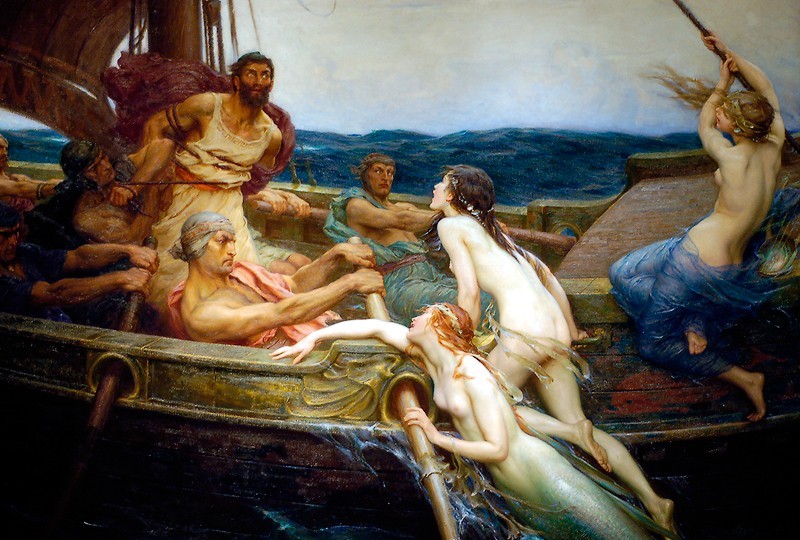
IMAGE: Matt Damon tempted by the Sirens in Christopher Nolan’s “The Odyssey”
(Actually “Ulysses and the Sirens,” 1909, by Herbert James Draper)
Epic Summer
by
27 responses
Comments
27 responses to “Epic Summer”
-
Of recent translations, I commend Fagles also both Lattimore and Mandelsohn.(both in verse). Nothing sounds like Homer but the original, but they will give you an idea.
Richard Bentley gave this review: “A very pretty poem, Mr. Pope, but really, you must not call it Homer”
-
Paul Anderson Thanks for the input. I also own the Lattimore translation (so far unread).
-
Classic Ross Amico Let me know what you think.
-
Paul Anderson Not sure when I’ll get around to it, but I might make it an annual thing, to read another translation.
-
-
-
Exciting to know how popular such a weighty classic has become. Hope for the future!
-
Dolores Cascarino It says something that I walked into the local Barnes & Noble a few months back and they had an entire table devoted to “The Odyssey.” But then the director Christopher Nolan commands a lot of interest. Remember a couple of years ago, when audiences queued-up for ad hoc double features of “Barbie” and Nolan’s “Oppenheimer?” Barbenheimer became a thing. Personally, I’m not exactly a Nolan fanboy. I mean, I enjoy his movies, but I always rate them at least a star lower than anyone else. He does embrace old school practical effects and dislikes CGI, so at the very least there’s that. But I have yet to see a Nolan movie that made me think or feel, this is a four-star movie. But if it gets people interested in “The Odyssey,” cool!
-
Classic Ross AmicoI like Nolan’s films. But it’s impossible to meet level of the fanboys since they are almost borderline psychotic (since Dark Knight came out). This has already been deemed the “greatest” movie of all time by them. Or at least, the greatest since the last Nolan movie came out. I just hope I can hear the dialogue this time.
-
-
-
I’m hoping to catch one or more of your shows this weekend. I wish there were replays…
-
Kathy M Nazzaro Thanks. Hope you enjoy what you’re able to catch!
-
-
Classic Ross Amico i read the book a few decades ago since my teens i had it also l iliade! Im still not a fan of Nolan or Villeneuve. I only saw Oppenheimer 2 years ago and wasnt impress with it even it was the best film that year no cinematography! The standards are so low nowadays!
-
Christian Lalancette Christian! So good to hear from you! I agree about “Oppenheimer.” The cinematography, the editing, and the music were so frustrating. In its defense, I can say it was never boring, but I would have been a lot happier had it been directed with greater sensitivity to the narrative and performances. Whether it is true or not, in my memory, the whole thing was presented like the coked-up climax of “Goodfellas.” Naturally, the film won Oscars for its direction, cinematography, editing, and music (among other things). Whether or not standards are low or just different from what you and I regard as classics, they are certainly not to my taste.
-
-
You should listen to Gabriel Fauré’s masterful opera “Pénélope,” not to mention Monteverdi’s “Il ritorno d’Ulisse.”
-
Byron Adams I am familiar with the Monteverdi, but I only have the Prelude from “Pénélope.” I’ll have to make a point to search for the audio to the complete opera online.
-
Classic Ross Amico, there’s a lovely recording with Jessye Norman, Alain Vanzo and Charles Dutoit
-
-
-
I didn’t know there was an Odyssey movie coming out. The internet has been very quiet about it. I’m sure everyone will love it though.
-
I was under the impression that Christopher Nolan used the Emily Wilson translation more than Fagles or any others?? I’m quite excited to read hers for the first time after Lattimore.
-
Mika Godbole I don’t know what translation he read, or which is the basis for the screenplay. I doubt any translation is going to radically change the perspective of a movie, despite all the attention Wilson’s has received for rocking the patriarchy. From what I understand, the discrepancies she addresses are linguistic, as opposed to active. If so, I can’t imagine the thrust of the story is going to be any different, unless the director himself decides to take a revisionist approach. Of course, I can’t speak definitively about Wilson’s translation until I’ve read it for myself, which I too hope to do eventually. I was shocked when the Fagles’ version referred to the female servants condemned by Odysseus as whores. I would be interested to learn which passages Wilson believes were interpolated or given an inaccurate slant by later, disingenuous hands.
-
Classic Ross Amico I can’t speak to how the Fagles and Wilson compare since I’ve read neither or how much inspiration Nolan took from it but once I do, it’ll be a cool exercise to see what made it into Nolan’s film. But I am stoked to check out Emily Wilson’s since it’s been years since the Lattimore in high school so it will be like reading it for the first time all over again!
-
Classic Ross Amico Julian Grant An fascinating read!
https://www.vulture.com/article/the-odyssey-translator-emily-wilson-christopher-nolan.html
-
Mika, thanks!
-
-
Mika, I’m reading it now. It’s a very direct, easy read. The preface is rather interesting: lots of character status issues and ambiguities I hadn’t thought of are suggested.
-
Julian Grant Classic Ross Amico It sounds like we have a book club happening here, just saying…
-
-
-
I guess I should give Fagles another try(?)
I found the little bits I read to be terrible: “you’re cramping my style ” for example… I have a strong aversion to cliches in writing-
Simon Mauer And anachronistic cliches at that! By and large, I think Fagles did a good job with it. He kept it moving without overdoing the modern idioms (which I really don’t like in translations of ancient texts), though I agree, there are a few unfortunate exceptions. Supposedly, Fagles is a poet himself, or he’s published poetry, but if the translation is anything to go by, he’s no Seamus Heaney, for instance. However, his is a good version for modern readers who might be put off by anything too archaic or overtly literary. I was under no illusion that what I was reading was a direct transliteration of Homer. If you want the average reader to be able to get through “The Odyssey” and to find it pleasurable and not at all daunting, without stooping to “Classics Illustrated,” this is a good version, even if it might drive a more discerning reader up a wall (cliche intended!). Alexander Knox’s intro is full of interesting and valuable information for the lay reader. I nearly always recommend that readers turn to an introduction last, once they finish the book, and that’s certainly the case here.
-
Classic Ross Amico thanks for that response Ross, I think we’re on the same page… cliche intended again ha ha
-
-
-
The new translation by Daniel Mendelsohn is by far the best, keeping the original Greek meter and without making the cuts and simplifications that Wilson does. It’s truly a masterpiece.
-
“traduttore traditore” the Italian saying has it. Accepting this inescapable reality and, if we are not polyglots, we rely on translations. Having read Homer translations for a long time and having read some of Homer in Homeric Greek, I find Robert Fagles’ re-creations of the Odyssey and the Iliad (and of the Aeneid) the best we have.
Tag Cloud
Aaron Copland (94) Beethoven (95) Composer (114) Film Music (150) Film Score (143) Film Scores (255) Halloween (102) John Williams (198) KWAX (233) Leonard Bernstein (105) Marlboro Music Festival (125) Movie Music (165) Mozart (91) Opera (215) Philadelphia Orchestra (90) Picture Perfect (174) Princeton Symphony Orchestra (110) Radio (90) Ross Amico (244) Roy's Tie-Dye Sci-Fi Corner (290) The Classical Network (101) The Lost Chord (269) Vaughan Williams (107) WPRB (397) WWFM (881)
Leave a Reply