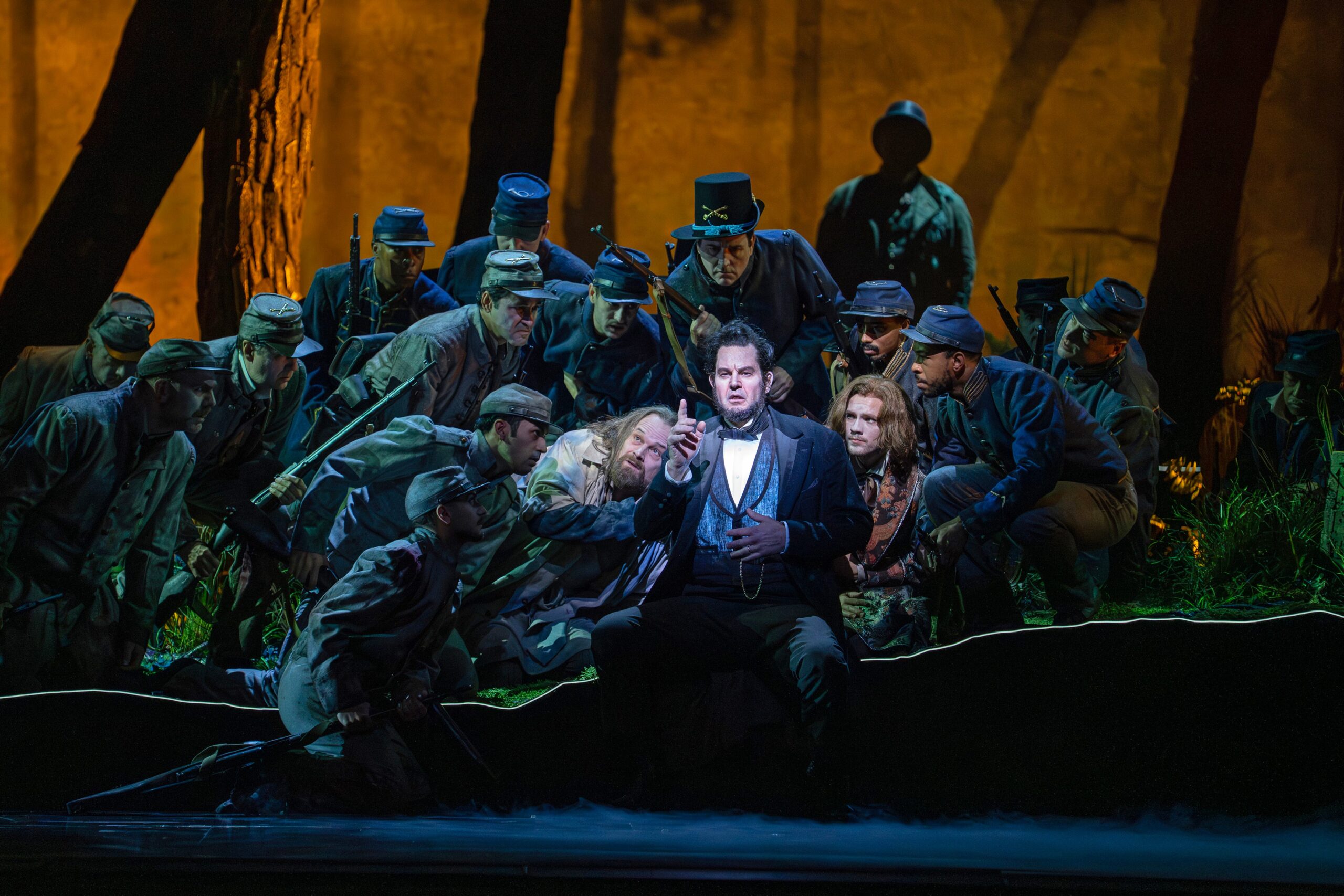
Here it is: the only bad review of “Lincoln in the Bardo” on the internet.
Not bad, really (how satisfying it would have been to title a review “Stinkin’ in the Bardo”), but unquestionably mixed. And you know how it is: occasionally I’ll get swept away by my own rhetoric, so that I might come across as sounding a little harder on it than might be justified. Conversely, I don’t really take pleasure in hurting anyone, so I’ll turn around and pile on the qualifiers to soften the blows. Hopefully, the neurotic tension will make for an interesting read!
Missy Mazzoli’s opera, inspired by George Saunders’ experimental novel, is being performed at New York’s Metropolitan Opera through November 14.
It is the first Met commission from a woman since the company was founded – in the 1880s! 113 years passed between stagings of Ethel Smyth’s “Der Wald” in 1903 and Kaija Saariaho’s “L’Amour de Loin” in 2016. WTF, Met? But over the past decade, five operas by women have been staged, so perhaps we’re getting somewhere. Of course, during the same period there have been hundreds of performances of operas composed by men. Not that gender should have any bearing on the quality of the work.
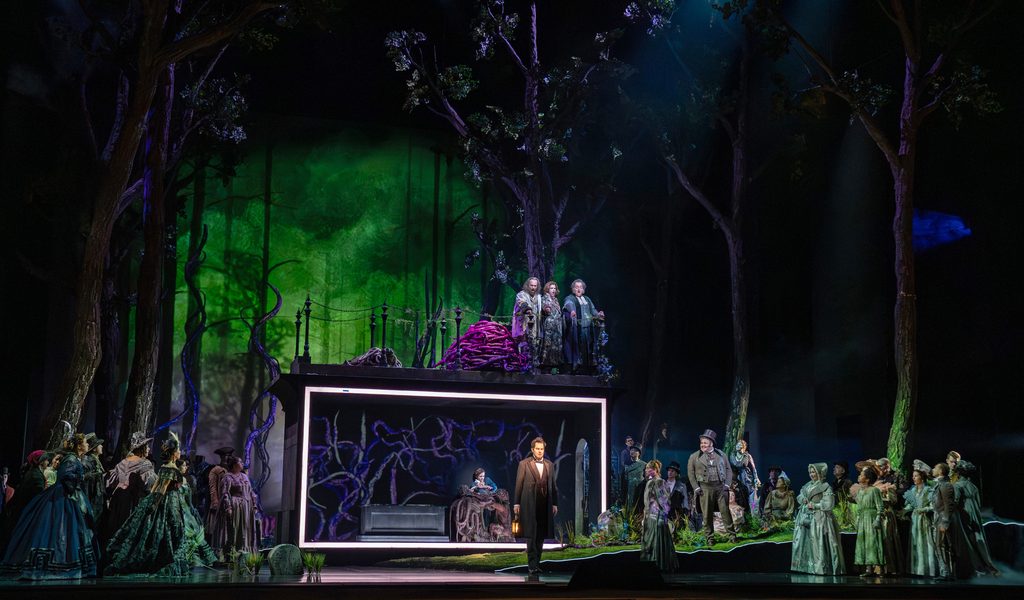
First off, the overarching concept: the “action,” as in the novel, is set in Oak Hill Cemetery in Georgetown (not yet merged with Washington, DC). Abraham Lincoln’s son Willie has died of typhoid fever, and the mourning president, overwhelmed by loss, visits his crypt inside a mausoleum. Unbeknownst to him, the graveyard is active with spirits of the dead that don’t realize, or are unwilling to admit, their current situation. They linger in the bardo, really a Buddhist concept, an intermediate state between planes of existence, haunted by their unfulfilled desires. They believe they are in a “hospital-yard” and that they sleep in “sick-boxes.”
It is only when they achieve awareness and accept the reality of their circumstances that they are able to move on, through a process known as matterlightblooming (a portmanteau sounding an awful lot like something out of James Joyce). Spirits of the young generally do so the quickest, but Willie is bound to the yard by what he perceives as his father’s need. However, the longer he remains, the more he risks being held there forever.
To be honest, I was not the biggest fan of Saunders’ book (again, the only bad review of “Lincoln in the Bardo” on the internet), which I found a mite tedious, in many of the same ways I found aspects of the opera to be so. I am by no means a prude, but the bawdy/scatological humor got to be a bit tiresome. (I know, I know, even Shakespeare employs penis jokes, but, Lord, how long…?) A lot of the information is conveyed as spoken fragments and would-be aphorisms. There is very little poetry in the writing itself. I began to question whether “experimental,” in this case, was simply an excuse not to get bogged down in the more challenging aspects of having to actually write, such as grappling with language and formulating interesting sentences and paragraphs in the service of a compelling story.
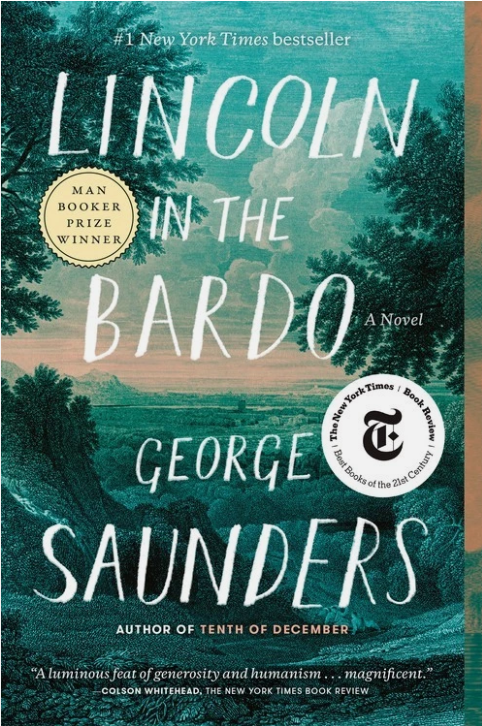
Yes, I know, some writers are able to do a lot with a little, beauty is in the eye of the beholder, and all that. Or as someone so eloquently commented on one of my previous posts on the subject, no accounting for taste. Indeed.
Or it could be simply that the form of the novel felt to me like a stunt, or at the very least that the author started to get too interested in his puzzle, and it didn’t really lend anything to the story. I don’t know who these critics and readers are who found it to be so innovative or particularly challenging. Either they weren’t English majors, or they haven’t read very widely. But Saunders seems like a nice guy, and I don’t begrudge him his success. It’s not a bad book; I’m just not a fan. To me, the experimental narrative just felt flimsy, although even as I’m writing I want to argue against myself, as I think I have a pretty good idea of what he was aiming for. But I would have preferred less head and more heart. I realize what I would have liked would have been a different book.
Nor is the concept itself radically new. There was a 1923 play, “Outward Bound” by Sutton Vane, that handled something of the same theme, the dead only gradually realizing they’re no longer with us. It was adapted for the screen in 1930 and remade as “Between Two Worlds,” with John Garfield, Paul Henreid, Sidney Greenstreet, and Eleanor Parker, in 1944. It was used for that matter in any number of other movies I won’t bother to catalogue, since the characters’ realizations are often the final twists of those surreal, often eerie, tales. To even mention them in this context would be to spoil them. But to my knowledge, none of these build to a transformative moment of the type that Saunders clearly hopes will leave his readers with a sense of transcendence and grace. I grant him that.
I realize I am about to contradict myself in the next paragraph, since I’ve been going over this now for too many days, torturing it into some kind of shape so that I can finally post it. Does the public find the book challenging (as in the straw man argument above), or is it actually an undemanding read? Is my acceptance of Saunders’ narrative payoff grudging or absolute? You will find such inconsistencies in my attitude and tone throughout. That’s the price of not limiting the scope of my observations or owning a functional printer, so that I can leaf through the pages and see the piece as a whole! Or, as here, I just don’t have the spirit to even polish it anymore. If I were a character in the book, here is where I would append my name in lower case.
And so…
I confess, I’m commenting on a book I haven’t read in probably seven or eight years (pre-pandemic), so I may be distorting the particulars. In its way, I suppose, cumulatively at least, it builds to something, but my impression while reading it was that it was almost as if it could have been a play. At least it was a mercifully quick read, but it made me suspicious that perhaps its outsized success had more to do with the fact that it was so undemanding, as opposed to anything particularly literary. It’s the perfect “literature” for the graphic novel generation. If you liked it, good for you, you are obviously not alone, but for me it was a bit too much like drinking chicken broth with nothing in it.
When I heard that Mazzoli would be using it as the basis for an opera, I thought, well, this might actually work. Since it’s already somewhat like a play, setting it to music could lend it some dimension and potentially boost it to the next level. Now, having seen the opera, I’m wondering if it might be best experienced as an audio book. From what I understand, there is actually one on the market that employs an array of celebrity voice actors.
It says something that in the hierarchy of those deserving praise, I am inclined to extend it first to the production team, then the singers, then whoever’s left (basically the composer and the librettist, probably in that order).
Presumably as much in the way of compensation for, as in support of, libretto and music, the Met overachieves with an admitted triumph of stagecraft. Puppetry! Projections! Literal fireworks! The tech crew throws everything at it, in an attempt to really sell the piece. As well they should. The opera would have seemed even longer without their dazzling efforts.
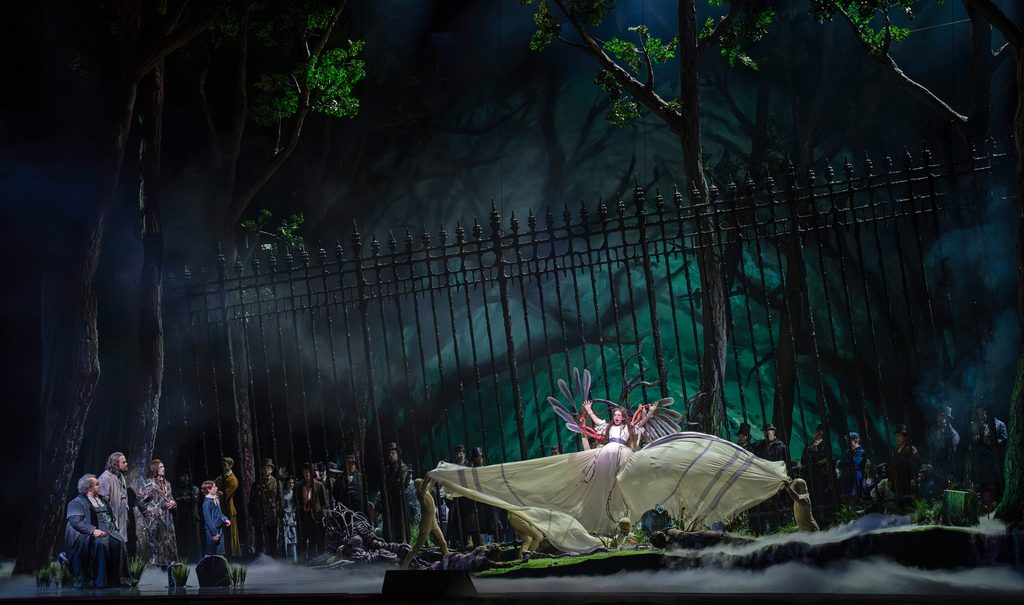
The quality of the singing was also mostly very good, occasionally even outstanding. But I suspect there was a lot of filling in around the edges by a game cast, perhaps shepherded by the director, to find ways to bring these characters to life (so to speak). I mean, probably more so than usual. Musically, a lot of it is simply not memorable, and it is certainly not operatic. Without dramatically-gifted performers of this caliber, I imagine the work would really fall flat(ter). In the old days of park-and-bark, it would have been D.O.A.
This is essentially another Met novelty opera. I have nothing against that. I’ve attended several over the past year. It’s not that it isn’t diverting, and even sporadically entertaining, but anyone hoping for an extraordinary experience, let alone a transcendent one, is likely to be a little disappointed. Beyond the visuals, I mean. It’s not that I disliked it. It was more like, okay, once and done.
One need only compare it with Gabriela Lena Frank’s “El último sueño de Frida y Diego” (“The Last Dream of Frida and Diego”), another opera about souls transitioning between worlds, presented at the Met last season, to grasp what Mazzoli’s “Lincoln” lacks. Frank is a master of orchestration, who doesn’t simply rely on effects, and she also understands how to write an aria. Neither opera is overtly “melodic” or has any big tunes, but Frank, at least, manages at least one showstopper. I can still remember quite vividly Catrina’s big aria, which to me possesses a kind of rough-hewn Mussorgskyan power.
But even there, the Met had acrobatic skeletons tumbling all over the place (not just in that scene, where they are most welcome).
Yes, the operas have different requirements. “Frida y Diego” had perhaps four lead characters. “Lincoln” is full of players with smaller roles who step forward from time to time to have their moments.
Neither production spared any expense. Both offer plenty of visual effects to dress up their scores. Mazzoli’s crew imaginatively translates the spirit – and spirits – of Saunders’ novel to the stage, and Frank’s recreates some of Kahlo’s canvases and offers a floorshow of writhing skeletons. But the proof is in the pudding. Take away the eyepopping designs and choreography, and Frank still presents an interesting and cohesive work of art. It would be unfair of me to dismiss Mazzoli’s music out of hand, having heard the opera only once, and having so many distractions coming in through the eye, but on first exposure, it didn’t exactly rock my world. Melody was scarce and much of the time the singers seemed to be walking an invisible tightrope, navigating vocal lines that are unsupported by anything in the orchestra. That last point is not a criticism; merely an observation.
Not that “Lincoln in the Bardo” is entirely worthless as theater. I don’t want to dissuade anyone from going. The Met needs your support, as does the art form in general, and the house does offer up quite a show. As I say, there is plenty in it to divert and to entertain and, in the end, perhaps even move. But by its nature it is a stagnant piece, with many of the characters simply treading water (they are, after all, caught between planes of existence), and any number of the vignettes might have been pruned and no one would have been the wiser. As it is, there is no forward momentum, and the first act turns out to be a dramatic slog.
The spirit of Willie wanders through this waystation to the afterlife and encounters one outlandish character after another. After witnessing how they handled Anthony Roth Costanzo’s character on Saturday afternoon, with puppeteers working hard to translate an array of manic cartoon effects (the full import of which I imagine would be lost on anyone who hasn’t read the novel), I wondered if certain elements aren’t some kind of eldritch take on “Alice in Wonderland.” Through a looking-glass darkly, indeed.
Not that it’s all mad tea parties, alas. As in the best haunted house stories, many of the spirits carry powerful psychological scars of indignity and pain. The spirits of the enslaved convey the abuses and the iniquities and the debased humanity inherent in the practice of men owning men. The lovelorn pine because of loss and unfulfillment.
Then, as in any microcosm, there are those who are completely oblivious and cannot read the room, such as a couple of crass “Master of the House” types, who neglected their children in life and met their ends after they’d “had a few.”
The stage is full of Swamp Thing tendrils and Lovecraftian Cthulhu beards. If you ever wondered what it would be like if Thornton Wilder had written “Stranger Things,” see “Lincoln in the Bardo.”
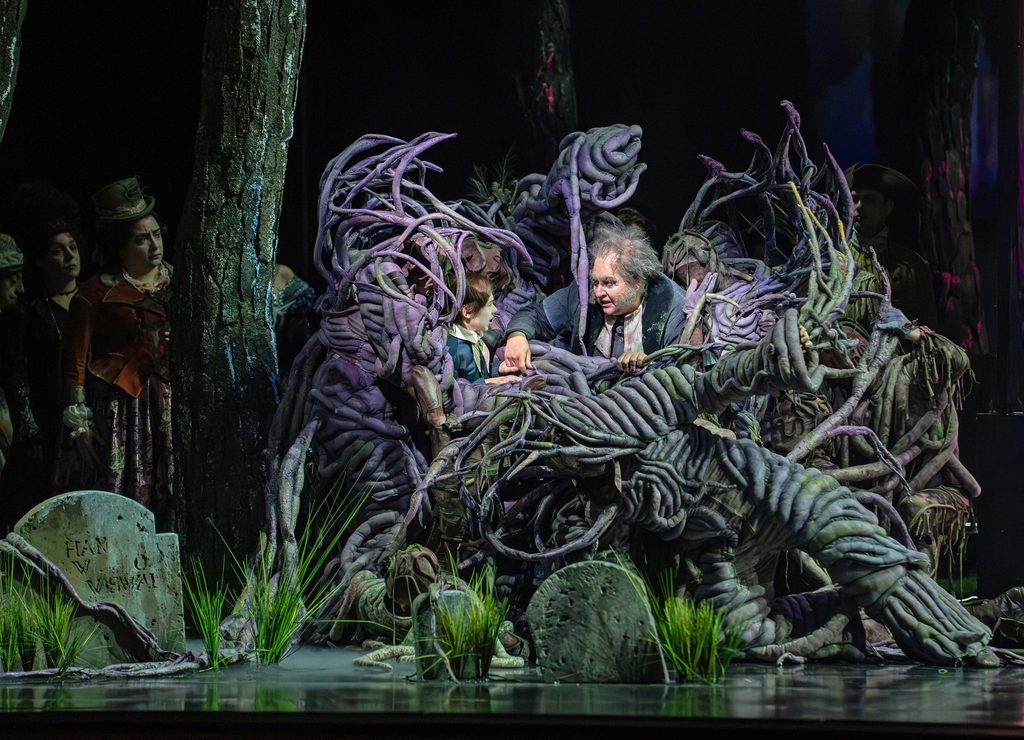
Of course, the action being set in a cemetery, with wrought-iron fences, a mobile mausoleum, and headstones half submerged by creep, it is not a bad choice of programming for the Halloween season. From the start – and even before – there was an admirable attempt at total immersion. As the Met’s starburst chandeliers rose to the ceilings, they began to flicker, and the fry of faltering electricity was pumped through speakers into the house. Of course, Lincoln would have had more experience with gaslight, oil lamps, and candles. It was still a fun touch. The auditorium was flooded with the dank and spooky sounds of a nocturnal graveyard. The curtain, when backlit, was made to resemble black mourner’s lace. The conductor, the Met’s music director Yannick Nezet-Seguin, made his entrance unobtrusively, under the cover of darkness, so that the mood was unbroken by applause. The instant the light appeared on his music stand, the opera was underway.
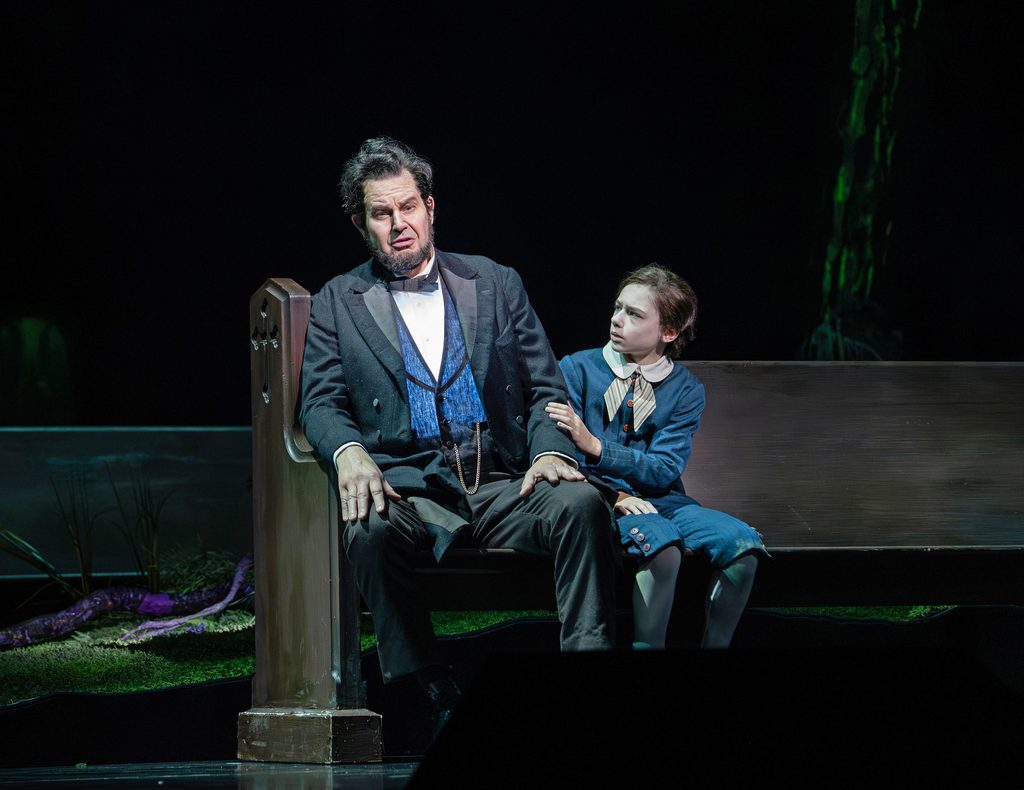
It is in the character of Lincoln that the opera, like the story’s spirits, finds its emotional center. Baritone Peter Mattei at first might not fit everyone’s mythic vision of our 16th president. But that is, in part, the point. He captures Lincoln’s emotional vulnerability (as he sings in falsetto, “Willie is dead”) and believably conveys his transformation from grieving father into figure of destiny.
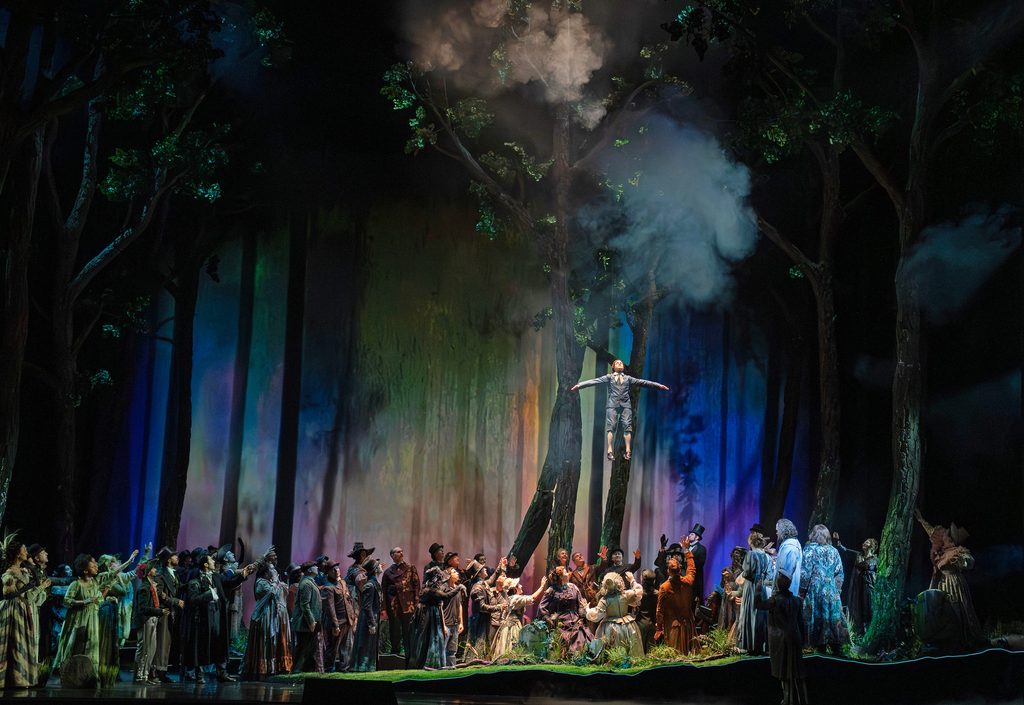
On the day I attended, Willie himself was sung by 11-year-old treble Everett Sobers. (Michael Hurst will assume the role for the October 31 and November 3 performances.) Sobers impressed with his mastery of such a substantial part, especially in an opera with, as I mentioned, very little melodic support. It was quite the feat of memory and execution. It is hardly surprising that one of such a tender age would lack the stage presence of an adult singer. So I was somewhat distracted during the big scene that finally brings Willie together with all the spirits of the bardo, trying to imagine how it might have been handled more effectively, instead of putting the entire burden on poor fey Willie (who sang without amplification). He sounds more present in the audio at the link at the bottom of this post than he did in the house.
And you know how kids are. Very few can sustain the illusion when called upon to be the center of attention. But Sobers does very well. It just seemed like a miscalculation not to have some vocal interjections from some of the other characters, or from the company, to lend a sense of mounting excitement to this climactic moment. Furthermore, the ascension effect was robbed of some of its magic after having experienced one with greater emotional resonance in “The Amazing Adventures Kavalier & Clay,” presented at the Met last year. Come to think of it, the Met does often seem to have someone ascending or descending.
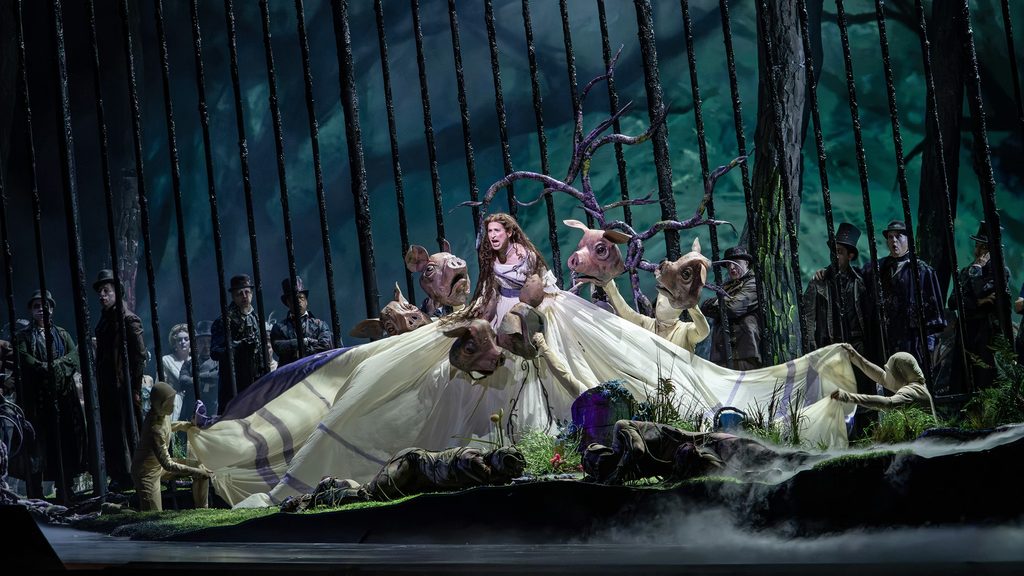
Anthony Roth Costanzo, always game for anything (after being flipped naked in “Akhnaten”), plays Miss Elise Traynor, a 14-year-old girl, trapped in the bardo, by frustration and regret at never having grown to womanhood, and therefore never attaining her dream of having a child, and through the metaphoric restraint of Lovecraftian tendrils. Costanzo is the center of a hurricane of puppeteers, who encase him in the semblance of a potbelly stove and harass him with the appendages of a vulture and pigs’ heads that emerge from his gown, which much of the time they set fluttering like a gym class parachute. Somehow, through all the stage business, he was able to keep his focus. He sang with character, concentration, and commitment, as if he were simply navigating another Baroque aria. Later, during the curtain calls, he took a playful curtsy. He certainly earned it!
Bass-baritone Ryan McKinny (who I heard last season as John Proctor in Washington National Opera’s lean and mean production of “The Crucible,” and will return to the Met later this season as Lt. Horstmeyer in Kevin Puts’ “Silent Night”) sang Vollman, saddled by the indignity of a writhing phallus (no, really – his character was killed on the verge of consummating his marriage). He was teamed for most of the time with tenor Jonah Hoskins as Bevins. The bardo’s Vladimir and Estragon, like everyone else in the bardo, they pursue their circular routine, bound by a shared longing for their respective loves. Their existential plight is broken only when they find shared purpose in their attempts to free Willie (pun unintended… maybe).
Stephanie Blythe shows up a couple of times as the questionable “better half” of the ribald team of Mr. and Mrs. Baron, with bass-baritone Craig Colclough, who played a very different, though equally repellent character as the Nazi officer Gerhard in “Kavalier & Clay.” In truth, they’re not really given a whole lot to do. Basically some perverse music hall style interludes, conveyed more overtly in the direction than in the music.
By contrast, tenor Joshua Blue delves deeply into his character as Thomas Havens, formerly enslaved, who savors memories of the brief tastes of freedom he enjoyed on Wednesday afternoons and for two hours every other Sunday, but with impossible-to-wholly-repress resentment at the injustice of such an existence, wherein not even those boundaries were always respected, bubbling to surface. Blue’s portrayal was palpably human and beautifully sung, with a powerful, richly expressive, and emotionally stirring voice.
Soprano Janai Brugger sang Mrs. Frances Hodge, also held in slavery, who makes her memorable entrance perched on the limb of an enormous descending tree to proclaim her frustrated vengeance against those who took her children. She carries this burden with her aggressively throughout the opera only to find a kind of release, as with the other characters, through a supernatural brush with Lincoln’s empathy.
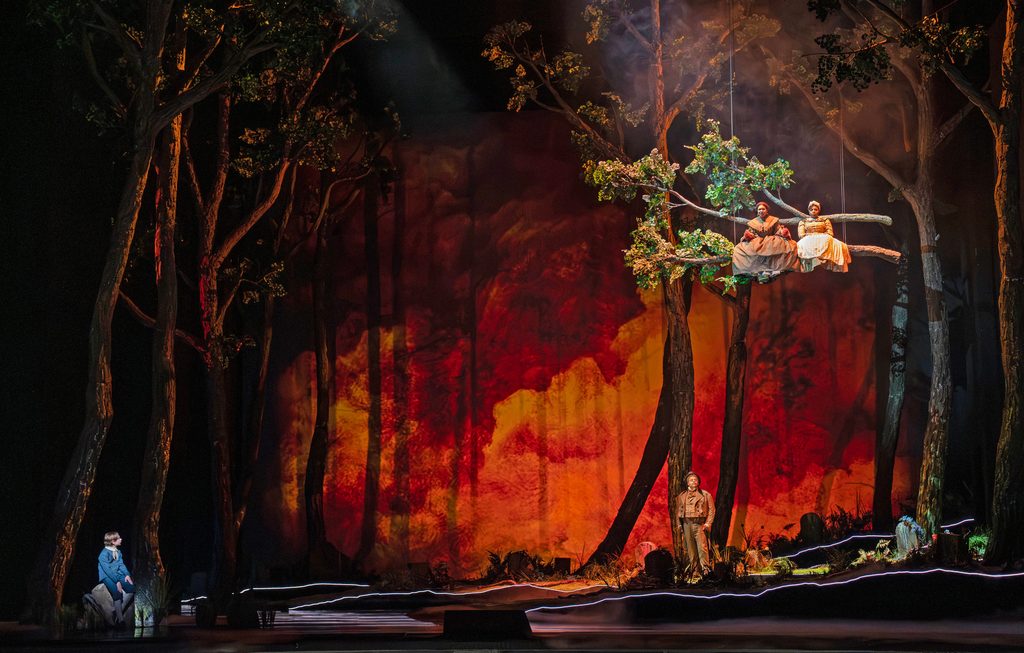
The director, Lileana Blain-Cruz, did what she could with it and brought many imaginative touches to the piece, and as I mentioned earlier, probably worked with the singers to punch up the characters. Set design was by Adam Rigg, costume design by Yi Shao, and “illusion and special effects design” by Jeremy Chernick. These artists and technicians and their assistants are worth every penny of the Met’s investment. It is through them that “Lincoln in the Bardo” makes its greatest impression.
In general, the Met is swinging hard on contemporary opera. It cannot be criticized for not doing everything it can to make these works audience successes. The trick is when and if the operas are picked up by smaller companies, and they are made to rise and fall more on their own merits. And since the Met now seems always in pursuit of the next big thing, to supplement its core repertoire of Verdi, Puccini, Mozart, and Strauss, will these works ever be revived at the Met itself? Once the novelty wears off and the publicity dies down, will they continue to fill the house?
In the end, I have to say, the opera is a pretty good reflection of the source material, and you may like it a lot more than I did, especially if, like most people who read it, you are a fan of the book (which I obviously was not). But for me, the opera impressed mostly as spectacle. It wasn’t that the music wasn’t effective. It just could have been so much more. As it was, it was almost like a film score, in that it often wound up being subservient to the imagery. The long-deferred emotional payoff resonates because of the poignancy of the situation itself – a grieving man unable to let go of his son, and America’s greatest president finding new resolve, transformed by his compassion, which allows him to connect empathetically with the suffering of a vast cross-section of the dead, who yet bear their humanity.
I’m sure we’ve all had experiences in which grief has opened us up to others. It’s an awakening of a sort to our kinship as human beings and an acknowledgment of our common lot. It does have a way of punching a hole in the constructs of our petty little existences, allowing an all-too-brief window of sensitivity, and perhaps receptivity. It allows us to see beyond the workaday and to reset our priorities. Some people are permanently transformed by it. Lincoln understood the importance of walking a mile in another man’s shoes. “I don’t like that man,” he is supposed to have said. “I must get to know him better.”
The spirits of the dead “pass through” Lincoln. (This is well-handled, I thought. I am an admirer of the Abraham Lincoln heart-light.) The music, sadly, doesn’t lend much. This is OPERA. There should be a sense of apotheosis that takes it to the next level. It occurs to me only retroactively that a good opera usually leaves me shaken. It makes me shudder at the curtain and even sob. This one, I experienced at a remove.
Of course, by its nature, opera is a synthesis of the arts, libretto, voice, acting, choreography, scenery, stagecraft, and MUSIC brought together in shared aspiration for the sublime. From Salieri to Richard Strauss – and probably earlier and later – composers have engaged in operatic debate over which comes first, the music or the words. In “Lincoln in the Bardo,” it’s the production design.
I’ve read an awful lot to the effect that Missy Mazzoli is one of the great hopes of contemporary opera. “Lincoln” is one of seven, and one of the most recent, she has composed. Judging only from this, I don’t get a sense that she is a natural opera composer. She does, however, have a formidable PR machine. And evidently some fans who will not tolerate dissent. Fan, after all, is short for fanatic.
As for the libretto by Royce Vavrek, it was seemingly endorsed by Saunders, as in at least one interview the author marveled that the 40-page treatment so successfully encapsulated his book. If that was the final draft, for me, 40 pages was too much of middling thing. It’s one thing to relate what happens, but it’s quite something else to transform the events, especially with such an episodic story, into a satisfying theatrical experience, let alone a poetical one.
I can report that the audience reaction to Act I was in marked contrast to what I experienced, with enthusiastic applause, and Yannick, especially, coming in for quite the reception when he returned to the pit for Act II.
For me, the second act was better, not least in that it was considerably shorter. It also had a strong start, with soprano Christine Goerke as the Reverend, her appearance remarkably transformed through a miraculous make-up job, relating the literal trial that led to his languishing in the bardo. This was enacted in pantomime in the background by a supernumerary double who flees the terror of judgment up an enormous staircase, shafts of light piercing the darkness, as inexorable, elongating, paranormal limbs, guided by puppeteers, pursue him up the steps in slow motion. What a piece of stage craft! There is a brief clip on the internet, but it by no means does it justice, and stops before things really get cooking.
(NOTE: Goerke will sing Wagner and Mahler with the Princeton Symphony Orchestra on January 23 & 24.)
As I say, the act also includes the emotional high point of Lincoln’s transformation.
On the downside, with so many characters, each with their own backstories, the opera packs in more resolutions than Peter Jackson’s “The Lord of the Rings.” Just when you think you are out, they pull you back in!
The luxury casting put me in mind of the Met’s overproduced “The Ghosts of Versailles,” John Corigliano’s Figaro opera commissioned for the company’s 100th anniversary in 1980. Packed to the gills with superstar singers, it ran for seven admittedly sold-out performances, then basically sank into Met oblivion. (It occurs to me, it is yet another opera set in the afterlife.) It took 11 years to get it on stage in the first place. Plans were announced for a Met revival in 2010, but in the end, finances prohibited it. In fairness, the work has been done elsewhere, sometimes in a scaled-back edition. Who knows, perhaps these composers will have the last laugh, and their operas will be performed long after I myself am languishing in the bardo.
Mazzoli contributes to a venerable literature of music inspired by our 16th president. If nothing else, it’s always nice to be reminded of when our presidents were great men, and that the best would never confuse compassion with weakness.
Paradoxically, in writing about this work, I like it both better and less than I did while actually experiencing the performance. Does that make any sense? But I also realize how very privileged I am that I was able to experience it at all. I want to make it clear, I did not walk into it with knives out. I approached with as much anticipation as anyone else.
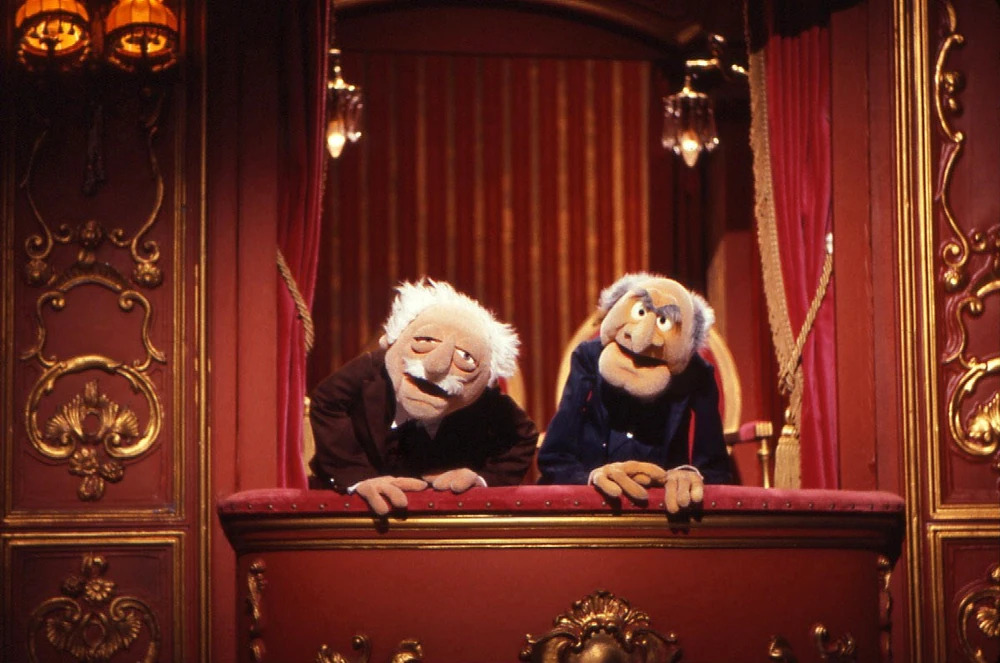
At the end of the day, it is Mazzoli who is in the trenches, making it happen, and I am just some schmo on the internet. But I wanted to offer an alternative voice, welcome or welcome not. If you choose, take these observations as the grousing of a Statler or a Waldorf. My newspaper editor, who met me there, quipped that he hoped we didn’t have box seats – less in respect to anything Muppet related than to that infamous night at Ford Theater. Too soon?
I haven’t much to say about the quality of the playing from the pit. It was the Met Orchestra, so of course the score was impeccably executed, and in an opera with no forward momentum or big, musically-motivated, emotional exclamation points, what could Yannick really do with it, other than play traffic cop, look to balance and levels and, if necessary, cue singers. It all sounded fine to me. The only thing missing was anything inherently interesting in the music. Sure, there were some kazoos at some point, and occasionally the music would take a grotesquely humorous turn in some of the jauntier sardonic numbers, just to be sure we grasp their decadence. What else?
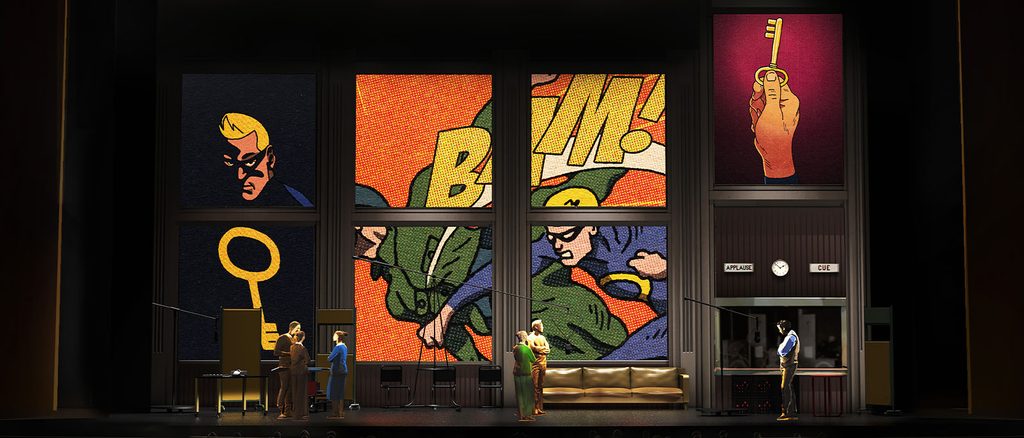
Look, I don’t want to be a wet blanket. It’s admirable that the Met is doing new opera with “important” new voices in the field. I enjoyed last season’s “The Amazing Adventures of Kavalier & Clay,” Mason Bates’ adaptation of Michael Chabon’s whizz-bang comic-book-as-reflection-of-the-immigrant/American-experience novel – “Kavalier & Clay” wound up being more cinematic than any opera I have ever seen – so much so, in fact, that I wound up seeing it twice at the Met and once as a Fathom Event at a local movie house. As I remarked at the time, I’m not sure how well “Kavalier & Clay” really succeeds as an opera, but it sure was a great show. And it had arias and choruses and the identifiable beats of an opera. Not that those things are always necessary. Form follows function, and there were times in Bates’ work that the music was even more like a film score than Mazzoli’s.
Nearly as enjoyable and perhaps more resonant was Gabriel Lena Frank’s Frida Kahlo-Diego Rivera Day of the Dead reunion, “El último sueño de Frida y Diego” (“The Last Dream of Frida and Diego”), which I saw once in the house and again as a Fathom Event.
If I had a chance, would I catch Mazzoli’s opera again as a Met transmission at a movie theater? Sure. But it won’t happen, thanks to the ten-minute, front and center, fully-engorged (and puppeteer-operated) male member that basically opens the show.
Look, if you liked the book, you’ll probably like the opera. If you’re looking for something more, you’ll probably be disappointed by the music, though you may find the performers and the stagecraft worthwhile. That’s all you really need to know.
Thank you for reading this far. I really grappled with trying to process the experience. It was good of you to keep me company, as I worked through it (like the opera, with more false endings than Peter Jackson’s “The Lord of the Rings”). I could tidy it up some more, but I’m not going to hang on to it any longer. It’s already ruining my Halloween. You can have the satisfaction of knowing you allowed me to get it off my chest, so that I am now prepared for my matterlightblooming.
Somebody posted most of the audio on YouTube. It’s missing about 20 minutes (the cut occurs just after the kazoos at 1 hour, 37-minute mark), and of course, in the house there’s a 30-minute intermission. Hurry up and sample it, before it gets taken down. Shorn of the spectacle, see what you think of it. If it sparks your interest, grab your ticket before November 14.
Opera photos courtesy of The Met
Leave a Reply