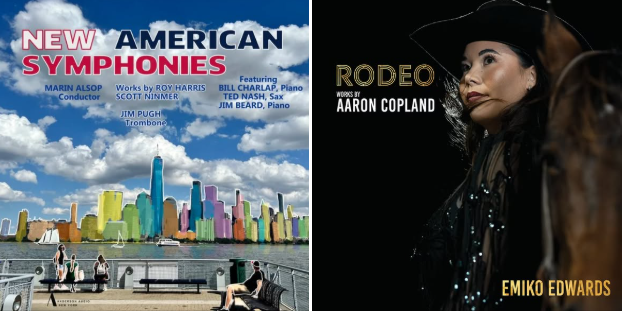
I’ve always had a soft spot for what I like to call the “Greatest Generation” of American composers – composers born around the turn of the 20th century, who really came into their own during the Great Depression and World War II. Sadly, aside from George Gershwin, Aaron Copland, Samuel Barber, and Leonard Bernstein, we don’t really hear all that much of their music anymore.
So you can imagine how excited I was to learn of two significant 2026 releases of American music of the period that I am very proud to feature this week on “The Lost Chord.”
First, a fascinating rediscovery of music by Roy Harris. Harris was born on Lincoln’s birthday in 1898, in a log cabin in Lincoln County, Oklahoma. If that doesn’t imbue a composer with a sense of destiny, I don’t know what will!
For decades, Harris was regarded as one of our great American symphonists. His Symphony No. 3 enjoyed particular success. However, I’m not sure anyone knows for certain exactly how many symphonies he composed, as sources often vary – probably because of works like the one we’ll hear that tend to throw off the count.
“American Symphony 1938” is sometimes identified as the “Trombone Symphony,” since Harris wrote it for Tommy Dorsey and His Orchestra. Or rather, he BEGAN it. Dorsey and the band decided to give the first movement a whirl, but they soon realized they were in over their heads. (A friend of mine quipped, “Maybe he thought he was writing it for Leo Gorcey.”) Dorsey’s rejection led Harris to abandon the project after completing a second movement.
It was trombonist Jim Pugh who reconstructed the symphony from the composer’s original manuscript at the Library of Congress. And now the work has finally been recorded, after all these years, for the label Anderson Audio NY – overseen by 13-time Grammy winner, recording engineer Jim Anderson, and producer Ulrike Schwarz.
Jim Pugh is the trombonist, and Marin Alsop conducts an ensemble of 16 crackerjack players, assembled from the worlds of jazz, classical music, Broadway, and studio recording. I won’t take the space to list all the personnel, but there’s a good chance you’ll recognize a number of them.
The symphony is coupled with a new work written for Pugh, “Night Suite” by Scott Ninmer. Audiophiles might also be interested to know that the recordings were captured using Digital eXtreme Definition (or DXD). I should add, the program notes are by Bill McGlaughlin. For more information, visit andersonaudiony.com.
Another notable release to cross my desk is an album called “Rodeo” – music by Aaron Copland played by pianist Emiko Edwards. I was privileged to host Edwards in the studio for an interview a number of years ago, when she was still living in Philadelphia. She has since moved to Sikeston, MO, home to one of the nation’s most storied rodeos!
The album features some of the usual suspects – the “Four Piano Blues” and the “Piano Variations” – alongside a few delightful piano miniatures. But the most ambitious undertaking is Copland’s neglected Piano Sonata of 1941.
This was written right in the middle of Copland’s “populist” period, the period that gave us the “El Salon Mexico,” the cowboy ballets, and “Lincoln Portrait,” among others. In fact, it was composed contemporaneously with his music for “Our Town.” But evidently, in private, Copland was prone to introspection, and the sonata is not that terribly well-known.
Edwards describes the work in her liner notes as “a true war sonata, tragic in nature and written in the romantic style. In his autobiography, Copland reflects on the great uncertainty and anxiety of the times, and you can certainly hear its effect in the score. The first movement is painful and expansive; the second, though marked Scherzo, and humorous at times, is riddled with the sound of ricocheting bullets; and the third, a requiem, oscillates between moments of hope and despair.”
Leonard Bernstein said it was his favorite of Copland’s works. The piece was commissioned by Clifford Odets.
Following the Sonata, we’ll have just a little time left for one of Edwards’ performances of a Copland encore.
The album was issued on the Lexicon Classics label. You can learn more about the pianist and find a link to her Copland release by clicking on “RODEO” at emikoedwards.com.
Join me today for “Lost Generation,” two essentially unknown works by representatives of the “Greatest Generation” of American composers, on “The Lost Chord,” now in syndication at KWAX Classical Oregon!
——–
Clip and save the start times for all three of my recorded shows:
PICTURE PERFECT, the movie music show – Friday at 8:00 PM EDT/5:00 PM PDT
SWEETNESS AND LIGHT, the light music program – Saturday at 11:00 AM EDT/8:00 AM PDT (***now with a repeat Sunday at 9:00 PM EDT/6:00 PM PDT***)
THE LOST CHORD, unusual and neglected rep – Saturday at 7:00 PM EDT/4:00 PM PDT
Stream them, wherever you are, at kwax.com!
Tag Cloud
Aaron Copland (97) Beethoven (95) Composer (114) Film Music (156) Film Score (143) Film Scores (255) Halloween (107) John Williams (198) KWAX (233) Leonard Bernstein (105) Marlboro Music Festival (125) Movie Music (170) Mozart (92) Opera (224) Philadelphia Orchestra (93) Picture Perfect (174) Princeton Symphony Orchestra (110) Radio (90) Ross Amico (244) Roy's Tie-Dye Sci-Fi Corner (290) The Classical Network (101) The Lost Chord (269) Vaughan Williams (109) WPRB (397) WWFM (881)
Leave a Reply