Aware of his shortcomings. Strove to improve himself. Assembled “team of rivals” to unify and learn from those with differing viewpoints. Understood leadership and sacrifice. Risked everything to preserve the Union.
16th president of the United States.
Abraham Lincoln was born on this date in 1809. They sure don’t make ‘em like they used to.
“Do I not destroy my enemies when I make them my friends?”
———
James Earl Jones in Aaron Copland’s “Lincoln Portrait”
Paul Turok, “Variations on an American Song: Aspects of Lincoln and Liberty” – conducted by Leonard Slatkin, newly-designated music director of the Nashville Symphony Orchestra
Roy Harris was born on Lincoln’s birthday in a log cabin in Lincoln County, Oklahoma. If that doesn’t imbue a composer with a sense of destiny, I don’t know what will.
Harris went on to became one of our great American symphonists. In particular, his Symphony No. 3 of 1939 has been much beloved and frequently performed. Unfortunately, we don’t hear all that much of his music anymore. And that’s a damned shame.
So thank you, Princeton University Orchestra, for reviving Harris’ Symphony No. 3 on your opening concerts this weekend at Richardson Auditorium, Saturday at 7:30 p.m. and Sunday at 3:00, on the same program with Hector Berlioz’s “Symphonie fantastique.”
Most of the orchestra’s personnel, mind you, are not music majors, but rather committed dilettantes pursuing degrees in other fields, such as astrophysics, bioengineering, computer science, linguistics, sociology, philosophy, and a lot of other things in no way related to music. Also, a substantial number of the players turn over every year as students graduate.
Yet on those occasions when I have been privileged to hear them perform, the orchestra has never been less than solid – interpretively safe, perhaps, but on occasion they surpass themselves. And I have heard them tackle Mahler’s 3rd, “Ein Heldenleben,” and the complete “Daphnis and Chloé.”
Most recently, a performance with the Princeton University Glee Club of Elgar’s “The Dream of Gerontius” was revelatory, finally unlocking the magic of the piece for me, which I had previously known only from recordings. Music director Michael Pratt, who has led the orchestra since 1977, is a miracle worker.
I can’t wait to hear Harris’ symphony. I’d travel a lot further to enjoy music from this now-neglected “greatest generation” of American symphonists. What a delight to have some of it right here, in my own backyard!
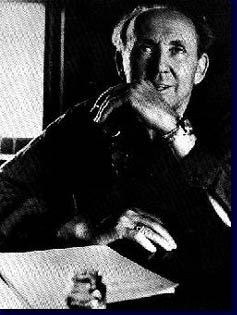
Carl Sandburg was the recipient of three Pulitzer Prizes: two for his poetry, and a third for his biography of Abraham Lincoln. He was also known for his 1927 anthology “The American Songbag,” espousing our native folk song and anticipating the folk song revivals the 1940s and ‘60s. On top of everything else, he was awarded a Grammy for his recording of Aaron Copland’s “Lincoln Portrait.” When Sandburg died in 1967, at the age of 89, Lyndon Johnson observed that “Carl Sandburg was more than the voice of America, more than the poet of its strength and genius. He WAS America.”
This week on “The Lost Chord,” we’ll hear music inspired by this popular – and populist – figure, with two works especially appropriate for Memorial Day and, in between, a piece after a poem evocative of the American heartland.
Philadelphia composer Romeo Cascarino (1922-2002), who had served in the U.S. Army, composed a plaintive elegy, “Blades of Grass,” in 1945, just after World War II. He expressed a preference, on several occasions, that Sandburg’s poem “Grass” be read before performances. You’re probably familiar with it:
Pile the bodies high at Austerlitz and Waterloo.
Shovel them under and let me work—
I am the grass; I cover all.
And pile them high at Gettysburg
And pile them high at Ypres and Verdun.
Shovel them under and let me work.
Two years, ten years, and passengers ask the conductor:
What place is this?
Where are we now?
I am the grass.
Let me work.
Leo Sowerby (1895-1968) was born in Grand Rapids, MI, and spent much of his career in the Midwest. Sometimes referred to as the “Dean of American church music,” he was the recipient of the Pulitzer Prize for Music in 1946 for his cantata, “The Canticle of the Sun.”
The published score of his symphonic poem after Sandburg, titled “Prairie,” from 1929, bears the following lines:
“Have you seen a red sunset drip over one of my cornfields, the shore of night stars, the wave lines of dawn up a wheat valley?
“Have you heard my threshing crews yelling in the chaff of a strawpile and the running wheat of the wagonboards, my cornhuskers, my harvest hands hauling crops, singing dreams of women, worlds, horizons?”
Last, but certainly not least, Roy Harris, who shared Lincoln’s birthday (though born 89 years later), was reared in a log cabin in Lincoln County, OK, only adding to his sense of destiny. Indeed, he went on to become one of America’s greatest composers.
Harris’ Symphony No. 6 is subtitled “Gettysburg.” It’s one of a number of works the composer wrote with a Lincoln connection. Each movement of the symphony bears a superscription taken from the Gettysburg Address: the first, “Awakening (‘Fourscore and seven years ago…’);” the second, “Conflict (‘Now we are engaged in a great civil war…’);” the third, “Dedication (‘We are met on a great battlefield of that war…’);” and the fourth, “Affirmation (‘…that we here highly resolve that these dead shall not have died in vain…’).”
Prior to composing the work, Harris read – you guessed it – Sandburg’s biography of Lincoln.
I hope you’ll join me for “Lincoln Logger,” an hour of music inspired by Carl Sandburg, on “The Lost Chord,” now in syndication on KWAX, the radio station of the University of Oregon!
Clip and save the start times for all three of my recorded shows:
PICTURE PERFECT, the movie music show – Friday at 8:00 PM EDT/5:00 PM PDT
SWEETNESS AND LIGHT, the light music program – Saturday at 11:00 AM EDT/8:00 AM PDT
THE LOST CHORD, unusual and neglected rep – Saturday at 7:00 PM EDT/4:00 PM PDT
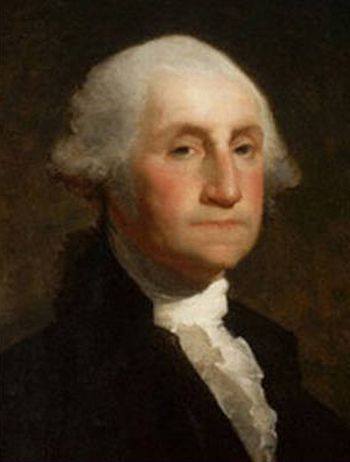
One never told a lie. The other gave everything to keep us united. We’ve come a long way, baby.
Hard to believe, but Virgil’s Thomson’s George Washington ballet “Parson Weems and the Cherry Tree” (a Bicentennial commission) doesn’t seem to be posted anywhere online in the version for chamber orchestra. I did, however, find it for piano. You just have to let it play through, from tracks 10-21.
Concert overture “McKonkey’s Ferry (Washington at Trenton)” by Trenton’s own George Antheil. Curious that a local boy would spell McConkey with two k’s!
John Lampkin, “George Washington Slept Here”
Roy Harris’ setting of Vachel Lindsay’s “Abraham Lincoln Walks at Midnight.” (The poem is posted below the video.)
Florence Price’s setting of the same poem
From “Abraham Lincoln: A Likeness in Symphony Form,” by Robert Russell Bennett
More Lincoln music under my post for Lincoln’s birthday on February 12
This week on “The Lost Chord,” it’s one more trip to the well, with well-played works of American composers rendered by Eugene Ormandy and the Philadelphia Orchestra.
Slake your thirst with selections from “Five Songs of William Blake” by Virgil Thomson (born on this date in 1896), the Symphony No. 7 by Roy Harris, and “Four Squares of Philadelphia” by Louis Gesensway.
Gesensway was born in Latvia in 1906. A violin prodigy, he was one of the founders of the Toronto Symphony Orchestra. He came to Philadelphia at the age of 19, where he played under both Stokowski and Ormandy.
In his mid-20s, he took a leave of absence to study composition with Zoltán Kodály. “Four Squares of Philadelphia” was described by the composer as a “symphonic poem for large orchestra, narrator and street criers.”
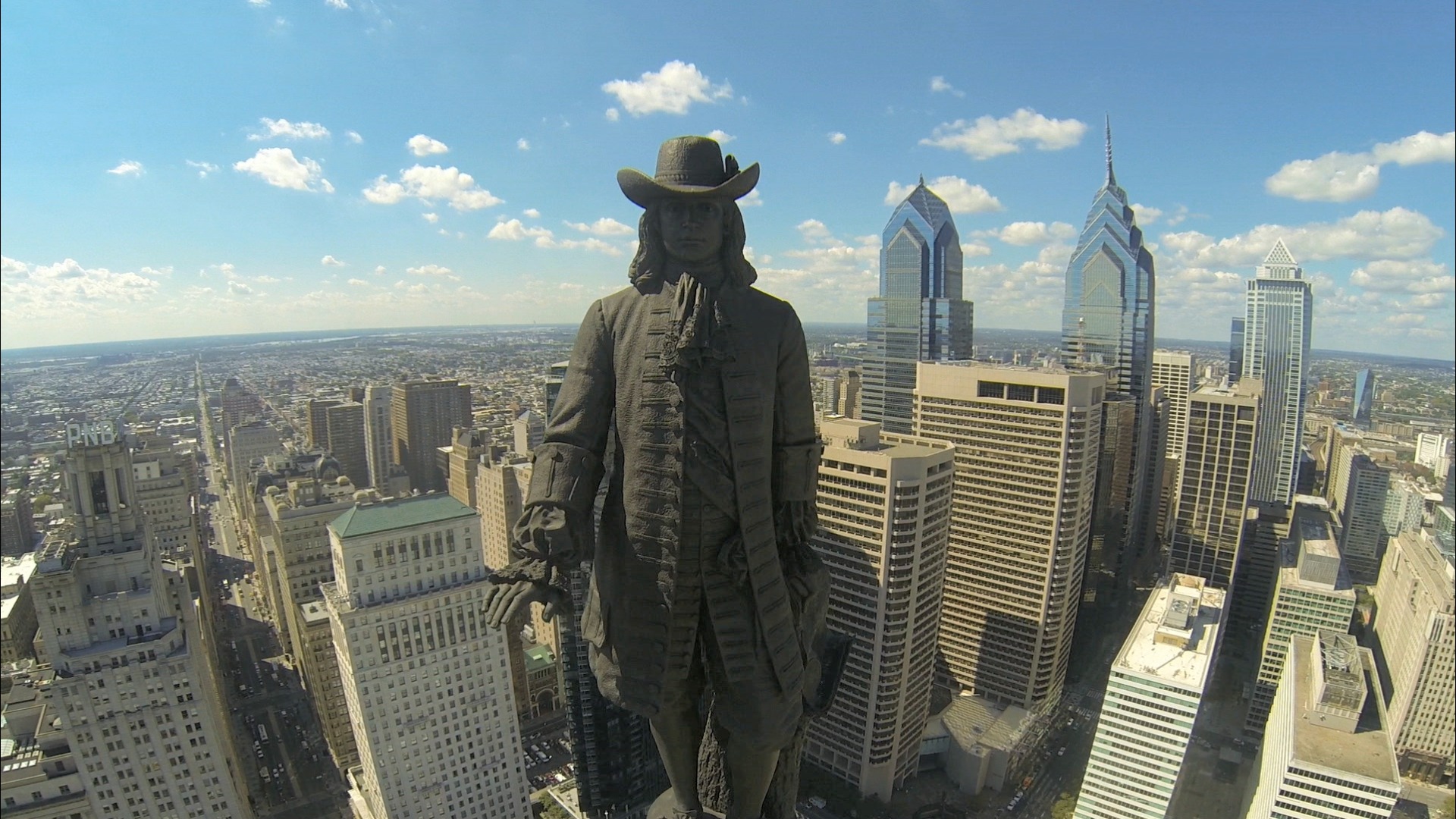
The piece opens with a recitation of William Penn’s prayer, then continues with musical evocations of Washington Square (in early morning, during Colonial times, with street criers hawking their wares), Rittenhouse Square (on a bright and cheerful afternoon), Logan Square (with its fountains at dusk), and Franklin Square (at night, evocative of noisy bridge traffic, a side excursion into Chinatown, and musical interjections from the honky tonk joints located around the square in the 1950s).
Be there or be square. Eugene Ormandy serves up the last of the Thanksgiving leftovers. I hope you’ll join me for “All-American Ormandy III,” now in syndication on KWAX, the radio station of the University of Oregon!
Remember, KWAX is on the West Coast, so there’s a three-hour difference for the Trenton-Princeton area. Here are the respective air-times of my recorded shows (with East Coast conversions in parentheses):
PICTURE PERFECT, the movie music show – Friday on KWAX at 5:00 PACIFIC TIME (8:00 PM EST)
THE LOST CHORD, unusual and neglected rep – Saturday on KWAX at 4:00 PACIFIC TIME (7:00 PM EST)
PLEASE NOTE: This show was recorded in 2015 and employs material reissued on compact disc for the first time on the Albany and Bay Cities labels. All three of these performances have since been remastered (including the wholly restored “Five Blake Songs”), as part of Sony Classical’s 120-CD box set of Ormandy’s Philadelphia mono recordings, “Eugene Ormandy: The Columbia Legacy,” in 2021.
The first installment of Ormandy’s stereo recordings were released earlier this month in an 88-CD box, also from Sony, “Eugene Ormandy/The Philadelphia Orchestra: The Columbia Stereo Collection,” on November 17.
Both Sony sets sound fantastic (with the caveat that the first is in mono). Both are highly recommended.
PHOTO: Statue of Penn, high atop the city he founded