Tag: Roy Harris

  • Sandburg’s America Music for Memorial Day

    Sandburg’s America Music for Memorial Day

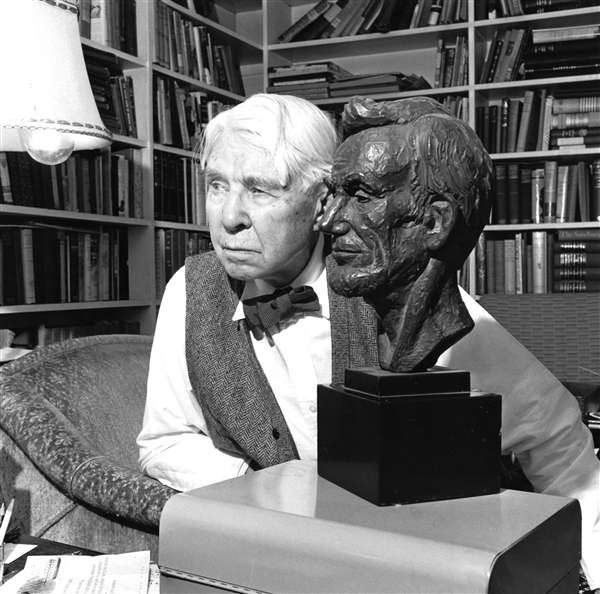
    Carl Sandburg was the recipient of three Pulitzer Prizes: two for his poetry, and a third for his biography of Abraham Lincoln. He was also known for his 1927 anthology “The American Songbag,” espousing our native folk song and anticipating the folk song revivals the 1940s and ‘60s. On top of everything else, he was awarded a Grammy for his recording of Aaron Copland’s “Lincoln Portrait.” When Sandburg died in 1967, at the age of 89, Lyndon Johnson observed that “Carl Sandburg was more than the voice of America, more than the poet of its strength and genius. He WAS America.”

    This Sunday night on “The Lost Chord,” we’ll hear music inspired by this popular – and populist – figure, with two works especially appropriate for Memorial Day and, in between, a piece after a poem evocative of the American heartland.

    Philadelphia composer Romeo Cascarino (1922-2002), who had served in the U.S. Army, composed a plaintive elegy, “Blades of Grass,” in 1945, just after World War II. He expressed a preference, on several occasions, that Sandburg’s poem “Grass” be read before performances. You’re probably familiar with it:

    Pile the bodies high at Austerlitz and Waterloo.
    Shovel them under and let me work—
    I am the grass; I cover all.

    And pile them high at Gettysburg
    And pile them high at Ypres and Verdun.
    Shovel them under and let me work.
    Two years, ten years, and passengers ask the conductor:
    What place is this?
    Where are we now?

    I am the grass.
    Let me work.

    Leo Sowerby (1895-1968) was born in Grand Rapids, MI, and spent much of his career in the Midwest. Sometimes referred to as the “Dean of American church music,” he was the recipient of the Pulitzer Prize for Music in 1946 for his cantata, “The Canticle of the Sun.”

    The published score of his symphonic poem after Sandburg, titled “Prairie,” from 1929, bears the following lines:

    “Have you seen a red sunset drip over one of my cornfields, the shore of night stars, the wave lines of dawn up a wheat valley?

    “Have you heard my threshing crews yelling in the chaff of a strawpile and the running wheat of the wagonboards, my cornhuskers, my harvest hands hauling crops, singing dreams of women, worlds, horizons?”

    Last, but certainly not least, Roy Harris, who shared Lincoln’s birthday (though born 89 years later), was reared in a log cabin in Lincoln County, OK, only adding to his sense of destiny. Indeed, he went on to become one of America’s greatest composers.

    Harris’ Symphony No. 6 is subtitled “Gettysburg.” It’s one of a number of works the composer wrote with a Lincoln connection. Each movement of the symphony bears a superscription taken from the Gettysburg Address: the first, “Awakening (‘Fourscore and seven years ago…’);” the second, “Conflict (‘Now we are engaged in a great civil war…’);” the third, “Dedication (‘We are met on a great battlefield of that war…’);” and the fourth, “Affirmation (‘…that we here highly resolve that these dead shall not have died in vain…’).”

    Prior to composing the work, Harris read – you guessed it – Sandburg’s biography of Lincoln.

    I hope you’ll join me for “Lincoln Logger,” an hour of music inspired by Carl Sandburg, this Sunday night at 10:00 EDT, on WWFM – The Classical Network and wwfm.org.


    Although not on tonight’s show, here, as an added bonus, is Sandburg narrating Aaron Copland’s “Lincoln Portrait”:

  • Roy Harris Gettysburg Symphony on WWFM

    Roy Harris Gettysburg Symphony on WWFM

    Roy Harris (1898-1979) was born in a log cabin, in Lincoln County, OK, on Lincoln’s birthday – albeit 89 years later. If that doesn’t imbue a composer with a sense of destiny, I don’t know what will.

    Harris went on to became one of our great American symphonists. In particular, his Symphony No. 3 of 1939 has been much beloved and frequently performed. Unfortunately, we don’t hear all that much of his music anymore. And that’s a damned shame.

    Join me this afternoon on The Classical Network, as we celebrate these dual birthdays with a recording of Roy Harris’ Symphony No. 6. Subtitled “Gettysburg,” each of the symphony’s four movements bears a superscription taken from Lincoln’s Gettysburg Address:

    I. Awakening (“Fourscore and seven years ago…”);

    II. Conflict (“Now we are engaged in a great civil war…”);

    III. Dedication (“We are met on a great battlefield of that war…”);

    IV. Affirmation (“…that we here highly resolve that these dead shall not have died in vain…).

    Of course, it wouldn’t be right if we didn’t also hear Aaron Copland’s “Lincoln Portrait.” Copland lent Harris a helping hand by putting in a good word for him with his teacher, Nadia Boulanger. The piece is a stirring reminder of a time when America still produced articulate, conscientious, and compassionate statesmen. The great William Warfield will recite Lincoln’s words, from an out-of-print LP on the Mercury label. Warfield always did such a fine job with Copland’s “Old American Songs.”

    At 6:00, it’s another “Music from Marlboro,” chamber music performances of works by Beethoven and Louis Spohr. We’ll see what else we can come up with, along the way.

    You can fool all of the people some of the time and some of the people all of the time, but you cannot fool all of the people all of the time. This man’s legs are long enough to reach the ground, from 4 to 7 p.m. EST, on WWFM – The Classical Network and wwfm.org.

  • Aaron Copland Rediscovered American Music Legend

    Aaron Copland Rediscovered American Music Legend

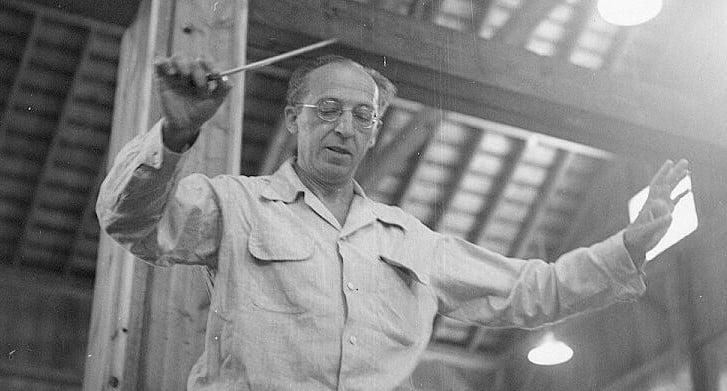
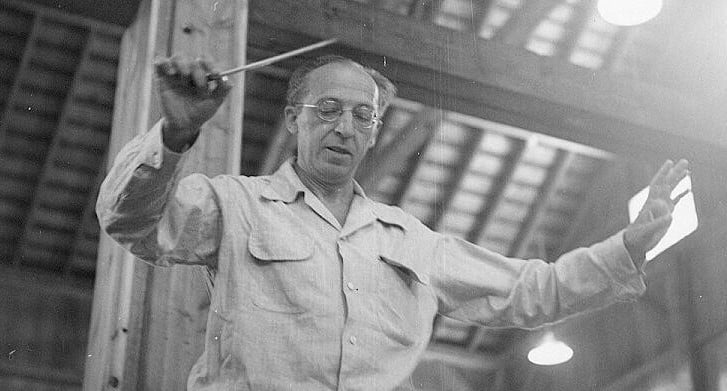
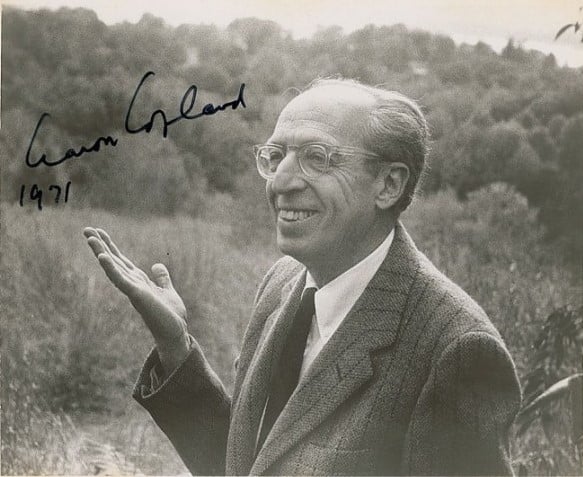
    I am so happy to rediscover this 30-minute documentary on Aaron Copland. I remember watching it years ago. What an exciting time for American music – and for America – to say nothing of the arts in general. Not that American music does not remain vital. But Copland seems to be the last man standing, in terms of the active repertoire, of that great generation. To catch a Roy Harris or a William Schuman symphony in concert is very rare indeed.

    It is the fate of even the greatest composers to be remembered through but a handful of pieces, usually from a particular phase of his or her career. In Copland’s case, it’s pretty much the cowboy music. Some people love it; some are put off by it. Cowboys aren’t exactly “in” right now, and when someone hears “I Ride an Old Paint,” they may not trouble themselves to look beyond the trappings.

    But nearly everything Copland wrote is worth hearing – and I’ve heard most of it – even the misfires. Once you get to know him, his sound is immediately identifiable in anything he touched. He had vision, he had craft, and he had integrity.

    I love this man, and I love his music, and I love what he did for music. Would that we had someone of his caliber today. Happy birthday, Aaron Copland.

  • Aaron Copland Documentary Rediscovered

    Aaron Copland Documentary Rediscovered

    I am so happy to rediscover this 30-minute documentary on Aaron Copland. I remember watching it years ago. What an exciting time for American music – and for America – to say nothing of the arts in general. Not that American music does not remain vital. But Copland seems to be the last man standing, in terms of the active repertoire, of that great generation. To catch a Roy Harris or a William Schuman symphony in concert is very rare indeed.

    It is the fate of even the greatest composers to be remembered through but a handful of pieces, usually from a particular phase of his or her career. In Copland’s case, it’s pretty much the cowboy music. Some people love it; some are put off by it. Cowboys aren’t exactly “in” right now, and when someone hears “I Ride an Old Paint,” they may not trouble themselves to look beyond the trappings. But nearly everything Copland wrote is worth hearing – and I’ve heard most of it – even the misfires. Once you get to know him, his sound is immediately identifiable in anything he touched. He had vision, he had craft, and he had integrity.

    I love this man, and I love his music, and I love what he did for music. Would that we had someone of his caliber today. Happy birthday, Aaron Copland.

  • Rediscovering Copland’s Genius

    Rediscovering Copland’s Genius

    I am so happy to rediscover this 30-minute documentary on Aaron Copland. I remember watching it years ago. What an exciting time for American music – and for America – to say nothing of the arts in general. Not that American music does not remain vital. But Copland seems to be the last man standing, in terms of the active repertoire, of that great generation. To catch a Roy Harris or a William Schuman symphony in concert is very rare indeed.

    It is the fate of even the greatest composers to be remembered through but a handful of pieces, usually from a particular phase of his or her career. In Copland’s case, it’s pretty much the cowboy music. Some people love it; some are put off by it. Cowboys aren’t exactly “in” right now, and when someone hears “I Ride an Old Paint,” they may not trouble themselves to look beyond the trappings.

    But nearly everything Copland wrote is worth hearing – and I’ve heard most of it – even the misfires. Once you get to know him, his sound is immediately identifiable in anything he touched. He had vision, he had craft, and he had integrity.

    I love this man, and I love his music, and I love what he did for music. Would that we had someone of his caliber today. Happy birthday, Aaron Copland.

Tag Cloud

Aaron Copland (92) Beethoven (95) Composer (114) Film Music (119) Film Score (143) Film Scores (255) Halloween (94) John Williams (185) KWAX (229) Leonard Bernstein (99) Marlboro Music Festival (125) Movie Music (134) Opera (198) Philadelphia Orchestra (86) Picture Perfect (174) Princeton Symphony Orchestra (106) Radio (87) Ralph Vaughan Williams (85) Ross Amico (244) Roy's Tie-Dye Sci-Fi Corner (290) The Classical Network (101) The Lost Chord (268) Vaughan Williams (102) WPRB (396) WWFM (881)

DON’T MISS A BEAT

Receive a weekly digest every Sunday at noon by signing up here


RECENT POSTS